
Today I Learned: Wack Wack was Once a Part of Quezon City

Metro Manila is a city constantly in flux. One of the world’s most densely populated urban areas, the national capital region is also the economic, political, and (some might argue) cultural heart of the country. While most foreigners think of Manila just as one city, we know that Manila in this context refers to a massive metropolis composed of 16 cities and one municipality.
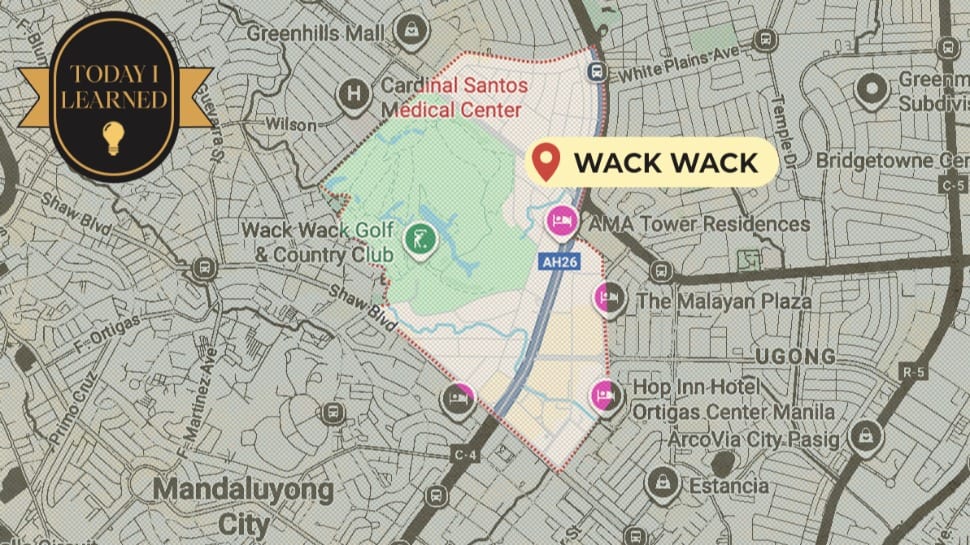
In many instances over the decades, some parts of one city were once integrated into another, which makes for some fascinating historical and geographical trivia. One example is Wack Wack, a barangay located in Mandaluyong City that is perhaps best known as the site of the similarly named golf and country club. While most people associate Wack Wack today with the vast expanse of green where powerful people get together over rounds of golf, it’s interesting to note that, throughout its history, the area had actually changed hands and became under the jurisdiction of two other cities before being a permanent part of Mandaluyong.
ALSO READ
Who Is Bill Shaw, Namesake of Shaw Boulevard?
Who are the People Behind the Famous Avenues and Boulevards of Manila?
Beginnings of Wack Wack
Wack Wack was actually founded in 1930 by William J. “Bill” Shaw; yes, the same man that gave his name to the busy boulevard that intersects with EDSA in Mandaluyong. We actually already did a profile on him, but, in a nutshell, Shaw was an American who came to the Philippines from his home state of Vermont in 1901.
Many local golfers are perhaps well-aware of Shaw’s story: about how he established Wack Wack as a direct protest against racial discrimination at the Manila Golf Club. Shaw was reportedly incensed when caddie Larry Montes, the 1929 Philippine Open winner, was barred from the awards dinner to celebrate his win. Shaw also found himself ostracized for marrying a Filipina. And so, he gathered 154 founding members, raised P400,000, and had professional golfer Jim Black design and build Wack Wack’s first 18 holes (now called the East Course) by 1931.
It wasn't long before Shaw acquired the adjoining land where he eventually built the West Course, finalizing the full 36-hole layout of Wack Wack.
Also, in case you were wondering, the name Wack Wack reportedly comes from the sound made by crows. You can see this in the golf club’s logo, which features two black birds.
From Mandaluyong to Quezon City
When plans were being drawn up to build a new capital city for the Philippines in the late 1930s, architect Harry Frost and landscape architect Louis Croft were commissioned to develop a comprehensive urban design for what was to become Quezon City. The idea for what was later to be called the Frost-Parsons master plan was to create a modern capital city featuring a large central park, a civic center, and residential areas.
Quezon City itself was chartered on October 12, 1939, under Commonwealth Act No. 502. That was when Wack Wack was transferred into the new city limits as part of a plan built around Frost–Parsons urban design. For those two years (1939–1941), the club was officially in Quezon City.
However, on June 21, 1941, just two years later, the boundaries of Quezon City were redefined thanks to Commonwealth Act No. 659. Besides inserting new sections in CA 502, which provided additional provisions and regulations related to the administration of the city, CA 659 also reverted Wack Wack to Mandaluyong’s jurisdiction.
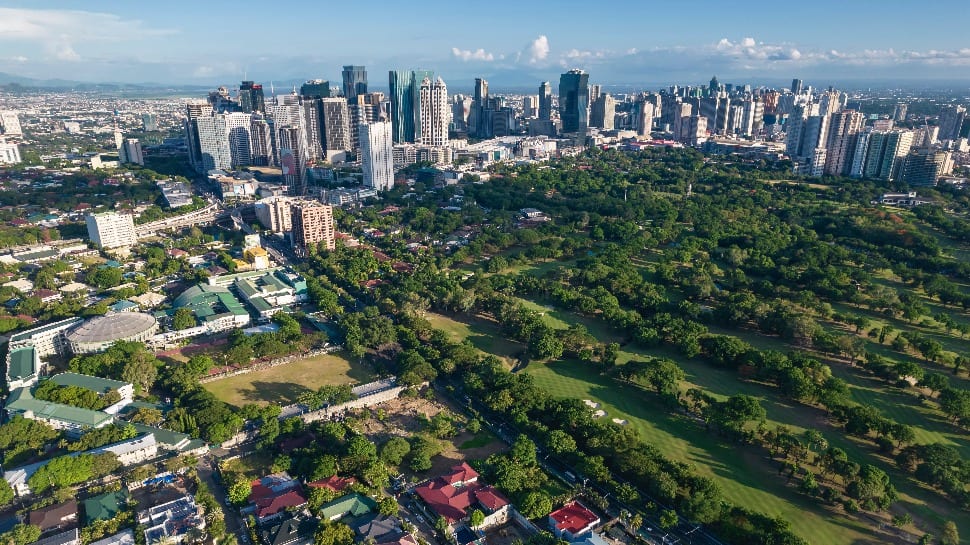
Aerial view of Wack Wack Golf and Country Club
But World War 2 was raging, and it wouldn’t take long before the conflict reached Philippine shores. On January 1, 1942, President Manuel L. Quezon issued Executive Order No. 400, which merged the cities of Manila and Quezon City, along with the municipalities of Caloocan, Makati, Mandaluyong, Parañaque, Pasay, and San Juan. It was an emergency measure to create a unified administration for the area. Thus, for a brief period, Wack Wack became part of the Balintawak district of Greater Manila, which was effectively under the governance of wartime Manila.
Greater Manila was dissolved in August 1945, after the war, and this was when Wack Wack was once again reverted to Mandaluyong, where it has stayed ever since.
Wack Wack today
Wack Wack Golf and Country Club is one of the country’s premier golfing venues and remains pretty much the same today from when it opened in the 1930s. It spans 115 hectares and is sandwiched between Shaw Boulevard and Old Wack Wack Road.
While the West Course is considered more accessible (6,540 yards, par-72, and ideal for seniors, guests, and sponsored corporate events), the East Course is widely regarded a true championship layout. It measures 7,222 yards, par-72, with water hazards, sweeping terrain, and the infamous par-3 16th hole, which is often called a make-or-break test.
Wack Wack has hosted the prestigious Philippine Open fairly regularly from 1935 into the 1990s. Golf legends like Arnold Palmer, Gary Player, and Seve Ballesteros have played exhibitions or tournaments here. Even the legendary Larry Montes—whose 1929 victory inspired Shaw’s course—also participated in these events.
In 1977, the club famously hosted the World Cup of Golf, where Ballesteros and Antonio Garrido won for Spain, while Gary Player claimed the individual title. Fifty national teams competed across a 7,734-yard setup on the East Course. Regular tournaments such as the British Chamber of Commerce annual golf cup (April 2025) and the SHDA (Subdivision and Housing Developers Association) Golf Cup are still regularly held there, attracting some of the country’s biggest businessmen, diplomats, politicians and other movers and shakers.
Despite Shaw’s vision of an inclusive golf club open to all, Wack Wack today is incredibly elite and exclusive, with membership transfers reportedly worth around P80 million, which is easily one of the most expensive in the country.
