

Today I Learned: The Science Behind the Green Algae in Boracay

ILLUSTRATION: Igi Talao
Boracay, an island paradise known for its powdery white sand and crystal-clear waters, has long been a dream destination for travelers. While numbers show a decreasing trend among foreign visitors in 2024, it cannot be denied that its beach still draws in tourists all year round. Yet, for some, the allure of this tropical escape is occasionally marred by an unexpected phenomenon—green algae or lumot. This natural occurrence can be a surprise for those unacquainted with Boracay's patterns.
Green algae, from the division Chlorophyta, has between 9,000 to 12,000 species. While most of them occur in freshwater, there are also terrestrial and marine species.
ALSO READ:
Why are People Opposed to the P8-Billion Boracay-Caticlan Bridge Project
Surprise? Boracay is No Longer the Top Local Travel Destination for Foreign Tourists
Green Algae Season in Boracay
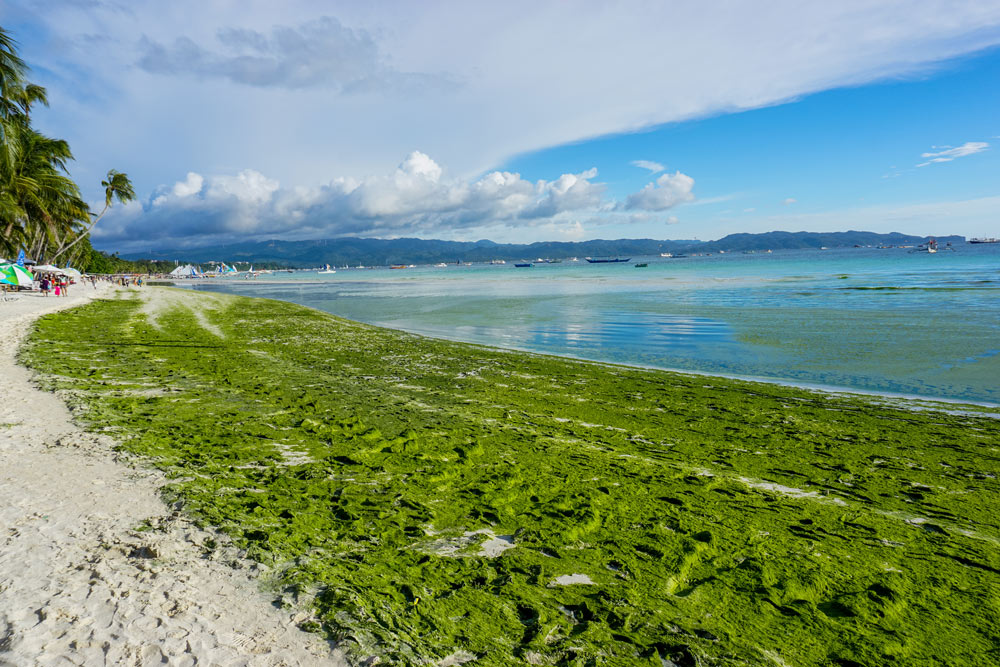
The green algae season in Boracay is most noticeable from February to May, coinciding with the transition, characterized by rising sea temperatures, between the cool and dry amihan (northeast monsoon) and rainy weather during habagat (southwest monsoon). During this period, the calm waters and specific weather conditions create an environment conducive to the growth of these green algae. While the green algae does not pose any health risks, its presence can alter the pristine appearance of Boracay's famous beaches, leading to mixed reactions from tourists.
"A number of macroalgal species, including green macroalgae (or seaweeds), can be seasonal. Their seasonal occurrences are related to certain environmental factors (both natural and anthropogenic), e.g., water temperature and availability of inorganic nutrients. The seasonal occurrence of certain macroalgal species is more prominent in cold-temperate and polar regions (where there are four distinct seasons). However, this can also be observed in tropical countries like the Philippines during different monsoon seasons and/or dry/wet seasons where a few degree increase in temperature can trigger the reproduction of certain macroalgal species, and the inflow of terrestrial-derived nutrients from rainfall can fertilize the coastal waters with the required inorganic nutrients (nitrogen and phosphorus) to trigger green algal blooms, among others," Dr. Michael Roleda, a professor at the University of the Philippines - Marine Science Institute tells Esquire Philippines in an exchange. He specializes in applied phycology (or the study of algae) and algal stress physiology.
Based on recent photos found online, Roleda noted that the algae in Boracay are attached to hard substrates, like rocks. This means, according to him, that they were able to thrive through available resources and optimal environmental factors.
"The question is where are the sources of propagules of these species," he said.
Roleda further explains: "Macroalgae propagules (microscopic spores and gametes) are floating suspended in the water (just like seeds and pollens flying on air), and when they touch down on the hard substrate, they attach, germinate, and grow, and bloom depending on the available resources (nutrients, temperature, light). The question is, is the source of nutrients natural or anthropogenic? If anthropogenic, then we have environmental issues." Anthropogenic means that their formation and reproduction are caused by human intervention, such as excess waste in the water.
"The presence of algae on hard substrates is natural. Their huge standing stock/biomass or their intensity of blooming can indicate either natural and/or anthropogenic sources of nutrients during months when algal propagules are readily available for recruitment/establishment under suitable temperature and light regimes," Roleda continues.
An investigation needs to be conducted into the amount of algae-friendly nutrients present in Boracay's ecosystem, particularly if there is a significant (and unusually) high amount of nitrogen and phosphorus supporting the algal bloom. Water sampling and nutrient analysis are necessary to see if tourist activities, wastewater treatment, and groundwater discharge are disrupting the levels of these elements.
Abundance of Green Algae
"Abundance is relative," says Roleda. Currently, the complaints about the presence of green algae or lumot on Boracay's white-sand beach are "primarily aesthetics." But for the seaweed expert, they are "beautiful (with bias) and source of good stuff." They are, after all, the base of the aquatic food web, providing not only food but also shelter to animals. They are eaten by primary consumers like zooplanktons, small fish, and crustaceans, which, in turn, are eaten by fish, small sharks, and corals, and so on and so forth.
Still, if nutrient levels are concluded to be unnatural and nutrient input is anthropogenic, then the overabundance of green algae can cause an imbalance in the ecosystem. "In their life cycle, they will naturally die, and the decomposition of huge biomass will cause a depletion of oxygen in the system, create a foul odor, and release noxious substances/compounds," Roleda adds.
It can be remembered that in 2018, Boracay went through a six-month government-mandated closure in an effort to resolve worsening sewage conditions, alarming fecal coliform levels in the water, and other environmental issues. It was even described as a "cesspool" by former President Rodrigo Duterte. In July 2024, Atty. Ramar Niel Pascua, Regional Director of the Environmental Management Bureau in Western Visayas, announced that all 24 monitoring stations in Boracay passed the water safety test.
Morphological analysis and better DNA barcoding should be done to determine the exact species of green algae found in Boracay. "These algae are morphologically simple and can only be classified relative to its Genus name but not up to its species name."
So, should we worry about the algae bloom in Boracay? Yes and no. Science, contrary to popular belief, is not exactly exact (alliteration intended). The current bloom is natural, but it can also be anthropogenic, as Roleda pointed out. As we usually say in our thesis conclusions back in college, further study is recommended.
Algae is a natural part of our ecosystem, and unless their existence is an indication of unnatural circumstances, we just have to let them be.
