
How to be a Girl’s Girl (Or a Man’s Man)

It’s taken me half a lifetime to be a girl’s girl. At least consciously. I celebrate all the important women in my life, whether they want to launch a skin line, build a small community, or write a book. A girl’s girl is like a man’s man on estrogen—that is, a girl’s girl is able to push you aggressively in the direction of your dreams with tough talk, memes, and alcohol, but is also able to map out your feelings and dispense a balm proportionate to the ouch (i.e. That relative blowing into town again and staying at your place? Here are some sunflowers).
I’ve had a girl’s girl, singularly or plurally, at every point in my life. Growing up, I had three sisters who brought me up, or called me out when the situation asked for it—this is also what a girl’s girl does: we don’t wholesale and blindly support each other. I remember a time I behaved badly, and looked to my sisters for validation—(we were on a break!)— and all three tsked and shook their heads, one nanosecond after the other. “You must think I’m a perfect jerk,” I told them. “No” one of them answered, “no one’s perfect.” And then they all laughed.
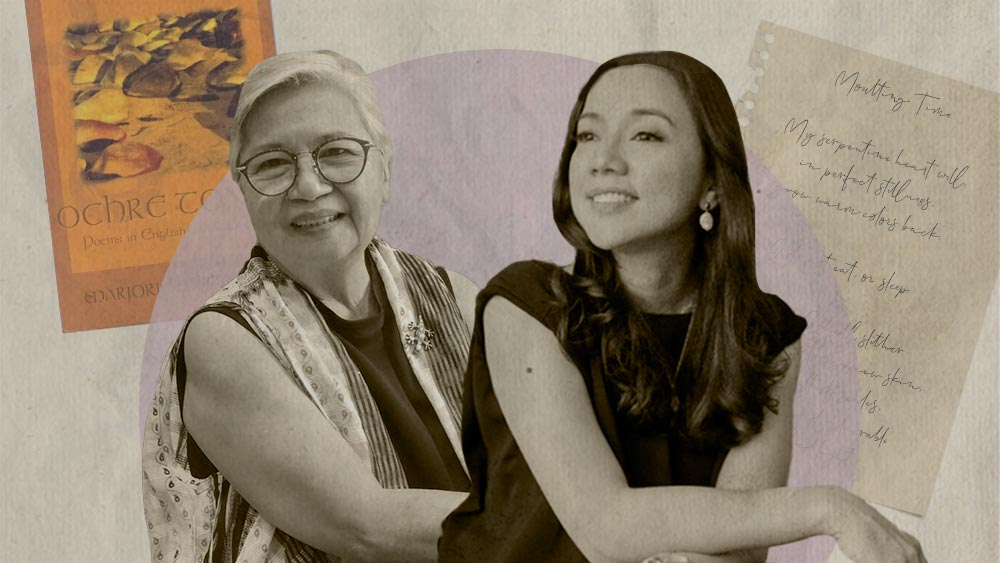
As I faced the arctic air of a sisterly time-out, I found the poetry of Marjorie Evasco, or it found me. Particularly, I found a poem called “Moulting Time” in a book called “Ochre Tones,” which, incidentally was given to me by another girl’s girl.
ALSO READ:
Poetry Is the Filipino's Favorite Book Genre, According to Study
Poetry in Three Languages: English, Filipino, and Hanunuo Mangyan
Moulting Time
My serpentine heart will,
in perfect stillness,
grow warm colors back.
I do not eat, or sleep.
In time I shall slither
from the dark to sun new skin,
leaving cast-off scales,
eyes bright and vulnerable
in the naked light.
If love for her poetry came first, awe for her person came next. Evasco is arguably the foremost woman poet writing in English in the country. Born in Maribojoc, Bohol, Evasco writes in both English and Binisaya. Her books Dreamweavers and Ochre Tones were seminal texts if you were studying literature in a major university in the early aughts. Later on, once you developed from casual to hardcore fangirl, you would graduate to her translated work, Skin of Water, a deliciously-titled work where various writers from the Philippines and Latin America translated her English poetry into Spanish. You might then move on to her collaborative work, Peces de Luz/ Fishes of Light, with Venezuelan-Cuban poet Alex Fleites.
Evasco was and is known for her muscular line and lyrical language—a delicate dance between intellectual poise and emotional flourish. She has won countless Carlos Palanca Memorial Awards for her essays and poetry, as well as National Book Awards for her books. She has also been conferred prestigious awards such as the SEAWRITE Award, the Ani ng Dangal Award by the NCCA, and the Gawad Balagtas Award by UMPIL.
But more than these career triumphs, it would be Evasco’s international reach that inspired me the most as a young poet for whom the world was one big ache and unknown song. Evasco was a stunning example of how the doors of the world could open to poets steadfast in their art, and loving in their craft. She was the Filipino representative to international festivals, among them, prestigious affairs in Medellin and London. She was also the recipient of writing grants that took her to Bellagio and Scotland—not to mention a fellowship to the prestigious International Writing Program at the University of Iowa.
All these accomplishments, however, which paved the way for next-generation poets like me, and showed us our own career signposts, do not eclipse Evasco’s impact as one’s personal champion.
When I finished my master’s degree in my early twenties, Marjorie Evasco gave me my first job. I didn’t know what to do with an MFA in Creative Writing that had brought me to a country thousands of miles from my own. When I flew home in the early aughts, more than a little worn from the wear-and-tear of life (life in your twenties is one fast hyperbole), Evasco had offered me a job at the university she taught in, mentorship with my poetry, and a motherly hand as we sifted through all the red tape that could get me hired. All this while she was one of the country’s leading poets, feminists, and essayists. I didn’t know why she did this for me then, but I do now: she was the proto-girl’s girl.
It was through writing this essay that I realized I knew Moulting Time by heart. I had lent my copy of Ochre Tones to a friend and had to look up the poem online for verification. I found a version in a scholarly paper, but it didn’t feel right. The words I knew were all there, but not in the sequence I had remembered them; there were also one or two words in the online text that I knew weren’t muscular enough for an Evasco to have written them. I needed to verify with the poet herself. Post-haste. Now. My deadline and sense of rightness demanded it. “That is not my poem,” Evasco wrote back, sending me a copy of the original text—which, I happily found, had been xeroxed word for word in the gray mush of my memory. Evasco’s poetry will do that to you; you will carry it like a talisman in your pocket for decades. You will never know you had it memorized until heartbreak makes you quote it to yourself. You will languish and then you will molt. Evasco will tell you, each time the hard moment demands it, that your heart will grow its warm colors back, and time and again, you will always believe her.
