

Financial Adviser: 5 Best Performing Mining Stocks So Far This 2022 and How to Profit From Them

The ongoing Ukraine-Russia conflict has escalated tensions in the market, sending investors rushing towards safe haven assets.
A weakening US dollar and rising inflation expectations are also driving demand for gold.
A weaker dollar makes the relative price of gold cheaper, while a drop in purchasing power increases the value of gold as a hedge against inflation.
In times of economy uncertainty, investing in gold is one of the best ways to protect your capital against market volatility and rising inflation.
The surging demand for the yellow metal has pushed the price of gold to an 18-month high at $2,000 an ounce last week, and many traders believe that the price will likely go up as the crisis persists.
Meanwhile, the global price for copper has been rising steadily since last year, gaining as much as 118 percent from a low of $2.05 per pound during the pandemic to $4.48 per pound to date.
Nickel also mirrored the same trend by rising 167 percent from a low of $11,055 per ton in March of 2020 to $29,609 per ton today.
Over at the Philippine Stock Exchange (PSE), the Mining and Oil Index has been the best performing index this year so far with a year-to-date return of +47.9 percent, outperforming PSE Index’s gain of 2.3 percent.
With market volatility in the global financial markets, demand for commodities such as copper, nickel and gold are expected to rise further this year.
Not all mining stocks are profitable. Buying a mining stock can be speculative, but you can lower the risks by focusing on the fundamentals.
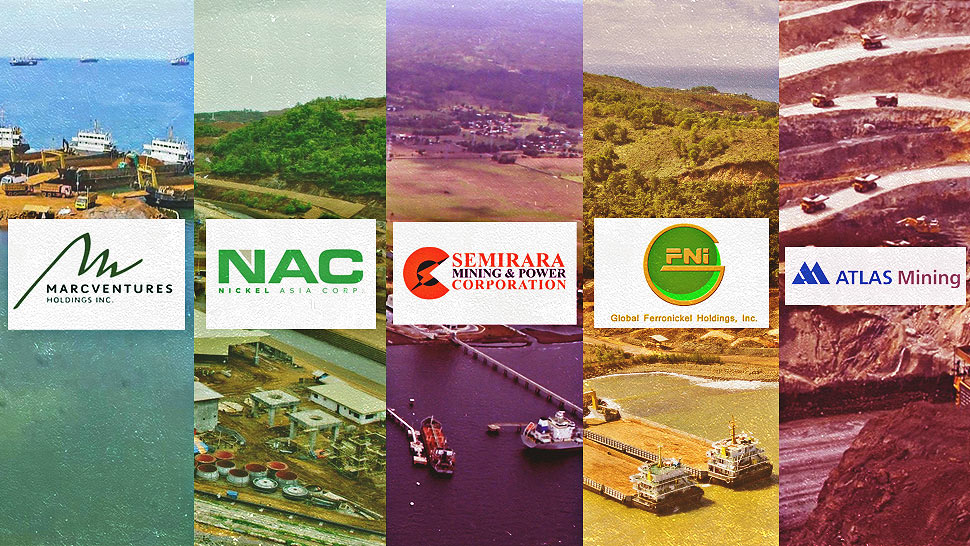
Here are the five best performing mining stocks so far this year and how you can profit from them:
1| Marcventures Holdings, Inc
Year-to-date gain: +66.7 percent
Marcventures Holdings (PSE: MARC) is primarily a nickel ore producing company, exporting one hundred percent of its production to China.
MARC holds mineral production sharing agreements that collectively cover a total of 21,872 hectares in Surigao Del Sur and the province of Samar through its four operating subsidiaries.
MARC’s total revenues have been growing by an average of 15 percent per year for the past 10 years, from P842 million in 2011 to P2.8 billion in 2020.
This steady revenue growth increased MARC’s net income by an average of seven percent per year from P209 million in 2011 to P375 million in 2020.
Last year, higher global prices of nickel and production increased MARC’s nine-month total revenues by 61 percent to P2.8 billion from P1.7 billion in 2020.
The surge in revenues increased MARC’s net income by almost four times to P790 million from only P163 million in 2020.
The stock of MARC has been rising since December last year from P1.05 per share to as high as P2.16 per share last week on expectations of sustained earnings growth this year.
Based on a MARC’s 12-month trailing net income of P1.0 billion, the stock is only trading at six times Price-to-Earnings (PE) ratio against the sector’s average of 12 times.
If demand for nickel continues to be high, MARC should be able to sustain its earnings growth momentum this year and double its stock price to P4.00 per share at 12 times PE ratio.
MARC also declared special dividend last year at P0.13 per share, which gives the stock a six percent dividend yield. The last time MARC paid dividends was in 2014 at P0.30 per share when it earned a net income of P841 million.
This year, with the company expected to earn more than P1.0 billion in 2021, it is likely to pay dividends again.
Assuming it will pay the same amount of P0.30 per share, this should give MARC a prospective dividend yield of 13.9 percent and further support the stock.
2| Nickel Asia Corporation
Year-to-date gain: +55.1 percent
Nickel Asia (PSE: NIKL) is the largest producer of lateritic nickel ore in the Philippines, and one of the largest nickel companies in the world. It also has a growing interest in renewable energy development.
NIKL operates four major mines: Rio Tuba in Bataraza, Palawan, which has a capacity of 24,000 tonnes of contained nickel; Taganito in Surigao del Norte, which has 36,000 tonnes capacity; Hinatuan in Surigao del Norte; and Cagdianao in Dinagat Islands.
The company is also into renewable energy business through its 86.3 percent subsidiary, Emerging Power, Inc., which operates a 32 MW solar plant in Subic Bay freeport that it plans to increase to 100 MW in 2021, as well as geothermal service contracts in Mindoro and Biliran.
NIKL’s revenues, 92 percent of which come from ore and limestone sales, have been growing by an average of 15 percent for the past 10 years from P4.7 billion in 2009 to P21.8 billion in 2020.
This growth in revenue has resulted in 27 percent annual growth in net income from P303 million in 2009 to P4.0 billion in 2020.
Last year, similar to MARC, rising prices of nickel ore in the global market increased NIKL’s nine-month earnings by 39.3 percent to P21.1 from P15.1 billion in 2020.
This surge in revenue growth translated to 168 percent increase in net income of P6.1 billion from P2.3 billion in 2020.
Based on NIKL’s 12-month trailing earnings, its stock’s PE ratio currently stands at 15 times, which reasonably reflects the company’s strong balance sheet and solid earnings track record.
Last year, NIKL paid a total dividend of P0.45 per share, 50 percent higher than it paid in 2020 on account of higher earnings.
Assuming the company will pay the same dividend this year, this gives the stock a prospective dividend yield of 5.1 percent.
3| Semirara Mining and Power Corporation
Year-to-date gain: +49.4 percent
Semirara Mining and Power Corporation (PSE: SCC) is the largest coal producer in the Philippines, and the only power producer in the country that owns and mines its own fuel source (coal).
SCC operates the largest and most modern pit mine in the Philippines with operating capacity of 16 million metric tons of coal per year. SCC also installed generating capacity of 900 MW, with an additional 1,200 MW in the pipeline.
SCC’s revenues, which is comprised of 65 percent coal sales and 35 percent power revenues, have been growing by an average of eight percent per year pre-pandemic from P22.8 billion in 2010 to P44.2 billion in 2019.
SCC’s steady revenue growth resulted to an annual net income growth of 10 percent—from P3.9 billion in 2010 to P9.6 billion in 2019.
During the 2020 pandemic, SCC’s total revenues fell by 36 percent to P28.2 billion from P44.2 billion in 2019, which cut its net income by about two-thirds to only P3.3 billion.
Last year, with the recovery in the global prices for coal, SCC’s total revenues for the first nine months almost doubled to P38 billion from P19.8 billion in 2020.
This increased SCC’s net income by more than three times to P10.3 billion from P2.9 billion in the previous year.
Last year, SCC also paid total dividend of P3.00 per share, which is more than twice the amount it paid at P1.25 per share in 2020 on account of strong earnings performance.
At this dividend rate of P3.00 per share, SCC currently enjoys an attractive dividend yield of 8.8 percent.
Given a 12-month trailing income, SCC’s current Price-to-Earnings (PE) stands at 13.7 times.
SCC will most likely sustain its earnings growth this year given the global demand for coal power generation from the post pandemic recovery.
4| Global Ferronickel Holdings
Year-to-date gain: +27.4 percent
Global Ferronickel Holdings (PSE: FNI), through its wholly owned subsidiary Platinum Group Metals Corporation (PGMC), is one of the world’s largest suppliers of nickel ore.
It is also the country’s third largest nickel ore producer by volume of nickel shipped and second largest by value of shipment.
Total revenues of FNI have been falling from P9 billion in 2014 to P3.8 billion in 2016 due to weak nickel prices. The fall substantially cut down its net income from P4.8 billion in 2014 to only P37.5 million in 2016.
But in 2017, as global prices of nickel started to recover, FNI’s revenues improved by 54 percent to P5.8 billion, which increased its net income to P779 million.
During 2020 pandemic, FNI’s total revenues grew by nine percent to P7.3 billion from P6.6 billion, which increased its net income by 42 percent from P1.3 billion in 2019 to P1.9 billion.
Last year, FNI’s nine-month revenues grew by 15 percent from P5.6 billion in 2020 to P6.4 billion due to the rise in nickel prices. The growth in revenues increased FNI’s net income by 19 percent from P1.6 billion in 2020 to P1.9 billion.
Based on a 12-month trailing earnings, FNI is only trading at PE ratio of 7.6 times, which is 36 percent cheaper than the sector’s PE average of 12 times.
FNI also paid cash dividends last year at P0.10 per share for the first time since 2013. At this dividend rate, current share price of FNI enjoys cash dividend yield of only 3.2 percent.
5| Atlas Consolidated Mining and Development Corp
Year-to-date gain: +25.6 percent
Atlas Consolidated Mining and Development (PSE: AT) is primarily engaged in production of copper and gold.
The company is jointly controlled by the Ramos family of National Bookstore, which owns 42 percent, and the SM Group, which owns 34 percent.
AT, through its wholly owned subsidiary, Carmen Copper Corp, operates the Toledo copper mine in the province of Cebu, which is considered one of the largest copper mines in the Philippines.
Prior to the pandemic, AT’s total revenues had been growing steadily by an average of 13 percent per year, from P9.9 billion to P16.1 billion in 2019, but it has never made a profit due to high fixed interest and financing charges.
By the end of 2019, AT has accumulated a total net loss of P5.9 billion over the last five years.
But during the 2020 pandemic, when prices of copper and gold were rising, AT managed to register a net income of P117 million from a loss of P565 million in 2019, as its total revenues increased by eight percent to P17.5 billion.
Last year, higher copper prices increased AT’s nine-month total revenues by 14 percent to P14.2 billion from P12.4 billion in 2020.
This increased AT’s total net income by seven times to P3.4 billion from P490 million in the previous year.
Because AT has been losing since 2015, the company has not paid any cash dividends. The last time it paid dividends was in 2014 when the company made a net income of P122 million.
It is possible that AT may declare dividends this year due to the strong recovery of its earnings. Given the high demand for copper this year, AT should be able to sustain its earnings growth.
Based on its 12-month trailing income, AT’s PE ratio stands at only 8.3 times, which should give it a lot of room for potential upside.
Henry Ong, RFP, is an entrepreneur, financial planning advocate and business advisor. Email Henry for business advice [email protected] or follow him on Twitter @henryong888
