
'Point of No Return': Tunnel Boring Machines Deployed for Metro Manila Subway Project

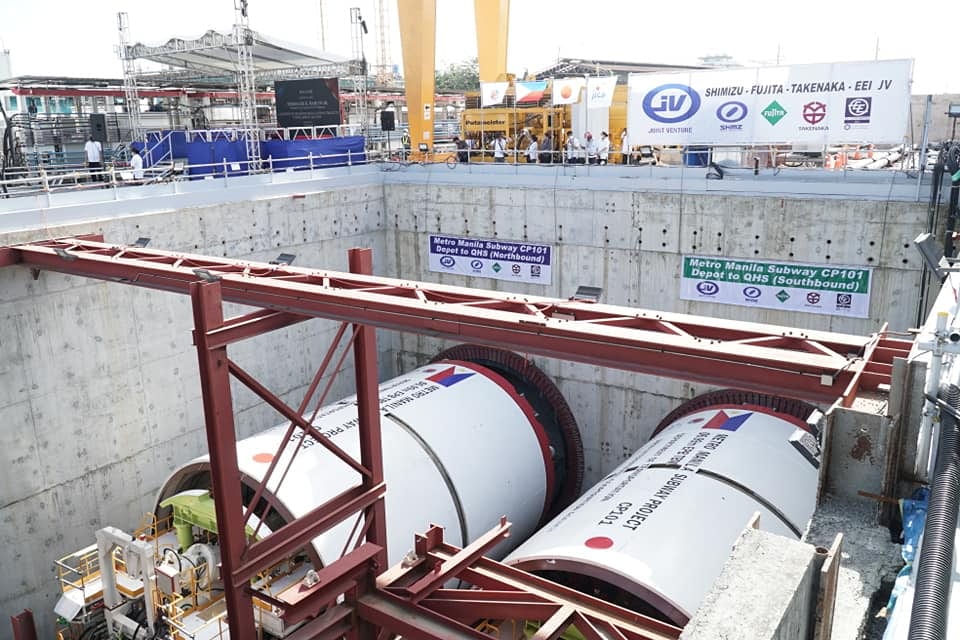
We’ve reached the point of no return, at least in terms of the country’s first underground railway system.
A tunnel boring machine (TBM) for the much-anticipated Metro Manila Subway Project (MMSP) has been deployed starting Monday (January 9), the Department of Transportation announced.
It’s a significant step in the process to build the high-ticket project, and, according to the DOTr, the deployment of the TBM means actual construction for Metro Manila Subway will commence as it will set in motion the operation and initiate its movement for excavation.
ALSO READ
Megawide Bags P17.75 Billion Contract to Build Underground Stations for the Metro Manila Subway
Two of Metro Manila's Subway Stations Officially Break Ground
“Today’s start of tunneling work signifies the point of no return,” DOTr Secretary Jaime J. Bautista said. “We are going full speed ahead to complete the country’s first subway.”
Photo of the giant boring machine used for the Metro Manila subway

Bautista added that completing the MMSP is a priority concern for the agency as it will provide direct connectivity to the Ninoy Aquino International Airport (NAIA), thus helping provide interconnectivity for the country’s infrastructure systems.
Six units of the TBM will be used at least for the MMSP’s Contract Package 1 or CP101, which is dedicated for the excavation of the tunnels. The DOTr said CP101 will use a top-down construction method for the stations.
With the TBMs and cut-cover equipment, around 1.2 million cubic meters of soil, or enough to fill 500 Olympic-size swimming pools, is to be excavated for the partial operability (PO) section of the project.
Meanwhile, for the tunnels, the excavation will produce around 711,000 cubic meters of soil or the equivalent of 285 Olympic-size swimming pools.
In total, the alignment is expected to produce about 7,419,940 cubic meters of soil, or the equivalent of 2,500 Olympic-size swimming pools.
The MMSP will stretch from Valenzuela City to FTI-Bicutan in Parañaque City with a spur line to NAIA Terminal 3 in Pasay City. Spanning 33 kilometers with 17 stations, the subway system will cut travel time between Quezon City and Pasay City to 35 minutes from the current one hour and 10 minutes.
It aims to serve up to 370,000 passengers per day and is expected to be completed in 2028.
