

Financial Adviser: 5 Business Lessons Everyone Can Learn from Tony Boy Escalante, Founder and CEO of Antonio’s Group of Restaurants

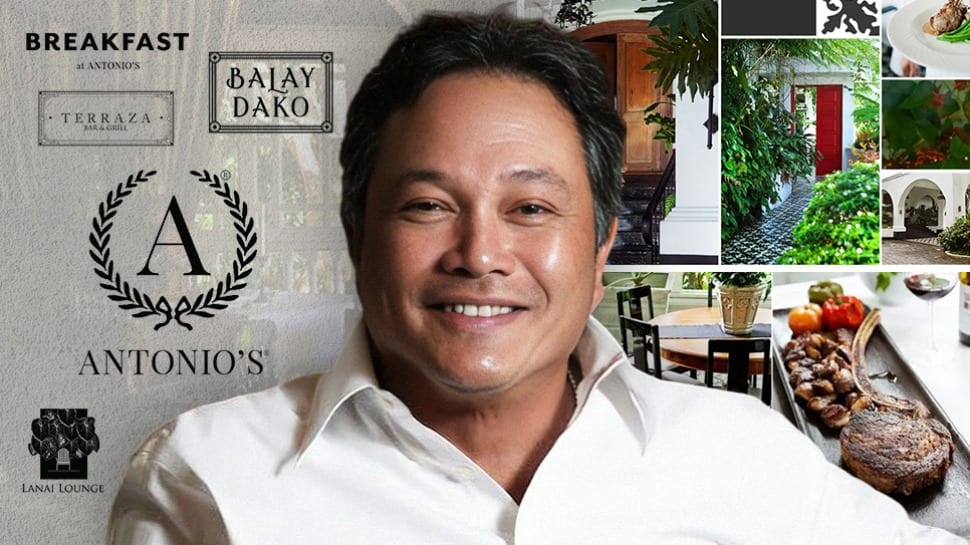
Antonio “Tony Boy” Escalante pursued dentistry after graduating from college upon the wishes of his father. However, one year before completing his premed studies, he chose to drop out. He found a job as a steward with Philippine Airlines in the early '90s, which gave him exposure to hospitality and the experience of visiting different restaurants and bars overseas.
After several years, he resigned and took a culinary course in Australia. While doing his practicum at the Tivoli Bar in the Mandarin Oriental Hotel in Makati, Escalante was already setting his sights on opening his own restaurant.
Following four years of training in fine dining, he purchased a property in Tagaytay where he built both his home and his dream restaurant, which he named Antonio's. The restaurant's serene location and excellent menu quickly attracted a loyal clientele, and within a year, Antonio's Restaurant had become a celebrated dining destination.
The success of Antonio's Restaurant encouraged Escalante to expand his business the following year by opening Breakfast at Antonio's, a more casual dining option that catered to the breakfast and brunch crowd. In the third year, he opened The Grill, which offered a more relaxed dining experience with a focus on grilled specialties.
A few years later, when an opportunity arose to expand The Grill, Escalante seized it and renovated the space and rebranded it as Balay Dako.
Balay Dako has become a beloved destination for both locals and tourists, known for its authentic Filipino cuisine and warm, inviting atmosphere. The restaurant's success is a testament to Escalante’s ability to innovate and adapt, continually refining his concepts to meet the evolving tastes and preferences of his customers.
Today, 22 years after the opening of his first restaurant, Escalante is poised to expand his culinary empire beyond the borders of Tagaytay. He has remained committed to maintaining the highest standards of quality and excellence in all his ventures. His hands-on approach ensures that each restaurant under his brand delivers a consistently outstanding experience, from the ambiance and service to the food itself.
What challenges did Escalante face while transitioning from a steward to a chef and restaurant owner? What strategies did Escalante use to attract and keep a loyal clientele at his restaurants for more than 20 years?
Here are the five business lessons everyone can learn from Tony Boy Escalante, founder and CEO of Antonio’s Group of Restaurants:
ALSO READ
1| Know how to align your passion to meet market needs
When you are passionate about what you do, it drives you to work harder and stay committed, even during challenging times. This intrinsic motivation can be a powerful force in sustaining your business over the long term.
Being passionate often means having a deeper understanding and expertise in your area of interest. Aligning your passion with market needs allows you to create a unique value proposition. People are naturally drawn to brands that convey a clear sense of purpose and passion.
Escalante saw the potential in creating a standalone fine dining restaurant outside of Manila, which was uncommon at the time. By envisioning a restaurant in a serene, scenic location like Tagaytay, he tapped into an underserved market of food enthusiasts willing to travel for a distinctive dining adventure. This foresight allowed him to create a niche that attracted a loyal clientele.
Escalante left a promising career path in dentistry to pursue his passion for cooking. This decision required courage and a belief in his ability to succeed despite the inherent risks. By taking this leap, he set the foundation for a career aligned with his true interests and strengths.
Throughout his journey, Escalante showed remarkable adaptability. When he quit dentistry, he was uncertain about his future. However, he quickly adapted to his new role at Philippine Airlines. His adaptability was also evident when he transitioned from being a steward to enrolling in culinary school and eventually opening his own restaurant.
“I was a medical student when I quit my studies,” he says. “My father told me to take up medicine. You know us, being Catholic and obedient to our parents and often felt guilty, we tended to follow their wishes. I chose dentistry because it was only for six years. I was in my fifth year, with one more year to go and I just dropped it and said, ‘This is not for me.’ I left everything because I wasn't happy. I knew it wasn't for me, but I passed; I didn't fail. I just knew what I wanted, so I stopped.
“I wasn't happy, but when I quit, I didn't know what I would do without graduating. At that time, if you didn't have anything going on here in the Philippines, you would be sent abroad, often to the US. Many of my cousins were there, but I didn't like it. So, when the first job opportunity came up with Philippine Airlines, I grabbed it.
“But when I joined, I knew that it wasn't for me in the long run. I was constantly thinking about what to do. I had a passion for cooking, so I told myself I would take up culinary studies. PAL maybe helped open my eyes, because before (the airline) flew to many places in Europe, which broadened my perspective.
“When I was there, I learned a lot about service, good eating, and good food. Traveling became an integral part of me, and it may have molded me into who I am now. Our family loves to eat, so it's a passion for us. In our family, the men are the cooks. My dad was a good cook. My mom didn't cook, but she knew how to give instructions. So, I think food was a big part of our family on both my mother’s and father's sides. It was our way of coming together. We were passionate about food.
“Di ba there was a time yung mga piloto nag-strike around 1998? When PAL closed down, I was already enrolled in Australia for a culinary course. I was already planning to leave for my studies, so I went to culinary school.
“Before I went to culinary school, I already knew I wanted to open a restaurant. During my travels, I noticed that for fine dining, you had to go to a hotel. There were no standalone fine dining restaurants in Manila, except for Billy King who was the first chef to open his own restaurant outside of a hotel. There were practically no white-linen restaurants outside of hotels in Asia.
“I knew that they were really good restaurants located outside the city. When I met Sonya Garcia, who had a small restaurant then in Tagaytay, I was inspired. If she could get people from Manila to dine in her restaurant, then I told myself I could do it, too. When she opened her restaurant, it was small and charming. She's Ilongga, like me, and I told her that I wanted a lifestyle like hers. I wanted to create something similar.
“I said I’m going to build one too, live outside the city and have a restaurant. In other countries, people travel for good restaurants, but I saw the potential traffic of the people who would be my target clients traveling to Calatagan.
“Do you know the BPI ATM here is the VIP machine? Hindi yan nauubusan ng pera maski brownout may generator yan, because all the big bosses go to Calatagan. Punta Fuego was already there, Highlands was there, but Punta Fuego was really new. Baguio was so hard to get to back then—it took six to seven hours.”
2| Know how to prepare and recognize expansion opportunities
Preparation ensures that you have a solid foundation, including a clear business plan, adequate funding, and a well-researched market strategy. This foundation is essential for long-term success.
Thorough research and preparation help you understand your target market, including customer needs, preferences, and behaviors. This knowledge enables you to tailor your products or services to effectively meet market demands.
Acting quickly on expansion opportunities allows you to establish a strong presence in the market. Early movers often capture significant market share and set industry standards.
Escalante’s formal education in culinary arts provided him with the foundational skills and knowledge necessary for a successful career in the culinary industry. After his studies, Escalante worked at the Mandarin Oriental Hotel's fine dining restaurant, Tivoli. He trained under Norbert Gandler for four years without pay to gain invaluable experience.
This hands-on training allowed him to hone his skills in a high-pressure, professional kitchen environment. During weekends, Escalante cooked for groups of 10 people at his house. These weekend sessions helped him build a loyal clientele even before his restaurant officially opened. This experience also allowed him to refine his recipes and service style.
While cooking for guests on weekends, Escalante was simultaneously building his restaurant. He recognized the importance of having a concrete plan and took the necessary steps to ensure his business would have a solid foundation.
After the success of his first restaurant, Escalante capitalized on its success by launching Breakfast at Antonio's and the Grill in the next two years. This expansion allowed him to build trust and credibility with customers, making his brand more recognizable and reputable.
“I studied culinary for a year and a half in Adelaide,” Escalante says. “After that, I worked for Mandarin Oriental, parang practicum. I was 33 at that time. I trained with Norbert Gandler and stayed there for four years without pay cause they wanted to hire me, but I knew if I get hired I'll be put in another kitchen. I just wanted the fine dining, the Tivoli in Mandarin. I just told him that I'll get the position, but I don't want to be employed. I spent four years there to gain experience. It was fast.
“But during weekends, I would cook for groups of 10 people here in the house. If there were 10 people, I would cook for them on weekends, and every weekend was fully booked. While I was cooking for people, as long as there were 10, I was also building the restaurant. I was already too old not to have a plan. I thought that I really needed a job. I really needed something to do with my life.
“My idea of my restaurant was casual but elegant. I named it after myself because I really believe that any restaurant or hospitality group needs to have a personality. But it was also a bit of a deterrent because, like how Mickey Mouse is expected to be in Disneyland, people expect me to be here all the time. But it's in my nature—I love getting in contact with people. I enjoy entertaining and love to entertain people, even in my own house.
“When I opened my restaurant, it became successful right away, just after two months. We started with 40 guests, then it reached 80, then 120, and eventually, it became a destination. When I opened in 2002, there weren't many restaurants in Manila, and many people from that generation still traveled to Calatagan and liked to move around. It was a full cycle of 15 years with my regular patrons and guests.
“After just one year, I built Breakfast at Antonio's. I got the idea from the book Breakfast at Tiffany's, so I thought, why not make a Breakfast at Antonio's? Then there was this house, the Macaraig house. Before, every time we would go to Punta Fuego with my children, I would always pass by this house. It looked like a haunted house kasi hindi naman tinitirahan. It was an old. I told myself I would turn that into a restaurant, and it came true.
“Then on the third year, I was able to put up a Filipino restaurant by the ridge called the Grill, which is now Balay Dako. For three consecutive years, I was opening one restaurant a year.
“Balay Dako, with its food and ambiance, was inspired by my upbringing in Negros. Growing up, we had a big house where we would say, ‘Kain na sa Balay Dako.’ And the farm, you know, so parang it's a big place so I called it Balay Dako.
“When we were kids, we would gather at our lolo’s main house, while we had our own small cottages. It was always, ‘Kain na sa Balay Dako,’ or ‘Tawag kayo sa Balay Dako.’ Parang everything I did was connected to how I grew up.”
3| Know how to assess and take calculated risks
Strategic risks often involve pursuing new opportunities that can lead to significant growth. Without taking risks, businesses may stagnate and miss out on potential breakthroughs.
By carefully analyzing and taking calculated risks, businesses can gain a competitive edge. Although there is always a chance of failure, successful risk-taking can result in substantial financial returns and market success.
Escalante envisioned a lifestyle that was more relaxed and provincial, away from the hustle and bustle of Manila. This personal vision drove his decision to create a restaurant that could also serve as his home if the venture didn’t succeed. By designing the restaurant to look like a house, he mitigated the risk of complete failure, ensuring that the investment would still serve a purpose.
Every weekend, Escalante cooked for groups of 10 people, and his sessions were always fully booked. This consistent demand provided him with confidence that there was a market for his culinary skills. The word-of-mouth referrals and repeat bookings acted as informal market research, indicating a strong customer base and validating his business idea.
While he understood that no business venture is free of risk, Escalante believed in the importance of planning and hard work. He recognized that while you can’t predict every outcome, you can prepare and position yourself to take advantage of opportunities as they arise.
He acknowledged that traditional business analysis might have discouraged the launch of his restaurant due to its unconventional location. However, he relied on his intuition, passion, and dedication, believing that his commitment would drive success.
“When I opened the restaurant, it was the lifestyle that I wanted,” Escalante says. “Parang provincial life. I didn't like Manila. In fact, I told my cousin who built this place to make it look like a house so that if the restaurant didn't work out, it could just be my house.
“Naisip ko na yung risk, but in any business, nothing is certain. No one can really predict what will happen. You can study and plan, but at the end of the day, it's about whether you can make it or not. But of course, there's always some level of calculation involved.
“I already knew that people would come because I was cooking every weekend for a group of 10. Every Saturday and Sunday, I was fully booked. So, every time they visited, they saw the restaurant being built. It was all through word-of-mouth because there was no social media back then. I didn't even have a computer myself.
“In the first year after I opened, I immediately opened Breakfast at Antonio's. The entrepreneur inside me was probably the driving force. You know, as they say, entrepreneurs don't always think through every detail. If my manager, who studied business, were to analyze this location, he might not have opened it. But for me, it was just guts and hard work, you know, like a dedication to what I was doing.
“Cost-control became an issue for me. I went overboard with my expansion because I'm not diligent with numbers. I encountered problems because I over-expanded. But if I hadn't done that, where would I be now? Maybe I would only have two restaurants, or even just one. One of the directors at the bank once asked me, ‘Why did you borrow from high-interest institutions?’ I replied, ‘Well, it's so hard to go to the bank. If you lend me money, the bank makes money, and I'll make money.’
“I'd rather have a business without money in my pocket at first, knowing that after three or four years, I'll have a business and money in my pocket. For me, business is straightforward: as long as you make money, one plus one equals two.
“If I wasn't brave and didn't know myself, I might have stuck to just one restaurant. I don't know where I would be now if I hadn't taken risks. Entrepreneurs are often described as go-getters, and that's what I am.
“You know what's important in business? You have to know yourself. You have to be secure with yourself because if you're not secure, you will be scared of these things.
“Of course, I've made a lot of wrong decisions. It's not all perfect, but it's about how you maneuver to get out of the situation. There are a lot of learning curves, but I would still take this path. I cannot say it wasn't calculated—it was calculated but hard.”
4| Know how to stand out with reputation built on quality
Consistently delivering quality builds credibility. Customers trust brands that reliably meet their expectations, which strengthens your reputation and encourages customer retention.
Prioritizing quality ensures that customers are happy with their purchases. Satisfied customers are less likely to have complaints and more likely to have positive experiences, which enhances your overall brand image.
Trust is a cornerstone of any business relationship. When customers trust that they will receive high-quality products or services, they are more likely to remain loyal and engage in long-term business relationships.
Escalante ensured the quality of his ingredients by personally testing them with suppliers. This hands-on approach guaranteed that only the best ingredients were used in his dishes.
He also opted to import around 80 percent of his ingredients to maintain high quality. He avoided local meat because it was more expensive and often required additional cleaning. By choosing higher quality imported meat, he ensured that his dishes met his standards.
Escalante emphasized the importance of making their own products rather than buying pre-made items. He resisted the temptation to take shortcuts that could compromise quality and he believed in the value of doing things the long way, even if it was more labor-intensive and time-consuming.
His focus on maintaining high standards consistently helped build trust among his customers. They knew they could rely on his restaurant for quality food, which encouraged repeat business and word-of-mouth referrals.
“The challenge when I first opened was getting good people to relocate to Tagaytay and sourcing ingredients,” he says. “In the beginning, no one was willing to deliver except for one supplier. You really had to go down yourself because there were not many purveyors back then.
“There were only a few before. It was very personal. I remember the first French guy who supplied me. He would come over, and we would test the ingredients before I bought them. For example, if it was pigeon, we would cook it first together. It was a very personal experience.
“Our ingredients are all imported, maybe 80 percent. Even Balay Dako doesn't use local meat kasi mas mahal and you have to clean it pa, minsan cara-beef pa. I don’t want to spoil that. Cow's beef is totally different from cara-beef. Cara-beef, matigas yan, maitim unlike cow’s meat, it can be pinkish or burgundy, but not deep red.
“We just have a vibe menu, but we stick to classic ingredients and stay true to traditional ways of cooking. I never limit myself na kailangan hanggang P1,000 lang yan. If it costs more than expected, so be it. If a dish ends up at P600 to sell, then it will be sold for P600. I don't set a cap or ceiling, like insisting a dish should only cost P500. We always prioritize quality first, then margins.
“Here, we have always been known for our steak since the beginning. For breakfast, we make our own corned beef and everything else. We do it all ourselves. I was even asked before, ‘Why don't you buy from me? You only have one restaurant.’ But I replied, ‘What will I do? Cook your bacon?’ I said no. You have to do things the long cut. So from the beginning, we made our own products. If I just make it easy for myself, kumuha na lang ako ng bacon, lulutuin ko, I wouldn’t be proud of myself di ba?
“We can create mayonnaise. I don't buy commercial mayonnaise but butter I don't think we can make. Maybe you can enhance it like I can make compound butter or flavored butter.
“For example, if you're given oil and vinegar, you can create a vinaigrette, but I can't make vinegar or oil. You can make your own dressing. There’s a famous dressing. We were able to make a raspberry dressing. It became well-known and is now being bottled and sold.
“People see and appreciate when you take the long way. But if you put the food here na parang binili lang naman ito ah? Anong pinaghirapan dito? People will question it. That's why I always tell my staff that the plates should show that a lot of effort has been put into them. It shouldn't look like something anyone could do. When you eat at a restaurant, you don't want to feel like people will say ‘I can do this,’ di ba?”
5| Know how to value life experiences more than accumulating wealth
Research shows that people who invest in experiences rather than material goods tend to be happier and more satisfied with their lives. Experiences provide lasting joy and fulfillment that money alone cannot buy.
Engaging in meaningful activities and creating lasting memories can reduce stress, anxiety, and depression. Positive experiences and social interactions boost your mental well-being.
A focus on experiences can lead to a higher quality of life. Activities such as travel, learning new hobbies, and exploring new cultures add richness and diversity to your life.
Escalante believes in the importance of making memories in life. He suggests that instead of hoarding money for old age, one should spend money on experiences that create lasting memories and personal fulfillment.
He advocates for enjoying life in the present, such as traveling and engaging in activities like backpacking in Europe. He highlights that these experiences enrich one's life far more than simply accumulating savings.
Escalante practices a "work hard, play hard" philosophy. He works diligently but also ensures that he takes time to enjoy the fruits of his labor, emphasizing the importance of balancing professional efforts with personal enjoyment.
Escalante stresses that experiences are more valuable than just saving money without learning or enjoying life. He points out that the return on experiences—personal growth, happiness, and fulfillment—outweighs the benefits of merely having a large savings account.
“I always tell my son to be kind to people,” he says. “Persevere and build a good reputation. Reputation doesn't happen overnight; it takes years to establish. A good reputation sums up all your efforts. Build good relationships and take care of your people. Hindi dapat ikaw lang umaasenso, dapat sila rin di ba?
“Dedicate time to your ideas and work on them. Once your ideas are in place, you have to keep working on them. At this point, I'm less involved in the day-to-day because I have professional people managing things. Pero overseeing everything from the top is still critical.
“Kuripot yung anak ko. Ako hindi. Ako yung gastador. I work hard and play hard. I believe that if you have money, give it to your children at an early age, and then spend your money because it's all about making memories in life. If you keep saving for old age, hindi ka na makaka-enjoy. Hindi ka na makaka-akyat ng Spanish Steps or maka-paragliding kasi even as a starter, you can go backpacking in Europe, which will enhance yourself.
“Ang balik is yung experiences. Its more valuable than just saving money and not learning anything. As you grow older, if you have a good mind and work ethic, your salary will increase unless kung tamad ka and you see yourself na hanggang dito lang ako. If you’re ambitious, you don’t need to worry about the future too much. Kasi marami ka ngang pera sa pagtanda mo, pero marami ka rin hindi nagawa pag dating mo ng 60.
There are many people who need your money, and of course, you have to be cautious about where to give and where to invest. But if it makes you happy, I think people are naturally happy when they give.”
Henry Ong, RFP, is an entrepreneur, financial planning advocate and business advisor. Email Henry for business advice hong@financialadviser.ph or follow him on Twitter @henryong888
