

Financial Adviser: 5 Things to Know About Romeo Chan’s Axelum Resources Corp in 2025 and How You Can Profit from It

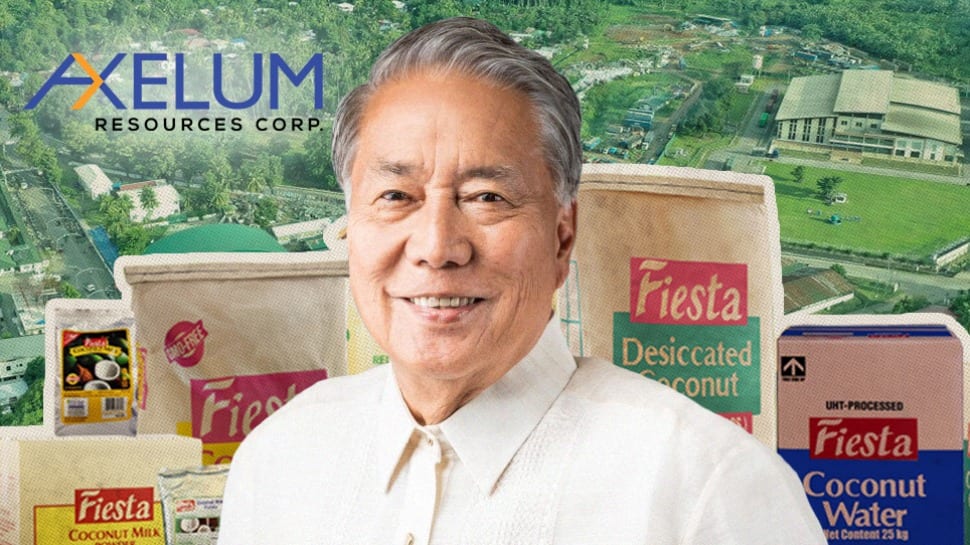
When Axelum Resources Corp. (PSE: AXLM) debuted on the Philippine Stock Exchange in October 2019, it entered the market with strong investor interest. At the time of its initial public offering (IPO), AXLM positioned itself as a key player in the coconut value chain that produces everything from coconut water and milk to desiccated coconut and oil.
The years after its IPO proved difficult for most local equities. Like many newly listed firms, AXLM’s stock faced headwinds as the PSE Index struggled through global uncertainties and the lingering effects of the pandemic.
From an IPO price of P5.00 per share, AXLM’s share price has moved largely in step with the weakness of the local bourse, even though the company maintained profitability and expanded its export business.
Today, the stock has lost 64 percent and is now trading at P1.80 per share, despite growing revenues and margins. This disconnect between business performance and share price became more pronounced as foreign investors withdrew funds from the Philippine market that pushed valuations lower across many sectors.
In 2023, the Metro Pacific (MVP) Group, through its agri-investment arm Metro Pacific Agro Ventures, Inc. (MPAV), acquired a major stake in AXLM. MPAV purchased 1.19 billion common shares and 200 million preferred shares, giving it an estimated 34.76 percent equity interest in the company by year-end.
The P5.3 billion deal made Metro Pacific the single largest shareholder of Axelum, while the founding group retained management control. The entry of the MVP Group signaled confidence in AXLM’s long-term potential and its growing importance in the Philippine agri-export sector.
Despite these strengths, the stock price has not reflected the company’s steady fundamentals. The broader market environment continues to weigh on small- and mid-cap stocks. Limited trading activity, weak sentiment, and global risk aversion have depressed valuations even for sound companies. As a result, AXLM stands as one of the market’s most undervalued companies, caught in the tide of negative sentiment surrounding the local stock market. While most investors focus on short-term market movements and large-cap plays, companies like AXLM continue to deliver quietly in the background.
Perhaps now may be the right time to take a closer look at this stock that the market has largely ignored. Before making any investment decision, every investor should take time to review the company’s fundamentals and study its financials.
Understanding what drives its performance is essential to seeing beyond short-term market noise. Here are five things to know about Axelum Resources Corp and why it deserves a closer look:
ALSO READ
1| Know the industry and market outlook
The global commodities market has entered a cooling phase after several years of price surges. According to the World Bank’s Commodity Markets Outlook, overall commodity prices are expected to fall by about 12 percent in 2025 and another five percent in 2026, led by steep declines in energy and a gradual easing of food and agricultural inputs. The World Bank warns that in real terms, this could bring prices to their lowest levels of the decade, though it also notes that geopolitical conflicts and supply disruptions could still cause temporary spikes.
In other words, the world is moving from an inflationary cycle to a more stable one, which is good news for food manufacturers that depend on imported energy and packaging but challenging for raw commodity producers whose revenues hinge on high selling prices.
Yet not all agricultural sectors will be affected equally. The coconut industry, which remains a niche but fast-growing global market, stands out as an exception.
Unlike other soft commodities that respond quickly to price signals, coconut production cannot ramp up overnight. New plantations take four to five years to mature, which limits supply flexibility.
This structural bottleneck, combined with steady global demand for plant-based, natural, and functional food ingredients, has kept coconut prices resilient.
In fact, while the World Bank projects easing prices for most agricultural goods, several research groups, including IMARC and Helios Ingredients, expect coconut oil prices to stay elevated through late 2025, which averaged between $2,400 to $2,500 per metric ton, with occasional peaks above $3,000 due to supply constraints in the Philippines and Indonesia.
For context, the U.S. Department of Agriculture forecasts that global coconut oil output for 2024 to 2025 could decline by about six percent as a result of adverse weather and aging trees in key producing countries.
Despite the limited global supply, demand for coconut products continues to grow as more consumers choose healthier and more natural options. Coconut water, milk, sugar, flour, and oil are becoming staples in plant-based diets and clean-label food products, driving steady consumption in health-conscious markets.
Industry research firm Mordor Intelligence projects the global coconut products market to grow at a 7.5 percent compound annual rate through 2030, driven by stronger retail and industrial demand.
These global dynamics matter because AXLM sits squarely in this growth pocket. As one of the world’s largest fully integrated coconut processors, it exports desiccated coconut, coconut milk, cream, and oil to major brands across the U.S., Europe, and Asia.
A tighter supply environment benefits companies like AXLM, whose entire revenue base comes from coconut-derived products. As a fully integrated processor, AXLM operates large-scale facilities and maintains direct sourcing relationships with thousands of local farmers.
This allows the company to secure raw materials more efficiently and convert them into higher-value exports such as coconut water, milk, cream, oil, and desiccated coconut, which creates an economic buffer that many smaller producers lack.
While many commodities face downward pressure, the coconut industry tells a different story. Tight supply, strong global demand, and the long-term shift toward healthier, plant-based products create a solid foundation for companies like AXLM to preserve margins and expand as markets recover.
2| Know the earnings strength of the company
AXLM’s earnings story shows a company that has quietly rebuilt its foundation and is now entering a phase of steady, sustainable growth. In 2024, AXLM delivered a full turnaround from the setbacks of the previous year. Revenues rose 29 percent to P7.34 billion from P5.68 billion in 2023, while net income swung to a profit of P688 million from a P818 million loss.
This recovery stemmed from higher export volumes, normalized logistics costs, and greater operational efficiency after the one-off inventory write-downs that affected 2023 results. By year-end, the company had restored profitability and profit margins.
This growth momentum carried into 2025. In the first half of the year, AXLM generated P4.51 billion in sales, up 40 percent year on year, while net income grew six percent to P220 million. This performance was driven by stronger demand and higher prices across all major product lines such as desiccated coconut, coconut cream, reduced-fat coconut, and coconut water where each posted double-digit growth.
Key export markets, led by the United States, Australia, and the Philippines, also expanded sharply. Despite raw coconut prices increasing by as much as 125 percent, AXLM managed to preserve profitability by effectively managing costs and maintaining stable order volumes.
If this trajectory holds, full-year 2025 revenue could reach about P9.8 billion, based on the company’s 2024 pattern where the first half accounted for roughly 46 percent of total annual sales. Applying the 2024 full-year net margin of around nine percent, projected net income for 2025 would be approximately P880 million.
This would represent an earnings growth of about 28 percent from 2024’s P688 million. This projection reflects not only higher export volumes but also the company’s ability to manage costs and maintain profitability despite elevated input prices.
3| Know the financial discipline of the company
A company’s financial strength reflects not just its capacity to grow, but its ability to endure. AXLM’s balance sheet has consistently shown a discipline that distinguishes it from most commodity exporters. Across the past three years, the company has maintained exceptionally low leverage, high liquidity, and steady profitability—conditions that make it resilient even in volatile global markets.
From its 2024 audited financial statements, AXLM recorded P860 million in total loans payable, that is, P857 million in current loans and P3 million in noncurrent borrowings, against P10.67 billion in total equity.
This translates to a pure debt-to-equity ratio of just 0.08×, or only eight centavos of debt for every peso of equity. Even when all liabilities are included, the ratio rises only to 0.16×, confirming that the company remains among the most conservatively financed in the food manufacturing sector.
A closer look at its financial trend reinforces that point. In 2023, debt-to-equity stood at 0.081×, virtually unchanged from 2024’s 0.08×. By mid-2025, it was still just 0.084×, despite higher working-capital needs to support export growth. This stability shows that AXLM’s expansion is funded primarily through internally generated earnings, not borrowings.
On the profitability side, AXLM generated P707.6 million in EBIT (Income from Operations) in 2024, which reversed the previous year’s loss and signaled a full turnaround in operational efficiency.
Based on an invested capital base of roughly P9.9 billion, this represents a pre-tax return on invested capital (ROIC) of 7.2 percent. With revenues expected to climb to around P9.8 billion in 2025, and EBIT projected at approximately P931 million, the company’s pre-tax ROIC could rise toward nine percent.
This gradual but steady increase in returns is significant because the company achieved it without added leverage. AXLM earns its growth through operations, not through financial engineering, which is a principle Warren Buffett consistently praises in strong businesses.
As he often notes, “You only find out who’s swimming naked when the tide goes out.” AXLM’s low debt load ensures that when markets turn, it will be among those still standing strong.
4| Know the pricing multiples of the company
One of the clearest ways to understand how investors view a company is through its price-to-earnings (P/E) ratio, which measures how much investors are willing to pay for each peso of profit. The higher the ratio, the greater the market’s confidence in a company’s future growth; the lower it is, the more the market discounts its prospects.
Based on audited and interim financials, AXLM generated a trailing twelve-month net income of P700.9 million. This is computed by taking its 2024 full-year net income of P688.1 million, subtracting the first-half 2024 figure of P207.3 million to avoid duplication, and adding the P220.2 million earned in the first half of 2025.
With a current market capitalization of P6.837 billion, the company trades at a trailing P/E ratio of just 9.8x.
Historically, Axelum traded at 12× to 18× earnings during stronger years following its IPO. At its current multiple, the stock is priced roughly 35 percent below its historical average.
When compared with industry peers, the gap becomes even more evident. Vita Coco, a global coconut products company listed on Nasdaq, currently trades at about 18× earnings, while regional and local food manufacturers such as Wilmar International and Century Pacific (PSE: CNPF) command multiples between 16× and 20×.
In contrast, Axelum’s single-digit P/E ratio undervalues a company that operates in the same expanding global segment for plant-based and natural food ingredients. The market continues to price it as if it were a low-growth domestic player by overlooking its established export base and improving profitability.
If Axelum were to be re-rated closer to its peers, the upside potential would be considerable. At its historical average P/E of 15×, the company’s implied market capitalization would reach roughly P10.5 billion, equivalent to a P2.75 share price.
If we were to price AXLM at 70 percent of the valuation levels of its peers such as Vita Coco, Wilmar International, and Century Pacific (PSE: CNPF), the effect would still be significant. These companies trade between 16× and 20× earnings.
Applying just 70 percent of that range, or roughly 12× to 14× earnings, would value AXLM between P2.30 and P2.60 per share. This implies an upside potential of 30 to 50 percent from its current price of P1.75, even without factoring in additional profit growth.
In short, AXLM does not need to reach full parity with its peers; a modest re-rating alone could unlock meaningful value for investors.
Another way to assess valuation is the price-to-book (P/B) ratio, which measures how the market values a company’s equity relative to its stock price. A P/B ratio below one indicates that investors are paying less than the company’s book value.
As of June 30, 2025, AXLM reported P10.67 billion in total equity and 3.798 billion shares outstanding, giving it a book value per share of P2.81. At its current price of P1.75 per share, the stock trades at a P/B ratio of just 0.62×. This means investors are paying only 62 centavos for every peso of net assets, or buying P2.81 worth of equity for only P1.75. In effect, the market is discounting AXLM’s balance sheet by almost 40 percent, a bargain for a profitable exporter with low debt and improving earnings.
Historically, AXLM has traded around 0.9× to 1.1× book value during periods of stronger sentiment. In comparison, the PSE food sector trades between 1.6× and 2.2×, while regional peers such as Vita Coco, Wilmar International, and Century Pacific command 1.8× to 2.5×. At 0.62×, AXLM trades at less than half those multiples, which suggests that investors are underestimating the company’s intrinsic worth.
A deeper measure of undervaluation can be seen through a “net-net” analysis, a concept popularized by Benjamin Graham and later echoed by Warren Buffett. It measures what would remain for shareholders if all current assets were liquidated and all liabilities paid off. When a profitable company trades close to this level, it typically offers a built-in margin of safety.
As of June 30, 2025, AXLM reported P6.41 billion in current assets against P1.84 billion in total liabilities, resulting in P4.57 billion in net current assets. Dividing this by 3.798 billion shares outstanding gives a net-net value of about P1.20 per share. With the stock currently trading at P1.75, investors are paying only P0.55 more than AXLM’s net current asset value, a premium of just 31 percent over its liquidation-type floor.
In practical terms, this means nearly 70 percent of AXLM’s share price is already backed by current assets such as cash, receivables, and inventories. The remaining P0.55 per share, equivalent to only P2.1 billion in total market value, represents everything else the company owns: its state-of-the-art processing facilities, brands, export contracts, and global distribution network.
Such a narrow premium between market price and liquidation value is exceptionally rare for a profitable company with consistent earnings, dividends, and a strong balance sheet. It indicates that investors are effectively paying only for AXLM’s working capital and getting the rest of the business for practically free. For long-term investors, this provides a powerful margin of safety.
5| Know where the next market cycle turns
AXLM appears to be completing its post-IPO Wave cycle, which began after its 2019 listing near P5.00–P5.50. Following an early spike, the stock entered a prolonged correction that can be viewed as one large A–B–C decline. From the chart, the move from P5.50 down to around P1.70 seems to represent a completed or nearly completed Wave C, which often marks the end of a long corrective phase.
The three key segments show a typical wave structure: Wave A (2019–2020) was the initial drop from P5.50 to P2.40 during market repricing; Wave B (2021) was a brief rebound to P3.40; and Wave C (2021–2024) saw a steady grind lower to P1.60–P1.70. Within that final wave, the price structure consists of five smaller downward legs, characteristic of a terminal C-wave, which frequently precedes a durable long-term bottom.
From a geometric perspective, the total post-IPO decline of roughly 70 percent aligns closely with two-thirds retracement rule, often identified as the point where bear markets lose momentum.
Fibonacci retracements from the P5.50 high place 61.8 percent around P2.10 and 78.6 percent at P1.60 , which places the current P1.75 price squarely in a classic turning zone.
Historically, broader market sentiment in consumer and export-linked sectors has tended to bottom every four to five years, which suggests that this time window into 2025 could coincide with AXLM’s base formation.
In terms of market psychology, AXLM reflects typical post-listing fatigue: early investors exiting, public float stabilizing, and liquidity drying up. Volume has contracted toward multi-year lows, which is often a sign of selling exhaustion rather than renewed weakness.
If the stock can stabilize above P1.60 for several weeks and later reclaim P2.00–P2.20, that would represent its first higher low in five years, confirming the start of a potential trend reversal.
Looking ahead, the short-term (zero to 3 months) outlook remains neutral to slightly bearish, with P1.60–P1.70 serving as critical support. In the medium term (three to nine months), AXLM may enter an accumulation phase between P1.70 and P2.20 as early basing behavior develops. Over the long term (2025–2027), if the P2.20 breakout is sustained, the stock could target P3.00–P3.50, representing the next major up-cycle.
Henry Ong, RFP, is an entrepreneur, financial planning advocate and business advisor. Email Henry for business advice [email protected] or follow him on Twitter @henryong888