
Financial Adviser: 5 Business Lessons Everyone Can Learn from Mariela Cancio, Co-Founder and CEO of Café Breton

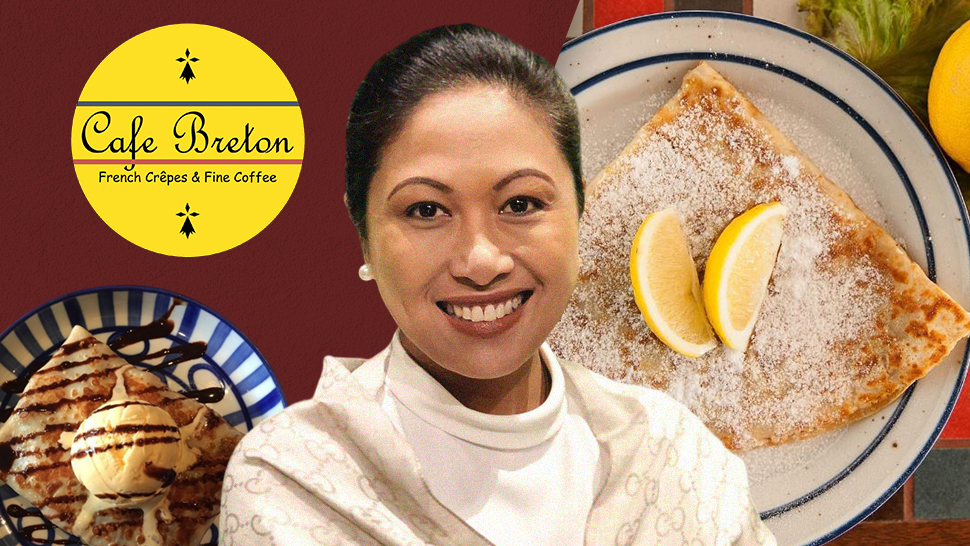
Mariela Luna-Cancio's journey from a professional interior designer to the founder of Cafe Breton is nothing short of inspiring. What started as a serendipitous turn of events eventually led to the creation of one of the most recognized local brands in authentic French crepes and desserts.
Mariela Luna and her husband Tony Cancio had been in the construction business in the late 1990s, focusing on building retail establishments like restaurants and cafes. However, their course shifted unexpectedly when a client defaulted on payments and proposed settling the dues with a coffee machine.
Instead of selling the machine for immediate cash, the couple saw this as an opportunity to venture into the café business. Despite lacking experience in running a coffee shop, the couple dedicated their time studying and researching on how to set up the business.
It was during the planning stages when the couple realized the need to offer more than just coffee on their menu. Inspired by their overseas travels, the couple decided to incorporate crepes into their offerings.
Mariela's passion for crepes eventually led her and her husband to travel to Brittany, France, the birthplace of crepes, to fully immerse themselves in the culture and hone their skills in crafting the perfect crepe.
On June 12, 1998, the couple opened their first Café Breton outlet in Malate. The response was overwhelming, and Cafe Breton has become a beloved destination for authentic French crepes and desserts even since.
Today, 25 years since its inception, Café Breton has solidified its position as the premier brand for French crepes and desserts. It has become a popular destination, renowned for its authentic French crepe offerings. With a legacy built on passion and a commitment to quality, Café Breton continues to delight customers.
How did the couple overcome the challenges of their lack of experience in the food and beverage business to become the leading crepe brand in the country? What lessons can aspiring entrepreneurs learn from the couple’s journey with Cafe Breton?
Here are the five business lessons every entrepreneur can learn from Mariela Cancio, co-founder and CEO of Café Breton:
ALSO READ
1| Know how to embrace challenges and capitalize on opportunities
Challenges often present hidden opportunities for growth and expansion. Rather than being deterred by obstacles, entrepreneurs who embrace challenges as opportunities are better equipped to pivot, evolve, and overcome setbacks.
Mariela’s ability to perceive challenges as opportunities, coupled with her resilience and proactive approach, enabled her to overcome setbacks and establish a successful business in the café industry.
When one of their big clients failed to pay and offered them a coffee machine instead of cash, Mariela and her husband saw this as a potential opportunity to explore the idea of setting up a café. This showed their willingness to step into new territories and take calculated risks.
The idea of serving crepes emerged during their brainstorming sessions. This sparked their interest, and the couple began researching and learning more about crepes as a potential menu item for their café.
Mariela actively engaged with the cooks at the Boracay establishment to learn the art of crepe-making, demonstrating her determination to overcome her lack of culinary experience. Her decision to immerse herself in the process of crepe-making exemplifies her hands-on approach to learning and problem-solving. Rather than relying solely on external solutions, she took proactive steps to acquire the necessary skills and knowledge to capitalize on the opportunities.
“I'm an interior designer by profession,” she says. “I graduated from UP Diliman. My husband was a contractor. He studied economics in UP also. So we were contractors and at that time in late 90s, they were building all these big restaurants. We were building three-story restaurants and all, and we would always wonder how much money people were putting into it and at that time, there were no little cafes then. They were all big restaurants, like Hard Rock Café, Fridays and all that. Starbucks hadn't opened yet.
“So we were building all these restaurants and we were wondering why people were willing to put up so much money and how was their ROI on that kasi they were spending so much because we could see it from the construction, right?
“So anyway, we're building, building, building and then one of our big projects failed to pay us the balance. They actually paid us once and part of the payment was a coffee machine, so we were thinking, what are we going to do with this coffee machine, you know?
“It's a machine, so maybe we can set up a little cafe, right? So if you are going to set up a cafe, what would we serve? What kind of food would we serve? Kasi it would be hard to get a chef. We're not chefs, I mean, we like to eat, we know food, but we're not chefs.
“During that time, when we were travelling, we kept coming across crepes in Europe, in Bangkok, in the States. Parang we could see the people lining up for the take-out crepe. So, this whole crepe thing kept coming up.
“And one day, we had a project in Boracay. This is the story I want to clarify, because most people are saying that Cafe Breton came from Boracay, which is technically not true. We met this French guy who had a creperie in Boracay, and it was an eight-seater kubo and it had no name, but we were there every week because we were doing construction and we got to talk to this guy.
“And then we were saying, you know what, maybe you should set up something like this in Manila and he said, ‘No, I don't want to be in Manila, but I can sell you a franchise? So sabi namin franchise, okay, what would the franchise include? Equipment, recipes, training, blah blah, so we were like, okay, so how much?
“So he gave us a price and we gave the amount, but we kept going back for months and he wasn't giving us anything. No nothing. Maybe we were thinking of a work book or whatever, right? And all his cooks were there and kami naman, we'd be hanging around. One day I just asked the cooks what's in that?
“And they were mixing so we would ask ‘Day, anong laman nyan?’ So Tony was writing down everything and then I said, ‘Pwede ba, when I'm here, can you train me? I'll cook, so we kept coming back to Boracay, back and forth, back and forth to practice.”
2| Know how to craft an authentic business concept
In a competitive market, an authentic concept sets your business apart from others. It helps you stand out amidst numerous options available to consumers. It communicates what your business stands for, its values, and its unique selling proposition to your target audience.
Mariela created an authentic business concept with Café Breton by drawing inspiration from various experiences and cultures, particularly her travels with her husband, Tony, to different creperies.
Their exploration of creperies across different regions, including Brittany, France, provided valuable insights into the origins and traditions of crepes. By immersing themselves in the crepe culture and refining their plans based on the knowledge gained, Mariela and Tony ensured that Café Breton remained true to the authentic French crepe experience.
Furthermore, their decision to locate the first Café Breton outlet in Malate, a vibrant and historic neighborhood, reflected their commitment to preserving the area's cultural heritage while offering an inviting space for customers.
By meticulously researching and tweaking every aspect of the concept, from the menu to the design, they ensured that Café Breton embodied authenticity and offered a unique dining experience to its patrons.
“During the time when we were deciding what to do with the coffee machine, I remember I brought my husband to his first Starbucks in the States in 1997,” Mariela says. “When Tony was in the store, he picked up a book. That book was called “Pour Your Heart Into it” authored by Howard Schultz, the founder of Starbucks. They were selling the book in the store and he started reading it. He was trying to read as much as he could before we finished our coffee. Because he was absorbed in reading it, I bought it, and gave it to him. That book became our de facto bible.
“That night, he stayed up reading because the whole idea of how Starbucks was built resonated deeply with him. The emphasis on treating his staff as part of the company and the heart and soul that went into opening that first branch struck a chord. He envisioned, you know, a clean, well-lit place. You know, we're very romantic.
“With the chaos of the world, you want to be able to provide a place where people can just sit and relax and enjoy the moment. So that's how it started and then we were traveling and we were cutting across all these creperies holes in the wall, some no more than holes in the wall, yet each left an impression on us.
“The crepe we had in Boracay, it was really simple. Ham and cheese, ham, egg and cheese, butter and sugar, very basic. So we researched, we went to Brittany. We were also trained by somebody who owned a creperie in one of the towns.
“We wanted to make it a French crepe kasi people would say, ‘You should make adobo crepe. You should make corned beef crepe and they were like, no, we can't because it has to be French.
“We researched in depth about this whole thing. We saw all the creperies. Crepes supposedly originated because Brittany is a coastal town, and people would use the crepe to wrap their food for the fishermen.
“So whatever information we got in France, we refined our plans based on what we learned. We researched and we tweaked everything based on what we were able to get. We said, ‘Sige we will start from that, but we'll tweak it.’
“We got the whole history of Brittany and everything, strengthened the concept, checked out the design and that's how we came up with the first Malate store. We wanted to be in Malate because, at that time, there was no Greenbelt mall.
“All these restaurants that you see with al fresco, that wasn’t there before because you would never get a Filipino to sit outside without an aircon. We knew that we could not afford to locate in mall because it was too expensive and Malate was a place we would go to all the time because it had history.
“It was artsy and the rent was cheaper, so we were actually knocking on every door on the apartments asking ‘are you renting your place?, until we finally found one and they said yes, we're renting this space. It was the ground floor and was about 75 square meters. It was one of those old apartments.”
3| Know how to bootstrap and scale a business
Scalability ensures that the business can grow and expand efficiently over time. By laying the foundation for scalability early on, entrepreneurs can avoid the need for major restructuring or system overhauls as the business grows.
Mariela and Tony utilized scrap materials from their construction projects to build Café Breton. They improvised with leftover tiles and other materials, giving the restaurant a unique and resourceful ambiance to minimize costs.
Unlike many restaurants that rely heavily on chefs, the couple developed a chef-independent concept for Café Breton. They created their own recipes, set up their own systems, and standardized operations, ensuring consistency and sustainability without being dependent on specific individuals.
Despite initial success, Mariela remained committed to continuous improvement. She constantly evaluated the business, identified areas for enhancement, and implemented changes to drive growth and efficiency.
“Back then, there were really no creperies in the Philippines. There was always pasta, sandwich, pizza and all that. The crepe was relatively new, of course, before meron na, but maybe there were some that were ahead of their time, but we felt that it was the right time and best of all, it wasn't chef dependent.
“This was something we could make on our own that we didn't have to depend on hiring a chef, and what if the chef doesn't work out? Then the chef leaves you? You know, we could do our own standards.
“We could set up the system ourselves. We could set up our own recipe. We could bring it to where we wanted it to bring and it was very standard. And knowing from Britanny, it was something that's sustainable. It’s a heritage food eh, it has history.
“We came up with the name Café Breton because Breton is what the crepe is. We serve crepes so you describe the food as Breton food. If it’s a café, it’s a Breton café. If you come from Britanny, you are Breton.
“When we started building our café, we used our scrap materials from construction. Our tiles in the kitchen had different designs with same size because it was leftover materials from our projects and the design of the restaurant eventually came together depending on what materials we had and so we put it together, you know and based from what we learned from Brittany and everything, we tried to make it look like that.
“When we opened, people were lining up in the streets. We had a 45-minute waiting time and our ROI was six months. During those days we would open at 5 p.m. and then we would close at about 2 a.m. during the weekdays. Weekends we closed mga 4 a.m. or 5 a.m. because that was the party place before.
“So after the day we go home, we wake up at 12 noon, market for that day's operations and go to sleep. Do the same thing over again because we only had so much capital for the day to day. I was cooking while my husband was the barista and the cashier. We had one extra cook. We were so full time with the restaurant so after the first year, parang okay, we said we cant do construction anymore.
It was very satisfying because it was so immediate. Somebody orders, you give the food, they're happy, they pay you, they leave. The transactions were so quick.”
4| Know how to prioritize customer satisfaction and build loyalty
Satisfied customers are more likely to recommend a business to others through word-of-mouth or online reviews. A positive reputation can attract new customers and enhance the credibility of the business in the marketplace.
Consistently delivering quality products and services helps to establish a positive brand image. A strong brand reputation sets the business apart from competitors and can influence consumer perceptions and purchasing decisions.
Mariela's focus on customer satisfaction, transparency, consistency, and integrity played pivotal roles in building trust and loyalty among customers, contributing to the success and sustainability of her business. She entered the business with genuine intentions to provide high-quality food and a pleasant dining experience for customers. This authenticity laid the foundation for building trust.
Mariela maintained transparency in her business operations, such as adopting a cash-only basis in the beginning due to high credit card charges. This decision was openly communicated to customers, reflecting a commitment to fair pricing and financial responsibility.
She also emphasized the importance of consistent quality by ensuring that portion sizes and ingredients remained unchanged over time. This commitment to maintaining standards reinforced trust and loyalty among customers.
Despite the potential for expansion through franchising, Mariela chose to keep the business private to maintain control over quality and pricing. This decision prioritized customer satisfaction over rapid expansion and profit maximization.
“In the beginning, we made sure that we would only spend what we had,” Mariela explains. “We never borrowed any money. When we started expanding, we would only expand when we had enough money for that next branch. We never borrowed anything for any branches because, you know, when you get popular, the banks will throw money at you eh. They’ll say, ‘You can borrow and open.’
“Then the malls will start courting you and say, ‘Oh, you open here and there.’ If you let your ego get the better of you, you will not make it. If a business is just about you, you can't do your business well. You have to be realistic in your expectations and you have to really know why you are in this business. If you say, I will be in business so I can be popular so people will know me, then that's not it.
“When we opened, people were saying ‘What? You're going to open a creperie? But it's just desserts and we're like, no, it's not just desserts, it's desserts and savory. Yeah, but people don't know that, so I said, ‘Well then, we can educate people.’ So in the beginning, we were serving one savory against four desserts and these people were like ‘You're never going to make it because it's not filling enough,’ or ‘It will not be a good meal.’ But this has been in France for years and years. It has been a tradition. How can it fail? If you have a good product, if it's something you want to do your best at, how can it fail? When we got into it, it was with the best intentions.
“In the Philippines, you know that most businesses depend on who you are and who your connections are, right? And it's like, ‘Oh, we go to this restaurant because it's owned by this person.’ But we were practically anonymous because people didn't know us as restaurateurs or whatever, but we did come in with the best intentions. We wanted to provide a place where people could sit and talk and eat, have a good meal and not have to feel like they've been robbed.
“In the beginning, we were cash basis only. They say, ‘Bakit cash basis lang?’ Our food naman is cheap and at that time the charges of the credit card companies were too high and our profit margins were not that high, so if we had to pay the credit card so much, it would eat into the profit and we couldn't afford it.
“Because we really wanted to maintain good prices even now, 25 years later, honestly, in the 25 years that we've been in operations, we’ve increased our prices only seven times. I think most of it happened during the past five years only because it's been crazy that the inflation has been so bad, but previously, even if things would increase, even with wage increases and everything, we would just take profit cuts.
“Do you know that I have a piece of cardboard wrapped in foil with a size? And it has to remain that size, kesyo tumaas ang itlog or tumaas ang ingredients. It has to be the same. We can never disappoint our customers. Don't cut corners. Don't take more than you should, you know?
“And that's the reason also why we've kept it as a private company. We didn't want to franchise because franchising would mean working for other people. It would mean that the basis for the business would be just to make money, right?
“Because if you sell a franchise, you owe people who bought the franchise the ability to make money. So we can't tell them, ‘Okay, we're not raising prices, profit cut muna kayo.’ Nobody will agree to that because when you buy a franchise, you expect an ROI and you want it in so many months or so many years or whatever and that's the promise. That would be too stressful. People would say, parang, ‘What's wrong with you? Why don't you want to franchise? Ayaw nyo bang kumita ng pera?’ Well, you know, it's just more complicated for us. After the pandemic, we realized that we are operating on the concept of enough. We don't have to be in every place. We don't have to be in every mall. We don't have to be the only ones who make business. There has to be room for everyone.
“It cannot be just you. You can't monopolize this whole thing, you know? As long as you keep on your toes and you make sure that you're doing your best and you're consistent then you’re pretty okay. But you can't say that you can't be in this business and be the only one who's good.”
5| Know how to balance profit and fairness
Balancing profit with fairness ensures that the business operates ethically and responsibly. By maintaining a focus on family values, businesses can achieve sustainable growth that benefits all stakeholders, including employees, customers, and the broader community.
When businesses prioritize fairness and integrity, employees and customers alike trust the company more. This trust fosters long-term loyalty, both internally with employees and externally with customers, suppliers, and partners.
Mariela's approach to balancing profit and fairness involved a combination of prudent financial management, a commitment to quality and service, fair treatment of all stakeholders, and the incorporation of strong family values into the business ethos.
She emphasized the importance of not going into business with more than one can handle and cautioned against overspending, encouraging practicality and resourcefulness.
Mariela stressed the significance of prioritizing the quality of the food served in the restaurant over extravagant decor or superficial aspects. She believed that the excellence of the food should be the primary focus. She also viewed her employees as partners and emphasized fair treatment, including timely payment to suppliers and respectful relationships with all stakeholders. She believed in treating employees well and fostering a supportive work environment.
The business owner also instilled family values into the business culture, treating her children like any other employee and teaching them the importance of hard work, humility, and respect for others.
“Never go in with more than you can handle,” she says. “Do not overspend when you start your business because people are so tempted to get the best equipment, to pay for the best thing, the best ganito, the best ganyan. Make do with what is useful and practical.
“Concentrate on the food. If it's a restaurant, it's not about, you know, there's so many vloggers and they want to make their restaurant pretty, but the food is mediocre. Make sure that if you're going to set up a restaurant, make sure that the food you're going to serve is the best that you can make it.
“You have to be fair. You have to make a decent profit, but not over. You have to treat your employees well. You have to consider them as your partners. You don't take advantage of people. You pay your suppliers as soon as you can. You respect that relationship with the supplier and then you have to learn to be happy with enough and to be able to advance, you should not have to put down anyone.
“You have to be honest. You shouldn't be afraid to work and this is not about ego. This is about service and hospitality so the most important thing are your customers.
“When my mother was alive, she used to get mad because our children would sometimes work in the store. But as trainees, they would have pins. They would wear uniforms. They would eat in the kitchen like everybody else. So my mother would get so mad and she would say, ‘Why are you treating my grandchildren as employees when they're the owners?’
Sabi ko, ‘They are not the owners. We own the business.’ This business has allowed us to make a life for the family, but this is not the children's, you know, it's not automatic that this is theirs. This allows us to have a livelihood. This allows us to support them, you know? So this is not theirs. So when my children are in the restaurants, they are not señoritos. You order, you pick up your food, you bust out your plates. You help when you need to help.
“My children, their friends don't know they own Cafe Breton because they don't use it na, ‘Let's go there and I'll treat my friends and everything. Sometimes, they'll ask for permission, ‘Mom, can my friends and I eat there?’ So they know that you're only as good as your last happy customer. Just because you're popular or successful now doesn't mean that's guaranteed. That's up to you. You have to keep working for it. You have to give keep giving people what they want.
“One thing I also expect from my customers is to respect my staff. We take care of our staff. Just because they are our servers doesn't mean that they should not be treated well. We're very particular about that. We say this is a family.”
Henry Ong, RFP, is an entrepreneur, financial planning advocate and business advisor. Email Henry for business advice [email protected] or follow him on Twitter @henryong888
