
What You Need to Know About EEI’s Acquisition of Island Cove’s Operator


Listed construction company EEI Corp. has bought out First Orient International Ventures Corp., which operates the former resort and eventually the biggest Philippine Offshore Gaming Operations (POGO) hub Island Cove in Cavite, for P2.8 billion.
To give you some context, Island Cove is First Orient's largest asset and used to be owned by the powerful Remulla political clan, which has held a stronghold grip on Cavite for decades. The family ran Island Cove as a resort from 1976 to 1985, and then again from 1998 to 2018.
The sale was made public via a disclosure to the Philippine Stock Exchange. EEI said it executed the share purchase agreement with KC Land Oriental Pacific Inc. to fully acquire First Orient and 46,806 common shares in the company.
First Orient handles about 49 hectares of land in Cavite, which covers the former POGO hub Island Cove. The company is primarily involved in acquiring, developing, leasing, and holding real properties for investment.
EEI justified the purchase as a move that would diversify its sources of revenue and would boost long-term value to its business.
“Real estate development represents a logical and timely progression for EEI. By integrating development into its portfolio, EEI strengthens its competitive position,” the construction company said. “The acquisition of [First Orient] is part of the company’s long-term growth strategy to evolve from a pure-play construction company into a fully integrated property and infrastructure developer.”
If we look at the second quarter of the year, EEI reported attributable net income of P18.34 million which is a drop from P59.77 million the same period a year earlier, but they also spent less this year.
The PSE said on Thursday that EEI shares gained four centavos or by 1.34 percent to close at P3.02 each.
ALSO READ:
Are We Playing Our Cards Right? Breaking Down Philippine Offshore Gaming Operators
How Does the POGO Ban Affect the Commercial Property Sector?
What’s the Deal with Island Cove and POGOs?
Island Cove wasn’t just used as the run-of-the-mill gaming hub; it was seen as the country’s largest POGO compound before Philippine President Ferdinand “Bongbong” Marcos, Jr. ordered all of the firms shuttered after a crackdown due to their alleged links to crimes.
A 2023 Aerial view of Island Cove
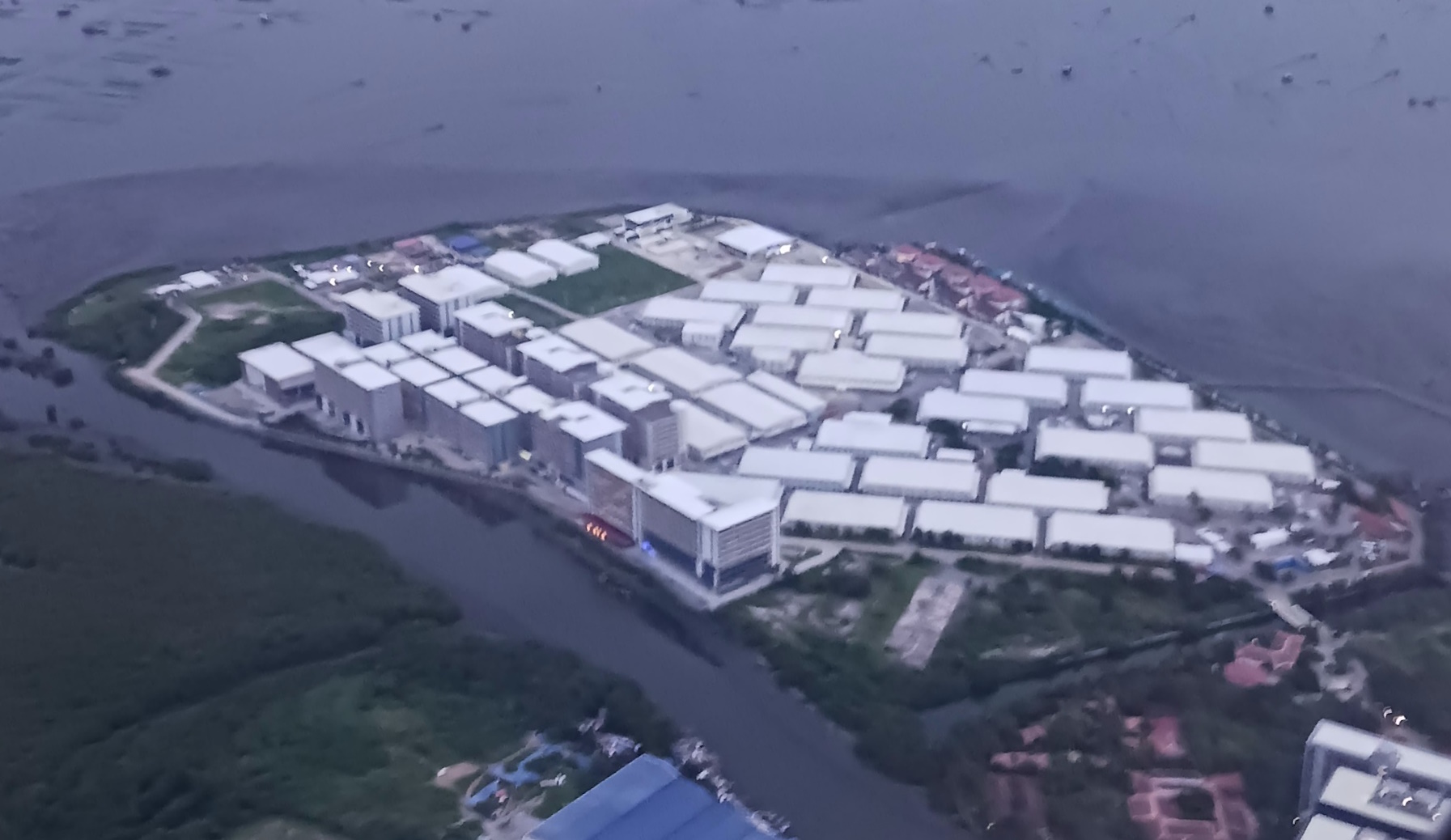
Despite their family once owning the property that was converted into a POGO hub, the newly appointed Ombudsman and former Justice Secretary Boying Remulla and his younger brother, current Interior and Local Government Secretary Jonvic Remulla, have been at the forefront of the government’s war against these illegal gaming companies.
The Remulla broters have gone after underground or “guerilla” POGO companies after the state sanctioned ban late last year, with Jonvic reassuring the public the absence of these outfits is unlikely to leave a big dent in the country’s economy.
The Interior and Local Government Chief earlier said that shuttering POGOs would only affect 0.25 of 1 percent of the country’s economic output.
Jonvic Remulla earlier said that his family sold Island cove to First Orient International Ventures Corporation in 2018, which the company then redeveloped into a POGO hub a year after, when the industry was on the rise.
In December last year, Jonvic himself padlocked the giant POGO hub in Kawit, Cavite during an operation cracking down on these firms. Both brothers have denied any involvement in the POGO hub.
Based on several news reports, Jonvic said that his family had paid around P400 million in taxes in connection to the property and that his family has not been running Island Cove since it was sold.
Jonvic had also dared anyone for P10 million to prove his family’s involvement in Island Cove’s use as a POGO hub or that the area was being protected by the Department of Justice or members of his family. A hird Remulla brother, Gilbert, is a former ABS-CBN reporter and current Philippine Amusement and Gaming Corp. director since 2022.
The Interior chief also denied Gilbert’s approval of a permit for the area to be used as a POGO hub since these were dated 2020 before his tenure as a director.
To recall, President Marcos outlawed POGOs outfits during his third State of the Nation Address amid his government’s crackdown on human trafficking cases linked to these firms.
POGOs, which mainly cater to Chinese markets, had operated under the guise of being legitimate business entities, before the government uncovered their links into illegal areas such as financial scams, money laundering, prostitution, human trafficking, kidnapping, torture and murder.
First Orient at the heels of the ban saw a P472.1 million loss last year from a P541.3 million upswing a year earlier.
Current Pagcor Chairman Alejandro Tengco earlier said that there were 298 POGO companies in 2019, with the government already whittling this number down to 17 last year.
In June, senators unanimously passed the Anti-POGO Act, which would sweep away and ban all remnants of POGO by mandating the forfeiture of all POGO-related properties and equipment to bar their reuse for illegal activities.
The government’s probe into POGO last year was in full swing after Congress raised alarm over dismissed Bamban Mayor Alice Guo and her involvement in coddling illegal POGOs in her town in Tarlac, where she ran and won for the first time as mayor in the 2022 local elections.
Guo had been accused of lying about her Filipino citizenship after the National Bureau of Investigation found that her fingerprints matched those of a Chinese national named Guo Hua Ping.
The ex-mayor and her cohorts were arrested in Jakarta in September last year after fleeing the country aboard a yacht amid a looming Senate arrest order and human trafficking complaints against her.
Under an executive order issued by ex-President Rodrigo Duterte in 2017, only Pagcor, Cagayan Economic Zone Authority, the Aurora Pacific Economic Zone Free Port Authority and the Authority of the Freeport Area of Bataan are authorized to license online gambling operations.
Lawmakers under Duterte’s term passed a law legalizing POGOs by taxing them even after alarms were sounded about the ensuing social costs. Chinese President Xi Jinping had asked his Philippine counterpart to ban POGO operations.
