
Today I Learned: James Hardie, Global Cement Manufacturing Company, Has Exited the Philippines

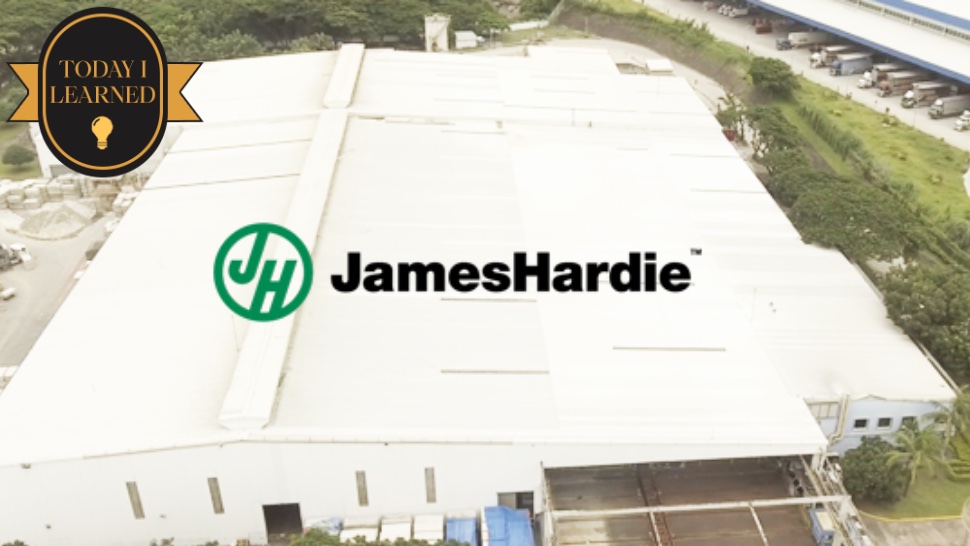
James Hardie, the global manufacturer of fiber cement products and other building materials, has officially exited the Philippines. The company, which was founded in Australia but is headquartered in Ireland and is publicly listed on the New York and Australia stock exchanges, announced that it has shut down its fiber cement board plant in Cabuyao, Laguna, which effectively ends over two decades of operations in the country.
In a statement, the company said it would cease all commercial operations in the Philippines in the coming months.
“(W)e continue to innovate to compete and win against brick and masonry,” Aaron Erter said during an earnings call with investors last August. “The concept of right to win is integral to where our efforts and resources should be focused to drive future value, and that is why today we announced our intention to exit the Philippines market. We conducted a thorough review and ultimately determined that operating in the Philippines was not consistent with our value creation strategy. This was a very difficult decision, but it is the right decision for James Hardie.”
ALSO READ
Is Holcim Philippines Delisting from the Stock Market?
Cement Wars: Why San Miguel’s Planned Takeover of Holcim Philippines Collapsed
James Hardie in the Philippines
James Hardie is well known in the Philippines for its products like Hardieflex fiber cement boards, which are mostly used for residential walls, ceilings, eaves, and cladding. Hardieflex is made from cellulose fiber, Portland cement, sand, and water.
James Hardie was founded in 1888 in Melbourne, Australia. It first made its presence felt in the Philippines in November 1996, when it formed a joint venture company with Jardine Davies to build a $50 million cement manufacturing plant in Cabuyao. The company was two-thirds owned by James Hardie while the remaining one-third was owned by Jardine Davies.
While James Hardie handled construction and operations, Jardine Davies assisted in sales and marketing. During the period when the plant was being built, James Hardie exported up to 10 million standard meters of its Hardiflex products into the Philippines.
Later that same year, James Hardie bought out Jardine Davies’ stake in the joint venture so it would fully own its fiber cement venture in the Philippines. Reports said James Hardie paid about $22 million for the one-third stake.
The fiber cement manufacturing plant opened in 1998 and produced about 20 million standard meters annually. James Hardie was one of the first to introduce the product to the Philippines and so it launched a major consumer advertising campaign to promote its products in the local market. It also hired and trained up to 3,000 carpenters and customer assistants in retail outlets.
A second manufacturing facility opened a few years later, also in Cabuyao.
Throughout the 90s and 2000s, James Hardie established its business in the Philippines and forged partnerships with many of the country’s top real estate and housing developers. The company was instrumental in promoting the use of alternatives to plywood as a building material in the country.
In the first quarter of 2024 (which for James Hardie ended in June 2024), the company reported overall net sales of $992 million, and net income of $178 million, up four percent and two percent from the same period the previous year.
The company issued a statement about the cessation of its manufacturing operations in the Philippines and did not elaborate on the reasons for the exit. However, in its earnings report, the company posted a two percent decline in net sales driven by lower volumes of nine percent versus the same period last year on its Asia Pacific Fiber Cement Segment, which includes Australia and New Zealand in addition to the Philippines.
“We came to the conclusion, as I said before, that we couldn’t see any long-term value creation (in the Philippines),” Erter added. “It’s been a nice business for us. We have a great team there. But if I think about resources, right, and where we have the right to win and we’re going to get our greatest return, I felt that we could take those resources and put them elsewhere.”
Interestingly, a Thai fiber cement company called Shera is currently building a new manufacturing facility in Mabalacat, Pampanga. According to reports, the plant has reached about 60 percent completion and is expected to be operational by the first quarter of 2025.
Shera’s P2 billion investment in the Philippines includes the construction of the 250-hectare facility is designed to produce up to 240,000 tons of fiber cement. When completed, it would be the first Shera production hub outside of Thailand.
