
Financial Adviser: 5 Business Lessons Everyone Can Learn from Lorna Cruz-Ambas, CEO of Abe Restaurant and The LJC Group

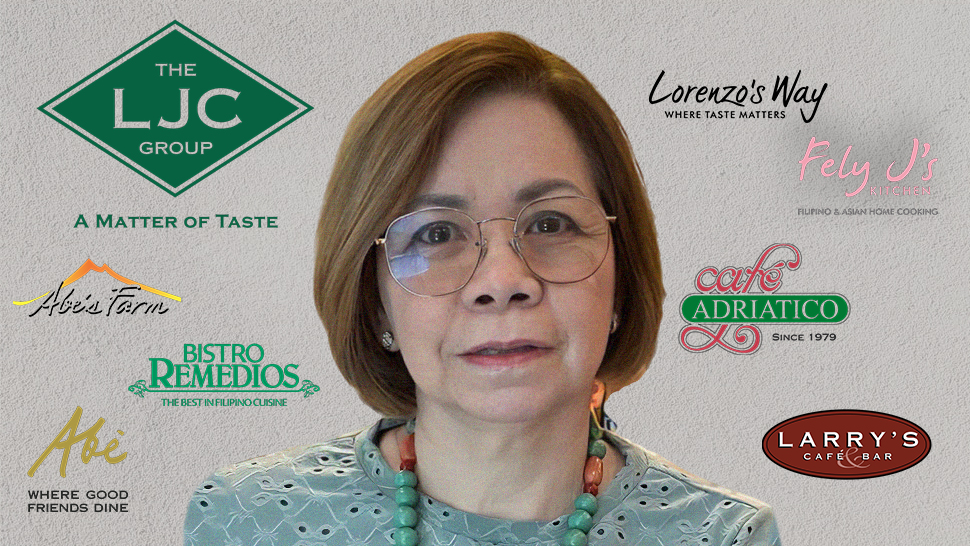
The late Lorenzo “Larry” J. Cruz was an entrepreneur, journalist, and lover of art and food who made a lasting impact on the culinary scene in the Philippines. His transition from journalism to the world of food showcases the perfect blend of passion, creativity, and an entrepreneurial mindset.
In 1979, Cruz began his culinary adventure by converting his art gallery in Malate into a cafe. It all started with a suggestion from a foreign client that inspired Cruz's imagination. He envisioned a lively place where art, culture, and food would come together harmoniously. The café, named after the street it was located on, became known as Café Adriatico and quickly evolved into a hub for locals and art enthusiasts alike.
The success of Café Adriatico inspired Cruz to introduce a variety of dining spots over the years, including Bistro Remedios, Prego, Afrodisia Grill, Solana, Bollywood, and more. At one point, Cruz's restaurants expanded to as many as 50 outlets. However, in 2008, complications from cancer led to Cruz's passing at the age of 66.
Following the unfortunate passing of Cruz, his daughter Lorna Cruz-Ambas took on a leadership role in the company, carrying on her father's culinary legacy. Under her guidance, the LJC Group flourished, becoming a prominent player in the Philippine restaurant industry and heralding a revival of Filipino cuisine.
The LJC Group's portfolio features a diverse range of renowned dining destinations, including Abe, Bistro Remedios, Cafe Adriatico, Cafe Havana, Fely J's Kitchen, Larry's Cafe & Bar, Lorenzo's Way, Larry's Bar, and Abe's Farm. Each establishment embodies the values of culinary expertise and warm hospitality that define the LJC brand.
As Cafe Adriatico celebrates its 45th year and Bistro Remedios its 40th, the legacy of Lorenzo Cruz thrives, resonating with both loyal patrons and new visitors. Despite the passage of time, the essence of Cruz's culinary vision remains tangible, infusing each restaurant with a sense of history and nostalgia.
What strategies did Lorna Cruz-Ambas implement to maintain the quality and reputation of her father's culinary legacy? How did she innovate within the LJC Group to adapt to changing consumer preferences and market trends?
Here are the five business lessons every entrepreneur can learn from the owner and CEO of LJC Group:
ALSO READ
1| Know how to transform challenges into opportunities
Entrepreneurial success often hinges on the ability to adapt to changing circumstances. By transforming setbacks into opportunities, entrepreneurs demonstrate their flexibility and willingness to adjust their strategies to meet the demands of the market.
Resilience also allows entrepreneurs to maintain a positive mindset even in the face of adversity. Instead of dwelling on setbacks, resilient individuals focus on finding solutions and adapting their strategies to overcome obstacles. This positive attitude enables them to stay motivated and determined to achieve their business goals.
Despite initially lacking experience in the restaurant business, Larry Cruz seized the opportunity presented by a foreign customer who proposed the idea of opening a coffee shop in Cruz's antique store.
Instead of shying away from the unfamiliar territory of the restaurant industry, Cruz embraced the challenge and agreed to collaborate with David. Despite the setback of David's sudden departure due to personal reasons, Cruz remained resilient and determined to make the venture a success.
Cruz's ability to adapt to unexpected changes and turn them into opportunities was evident in his resourcefulness. He utilized his family's expertise in supplying various products for the café, including chocolate, embutido, longganisa, and cakes.
By leveraging his network and connections in the media industry, Cruz attracted early patrons to Café Adriatico, laying the foundation for its success.
“It was my dad, Lorenzo Cruz, who started the business,” Lorna Cruz-Ambas says. “When he started Café Adriatico, I had just graduated from college, I think, and started working for a firm in Makati. He never really intended to do this because he was working with the government. He was with the Marcos administration as an Assistant Press Secretary under Kit Tatad. Prior to that, his line was journalism. He used to work with DZHP and also with Editorial Associates, doing magazines and other stuff.
“We had so many antiques kasi because he loves them. He used to collect like my grandfather, Emilio Cruz. They would always scour for antiques, maghahanap sila, clean them up, and put them in.
“My grandfather is also a painter. It got to a point that we couldn’t find any space anymore for all the antiques they had collected. So he thought of renting a space na naging antique store, where Café Adriatico now stands. It was called Collection K.O. Koleksyon at iba pa where all his antiques were housed and some of the paintings.
“One day, there was a guy, a foreigner, who approached him when he was there in the store and asked him why don’t we put up something here like a coffee shop? Ang sabi nya agad, I don’t know the first thing about the restaurant, but this foreigner, his name was David, he managed to convince my dad. He said, ‘I’ll take care of everything, we will set up, I’ll help you with it and we will be partners.
“So at that time, the idea of having a coffee shop was attractive because there were no decent coffee shops anywhere then. If you wanted a decent coffee shop, you go to a hotel. And so he agreed, so this David started to put everything. Inayos nya lahat and then he used my dad's furniture, the antiques, so the tables, the chairs, everything. And then there’s this iconic Eagles sculpture by the bar. Yan ang nangyari.
“When we were about to open and my dad was hospitalized, David visited him in the hospital to say, ‘I’m sorry I have to go.’ Beachcomber kasi 'yun eh, so he had to go do whatever. He let go of his share of the business even before the shop opened. ‘Can you just buy me out?’ So, yeah. They agreed to part ways. Now, we were stuck with the restaurant that he didn’t know anything about.
“This was in 1979. Hindi naman namin alam how to source. It was really more of a family business. My mom was the one supplying chocolate because that was from their family recipe, and then my dad talked to my Lola who supplied embutido, longganisa. Ganon lang, and then, I was the one supplying the cakes. I was doing some home baking and so dun lang kami nagsimula.
“It was already his happiness kung mag break even siya, kasi naman andun na eh, but I guess the early bloggers or influencers, you can could call them at that time, were his media friends, because of his work in the media industry. He knew a lot of newspapers and they were the ones who actually patronized the store. After their work, dun na nagpupuntahan. That's how it started.”
2| Know how to drive growth with passion
Passion serves as a driving force that ignites motivation and determination among entrepreneurs, especially during challenging times. It fuels creativity and inspires entrepreneurs to innovate in their products and services, leading to a competitive edge in the market.
Moreover, passion enhances the authenticity of the brand. Customers are naturally attracted to businesses led by passionate entrepreneurs who wholeheartedly believe in their mission and values.
Larry Cruz demonstrated his passion in business through his relentless pursuit of expansion and innovation. His passion for creating memorable dining experiences led him to establish multiple restaurants, leveraging his diverse experiences and exposure from his travels.
Cruz reinvested profits from successful ventures like Café Adriatico into new restaurant concepts. His passion for establishing food businesses, coupled with a keen eye for location and the willingness to adapt fueled his entrepreneurial spirit and paved the way for the establishment of up to 50 restaurants.
"To his surprise, it was a hit, but at that point, he was still working with the Department of Information,” Ambas says. “He never let go of his job. I guess it was a challenge for him. Maybe he loved what turned out, yung parang sabi nya, 'Oh, I'm enjoying this and all.' So he thought of putting up another one, at the other end of Malate. It was a much bigger place, probably double the size of the first restaurant.
“This time around, maybe he thought of it as an exit from the government. It was a mild success, but then the municipality of Manila decided to excavate and fix the roads, so we were closed for some time. He kept it on, even if it was a bit of a struggle, and then he set his sights on another place somewhere in P. Burgos in Makati, called Bistro Burgos. By this time, he asked me na to resign and help him out in 1982, so that's when I joined him, but I didn't have any training at all in the restaurant industry.
“When we started Café Adriatico, I would just go there and I would just supply the cake. That's it. I didn't know much. So when I started, I worked at the back of the house, from the stockroom to receiving everything, I did everything except actually cook because I didn't know how to cook. My dad can't cook either. Imagine having several restaurants and not knowing how to cook. But he had a very good taste and a palate of a Kapampangan. He was really exposed. So that's how I started, and I never looked back
“My dad put up other concepts because he had this exposure when he was in government. Ang dami nyang travels, ang dami niyang lugar na napuntahan, so he had many concepts and ideas. And I think he was challenged with the success of Café Adriatico at that time.
“Café Adriatico was doing well and whatever proceeds from the one restaurant, he would put in as reinvestment to put up another restaurant and marami siyang natayo na restaurants from Bistro Lorenzo to Ang Hang. I think he put up like 50 restaurants.
“He just loved creating. At one point, we had Café Adriatico along the circle, we had three or four restaurants doon. At that time, it wasn't hard because it was easy to manage since that was the central hub. So, it was just a walk across the street and there we were. Maybe he was just quite lucky, he had the Midas touch. But I don't recall having done any market research or whatever, you know. So, what was important to him is the location, location, location. It’s still always location.
“He hired professionals and consultants to assist him because he knew that he didn't like to pore through the numbers and such. He just wanted to create. Ang sabi ko nga, he just loved what he was doing, so he never really minded whether a venture was making money or not. In his mind, if one venture didn't work, he would reinvent it or create another concept to take its place, parang ganon. So I guess siguro kaya hindi din ganun kamahal yung investment kasi andun na eh, just a little tweak.”
3| Know how to blend tradition and innovation
In a competitive market, restaurants must stay relevant to remain successful. Innovation ensures that restaurants evolve with changing trends and customer expectations while still maintaining the essence of their traditional dishes.
Larry Cruz successfully balanced tradition and innovation by creating restaurants that honored their heritage while embracing innovation to meet the evolving needs of their customers.
The journey began with the establishment of Abe, a Filipino restaurant with a Kapampangan twist, inspired by the illustrious background of his father, after whom the restaurant was named. Abe celebrated Kapampangan cuisine and culture, staying true to its roots by hiring Kapampangan chefs and offering authentic dishes that reflected the region's culinary heritage.
Building on the success of Abe, Cruz also decided to launch Fely J’s Kitchen, named after his grandmother, who frequented their restaurants and had a penchant for cooking. Fely J’s Kitchen continued the tradition of honoring family members while introducing innovative Filipino dishes with Asian specialties.
“I guess Abe was close to his heart,” Ambas says. “There were a lot of other themed restaurants, but I think he realized, he saw the opportunity. There was no proper Kapampangan restaurant, the kind that they would all go to. In fact, the one that everyone went to was far away.
“Sabi nya, ‘Let's put up a Filipino restaurant; a Filipino restaurant, Kapampangan style.’ Yes, Kapampangan, and it was easy because we had a lot of material, a lot from my grandfather's paintings. I should mention that my grandfather was very much involved because he was a painter and magaling mag-drawing yun.
“So, he put up Abe to sort of honor the memories of his father. Abe was a painter, a diplomat, because he was also an ambassador extraordinaire for UNESCO. At some point, he was also a writer. He was an editor of The Daily Mirror for the longest time, so his background is illustrious. That's how Abe came about.
“When we opened Abe, we were surprised because we weren't really sure at first if that was the right market, kasi across ito ng Market, Market eh. And we were actually the first to open in that area. We were all surprised that it was such a big hit. We hired Kapampangan chefs, and of course, the direction was from him kasi he was a Kapampangan talaga so alam nya. And by that time, he already knew what could be done.
“Seeing the success of Abe, he decided to name his next restaurant Fely J’s Kitchen. Fely J, being his mom and my Lola, used to frequent his restaurants. In fact, she was a fixture in Café Adriatico in Malate kasi everyday she would go to mass in Malate church, and so she would stay there. She had a favorite spot in the restaurant. Mahilig siya sa baboy, magaling din magluto ang lola ko. So ang gusto ng Dad ko was to honor her naman.
“I think, at one point, the staff in Café Adriatico made her a Lola Ising’s Adobo, and that's how one of the specialties of Café Adriatico evolved, with lots of garlic and everything. So tuwang tuwa sya. Syempre, it was in her memory. The "J" stands for De Jesus in Fely J’s name. She was also a writer. She had a book, and she was a member of the Board of Censors before.
“Abe is Kapampangan, definitely, so we only serve Kapampangan food. However, there was a portion that reflected his travels with my grandfather, where he introduced some dishes to schools and some of his friends during his travels. It was just a small section on the menu. Eventually, we had to remove it because we wanted to focus purely on Kapampangan food. Fely J’s is different. It's also Filipino, but with Asian specialties.”
4| Know how to preserve a legacy while maintaining quality
A legacy represents the accumulated reputation and goodwill earned over time. By maintaining quality, businesses uphold the positive image associated with their legacy, ensuring that customers continue to trust and patronize them.
Ambas prioritized maintaining the quality of food and service across all outlets, as her father was known for it. This commitment ensured that customers continued to associate the restaurants with high standards even after her father's passing.
She also implemented consistent training programs for chefs and staff to ensure that the quality of food and service remained consistent across all outlets. The use of the same team for new restaurant openings helped maintain continuity and uphold the established standards.
By introducing new dishes through rigorous testing and evaluation, she ensured that the menus remained fresh and appealing to customers while staying true to her father's original mission of providing top-quality food at reasonable prices.
“After his passing, I looked at our successful outlets, especially Abe, and considered starting to expand into other areas,” Ambas says. “The first one that we opened was in Megamall, and fear namin nun that it might diminish the customer base in Serendra, but it had its own separate market with its own customer base.
“Number one, I really wanted to preserve his legacy and keep all of these restaurants. So, the challenge was to maintain the quality he was known for it. We didn't want the quality of the food or service to suffer. Yun ang first order ko because I didn't want people to say that, ‘Nawala lang si LJC pumangit na yung service, pumangit na yung pagkain,’ so yun ang aming talagang tinutukan at that time.
“And keeping LJC's restaurants in the consciousness of the people, we felt that maybe it's time to branch into different areas. We expanded into Alabang, Mandaluyong, and even Mall of Asia. We took a hard look at the outlets because my dad loved all of his restaurants, and maski hindi kumikita, ayaw nya talaga i-give up. When he felt like throwing in the towel, he would think of something else.
“The first thing we did was to examine the outlets of other brands. We closed it down if it’s not profitable and turned it into another Abe. That's what we did. I have to admit naman, I told my dad before, ‘Dad, I don't have your creativity. I can't just think of a concept, right top of my head ganito and see it through.’ I knew my limitations, but at least there was an opportunity, so I grabbed it. That's all I had in mind.
“And then, of course, we have professionals. My dad put up the entire setup with experts and professionals in their field. So it made my job easier. We recognize that we need these people to run it kasi hindi na pu-pwedeng yung mga ginawa namin when we started Café Adriatico.
“We already have an executive chef, and we are constantly training our chefs to ensure that the quality remains consistent. When we open a new restaurant, we utilize the services of the same team; we don't hire a different team.
We select people from each restaurant who are familiar with the taste and how to prepare dishes, as well as the brand of service we want for the restaurants. This is the LJC way, as we call it: to ensure that the food quality is consistent across all our establishments. When we open new restaurants, I didn't want the customers to say, ‘mas masarap ang pagkain dito kesa doon.’
“We also had to strengthen our commissary. By this time, we already had one, which made it easier because certain dishes could be cooked there and then sent to the different outlets. We did this gradually, and we regularly reviewed the menu to see which items were frequently ordered, which were the best sellers, and which were the least popular.
“We would then make changes accordingly and challenge our chefs. During meetings, especially with the executive chef, I would ask why certain dishes tasted different in different locations. They would each bring their version of kare-kare, for example, and we would discuss the differences in taste and flavor profiles. Wala kaming ginawa kundi taste test, nagpapa-food test kami lahat. Yun ang ginagawa namin.
“We also wanted Abe and Fely J’s to have their own identity. So hindi pu-pwede that if they create a new dish here, they introduce it for all the brands. Why? So, at least quarterly, our executive chef would come up with new dishes that would go through a series of food tests. Before they pass, there are many tests conducted.
“We test it, and then we start the process when everything is in order, including all the costings kasi what I always do is keep in mind the mission that my dad had from the beginning. He wanted to serve the best quality food with reasonable pricing and in a delightful setting. The ambiance is important to him.”
5| Know how to expand strategically without overextending resources
Growing wisely with controlled expansion is crucial for businesses to achieve sustainable growth while minimizing risks. When expansion occurs in a controlled manner, companies can maintain stability and conserve resources. This prevents the likelihood of overextending financial or operational capacities, which can lead to instability and potential failure.
Ambas adopted a cautious approach to opening new restaurants. Unlike the rapid expansion strategy employed by her father, she opted for a more measured and deliberate approach. Instead of opening numerous restaurants at once, she focused on establishing a strong foundation for each new outlet.
She also emphasized the importance of keeping the restaurants relatively small. This decision helped maintain operational efficiency and prevented overextension of resources. Additionally, she strategically chose to open new outlets only in malls, recognizing that malls attract higher foot traffic compared to standalone locations.
Learning from her father's emphasis on quality and service, she prioritized maintaining high standards across all aspects of the business. She refused to compromise on quality, ensuring that every dish served and every customer interaction met the established standards of excellence. This commitment to quality helped build customer loyalty and trust in the brand.
“We didn't want to follow the pace that my dad did before, na opening restaurants left and right,” ambas explains. “So, slowly but surely na kasi established na kami. We just wanted to make sure that we keep the people interested. Siguro at least one restaurant or branch a year. Before, we used to open two. However, the problem was we didn't want to stretch the resources of the company.
“What we're looking at now is to keep it small and not go beyond 200 to 220 square meters. We also recognize that we only open in malls because that's where the people are now. You can't rely on the 'If you build it, they will come' idea anymore because sometimes local agencies and municipalities pose problems like parking and low foot traffic, so that's also a consideration.
“I've learned a lot over the years from my father. I started by cleaning tables and doing cashiering, so parang he made sure that I knew the ins and outs of everything, including the costings. One of the things he would keep telling me was to never compromise on quality and service. He would always get upset with the staff pag sinasabing ‘pwede na ito.’ Hindi pwedeng ‘pwede na.’ Kailangan masarap. He couldn't stand mediocrity.
“And also, I guess discipline and being hands-on were important to him. He enjoyed seeing people, and he was there until the wee hours of the morning. Treating customers well was really important to him because, you know, customers are everything.
“Being in the restaurant industry, you always have to deal with customers. He taught us early on na kapag merong complaints to deal with them directly; huwag kang magtago kasi it could lead to bigger issues later on. Also, he also emphasized treating your employees as partners because they worked night and day.
“So I have to keep them happy. If they're not happy, then it shows in the way you conduct their business. Those were some of his life lessons, and they're valid. Enjoy what you're doing kasi if you're not happy, why do it at all?
“When it comes to handling money, ako yung mas mahigpit sa kanya, lalo na sa budgeting kasi I saw him create lang siya ng create tapos kami naman ang namomoblema where to get the money. Ayaw namin na turned off yung mga partners because of financial issues, so kailangan by hook or by crook maghanap ka ng pera.
“At that time, we were cash-strapped because we had many restaurants open, pero hindi naman lahat kumikita. So yung importanteng life lesson na natutunan ko is you don’t go into any business without sufficient capital.”
Henry Ong, RFP, is an entrepreneur, financial planning advocate and business advisor. Email Henry for business advice hong@financialadviser.ph or follow him on Twitter @henryong888
