

Financial Adviser: 5 Business Lessons Everyone Can Learn from 'Frozen Yogurt King' Nestor Bonoan, Founder and CEO of BTIC Better Than Ice Cream

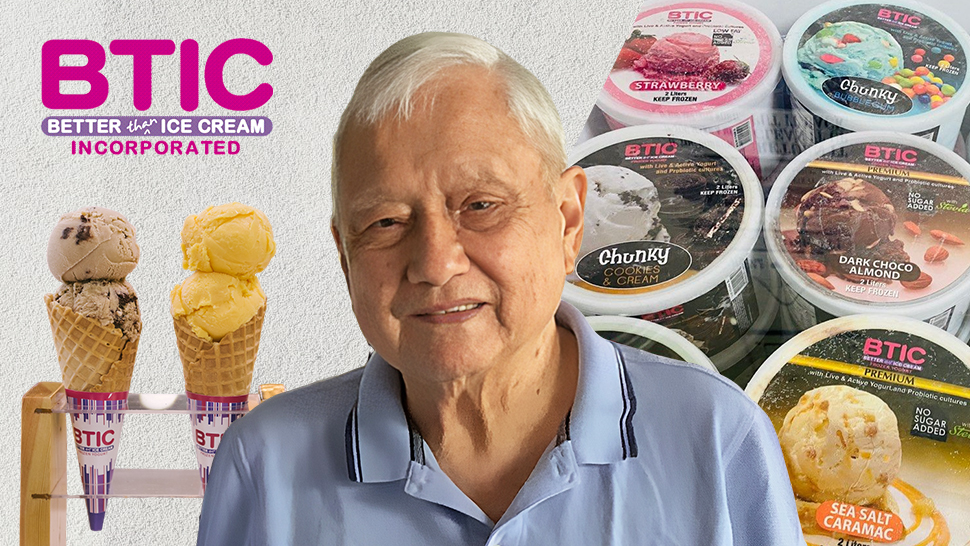
Nestor Bonoan's story is one that exemplifies the resilience and tenacity required to succeed in the face of adversity. Rising through the ranks as a successful banker, Bonoan's story took an unexpected turn when a heart attack in the late 1980s led him to discover a new passion that would eventually shape his legacy in the food industry.
At the age of 47, at the height of his corporate success in 1986, Bonoan suffered a heart attack that necessitated a double bypass operation. This health scare not only posed a threat to his well-being but also compelled him to reconsider his priorities and future endeavors.
During his time recovering in Honolulu, Hawaii, Bonoan's children would often bring him to a nearby frozen yogurt ice cream shop. At the time, yogurt ice cream was not that well known in the Philippines. This gave Bonoan an idea to consider bringing a healthier ice cream option to the Philippines.
Bonoan then tried to explore franchising options with American brands but encountered several rejections because of the prevalent political instability in the Philippines during the late 1980s.
Undeterred by these setbacks, Bonoan pursued alternative paths to realize this vision. In 1990, at the age of 51, he established his own yogurt factory in San Juan, which marked the inception of Better Than Ice Cream (BTIC), specializing in soft-serve yogurt ice cream.
Today, after more than 30 years, BTIC is the leading and highly regarded brand for authentic yogurt ice cream, serving a discerning clientele with a strong focus on health-conscious consumers. Bonoan's steadfast dedication and innovative approach have cemented BTIC's reputation for premium quality and unparalleled taste.
Despite facing significant personal and professional challenges, including a second heart bypass in 1998, Bonoan's legacy reminds us that with unwavering courage and resilience, even the most formidable obstacles can be transformed into remarkable opportunities for growth and success.
How did Bonoan shift from a thriving corporate role in the banking industry to establish himself as a prosperous entrepreneur in the yogurt ice cream sector? What lessons can aspiring entrepreneurs learn from Bonoan's journey?
Here are the five business lessons everyone can learn from Nestor Bonoan, founder and CEO of Better Than Ice Cream (BTIC):
ALSO READ
1| Know how to capitalize on entrepreneurial opportunities
Identifying business opportunities enables entrepreneurs to capitalize on emerging trends, changing consumer demands, and market gaps, enabling them to stay ahead of the competition. It fosters innovation and the development of new products or services that can meet the evolving needs of consumers.
Bonoan's journey from corporate banking to entrepreneurship was spurred by a series of events that prompted him to recognize untapped business opportunities. His experience in the banking sector, coupled with personal health challenges, led him to discover a potential market gap that he could leverage.
Following his tenure at Bank of Hawaii and the health scare he encountered, Bonoan's exposure to frozen yogurt in Honolulu became a pivotal moment. Recognizing the absence of this product in the Philippines, he saw an opportunity to introduce it to the local market.
This realization inspired him to explore the possibility of obtaining a franchise from various frozen yogurt companies in the United States, marking his initial steps towards entrepreneurship in the food industry.
Bonoan's ability to spot an unmet consumer demand, coupled with his past entrepreneurial experiences and his drive to seize opportunities, played a critical role in his successful transition from corporate banking to entrepreneurship.
“I used to be a banker,” he says. “I started my banking career with Citibank, and then I joined a local bank. From there, I was hired by the Bank of Hawaii to manage their offshore banking unit here in Manila. But after the assassination of Aquino, we stopped lending and my superiors at Bank of Hawaii suggested for me to go to Honolulu and spend a couple of years there.
“I was working with Bank of Hawaii in our head office in Honolulu, managing the international credit analysis of our clients. And then in 1987, I suffered a heart attack. I was only 46 years old at that time. According to the doctor, I must have suffered a heart attack, which I mistook for indigestion because they noticed that my heart had already been damaged.
“I had a heart bypass at that time. I was very fortunate. I was in Honolulu because in Manila there was no heart bypass being done, and even in Honolulu, there were only a couple of doctors who had done a quadruple bypass.
“So I had my quadruple bypass, but six months after, two of my bypasses occluded so, but the doctors decided not to operate on me again because they thought I could not handle a second heart operation so soon. They gave me a 24-hour medication and suggested that I do some regular exercises, and that was walking.
“When I was in Honolulu, the doctors prohibited me from eating very rich ice cream and steak and those kinds of thing because of the high cholesterol. So my children, who were at that time already familiar with a frozen yogurt company in Honolulu, dragged me in there and had me taste the frozen yogurt and I liked it.
“The name of the brand was The Country's Best Yoghurt or TCBY. I liked it so much that when I returned to Manila, I wrote to all frozen yoghurt companies in the US, about seven of them in total, because I did not know how to go about making frozen yogurt so the natural thing to do was to write these seven companies for a franchise.
“I was always entrepreneurial on the side. Even before the frozen yogurt company, my wife and I also built up a toy manufacturing company and children's furniture company, which was doing very well except that the factory burned down and, at that time, wooden factories were not insurable, so we decided to abandon that.
“I always thought that eventually I would quit the corporate world and just manage a business that I would set up myself.
“Because (frozen yogurt) was very, very popular in the United States, I thought that there's no reason why it wouldn't catch on here in Manila.”
2| Know how to thrive when faced with challenges
Knowing how to convert setbacks into breakthroughs is crucial for personal and professional growth. Resilience, innovation, and a growth mindset are key aspects of this process. Converting setbacks into opportunities not only builds resilience but also fosters creativity, enabling individuals to develop new solutions and approaches.
Facing initial rejection from several yogurt companies due to the country's political instability in 1988, Bonoan took the proactive step of exploring an alternative route. Recognizing the potential of frozen yogurt in the Philippines, he took the chance to study the manufacturing process through an intensive course at Penn State University in the U.S. by enrolling his daughter and his wife.
With a focus on health-conscious consumers, Bonoan positioned his brand as a pioneer in offering no-sugar-added frozen yogurt, setting his business apart from his competitors. This unique market positioning helped him establish BTIC’s presence and credibility in the industry.
Even amid increasing competition from US-based frozen yogurt companies, Bonoan's visionary approach and proactive measures allowed him to remain ahead of the curve, solidifying his position as a trailblazer in the frozen yogurt market.
“At that time, frozen yogurt was introduced in the US and became very, very popular, so I wrote all seven yogurt companies in the United States to ask for a franchise here in Manila, but this was in 1988 at that time, there were seven coups here in a period of one and a half years.
“Many of them considered the Philippines to be unstable, and they turned down my application for a franchise. So, I did the next best thing. I had read in the Asian Wall Street Journal that there was this Penn State University in Pittsburgh that ran an intensive course on ice cream and frozen yogurt manufacturing.
“I enrolled my daughter Pie, who was working in LA after her graduation from Honolulu at that time. I asked my wife and my daughter to take this course. I enrolled them in this course at Penn State University, where they learned how to make frozen yogurt and the technical aspects involved. However, it took a long time after they completed the course for them to experiment with developing flavors that were palatable to the Filipino taste.
“I was more involved in the financing and the acquisition of equipment. So, we bought a 570-square-meter property in San Juan with an old house. We remodeled and developed it into the factory, and that's where the factory stands now.
“At that time, our first set of equipment was second-hand from the United States. Very early on, we decided to target the health-conscious segment of the population.
“Apart from the fact that frozen yogurt itself is a healthy product, we decided to introduce it with no-sugar-added flavors. We were the first to do this in the country, even ahead of major brands like Magnolia or Unilever. We developed this line and gained recognition in the market as a producer of no-sugar-added frozen yogurt.
“Ever since the 1980s, when frozen yogurt exploded in the US, there were actually several people who attempted to bring it here. It was a matter of who would be the first in the market, and we were the first ones.
“For a couple of years, the US frozen yogurt companies hesitated to enter the market. By that time, they decided to come here, but I was already established. As a matter of fact, TCBY attempted to establish a business here, but they did not succeed. People thought that we copied them, but they actually copied us.”
3| Know how to adjust business strategies in response to market changes
Being adept at revising business strategies enables companies to remain relevant, competitive, and resilient in the face of unpredictable market shifts. This ability allows businesses to capitalize on emerging opportunities, mitigate risks, and maintain a strong position in the market.
Flexibility and agility in adapting to changing market conditions enable organizations to align their offerings with customer needs and preferences, fostering customer loyalty and enhancing overall business performance.
Bonoan adapted his business strategies by leveraging a new machine called the batch freezer to address operational challenges and expand product offerings. This strategic move capitalized on consumer preferences and improved the overall shopping experience, leading to increased sales and customer preference for the scoop option.
As the market landscape continued to evolve, Bonoan responded to the proliferation of competitive offerings of cheap frozen yogurt and escalating mall rental costs by pivoting their focus towards supermarkets. This shift in market concentration enabled them to capitalize on a more favorable cost structure and capture a broader consumer base.
Moreover, the strategic placement of stores in medical facilities and hospitals strategically aligned their product with the health-conscious recommendations of doctors, enabling them to tap into a specialized market segment and drive further growth and profitability.
“We started out with soft serve frozen yogurt ice cream in Park Square. We were the first to offer it and it was doing very well. We had three machines, but it was very difficult to operate because you're limited with the flavors.
“At the time, we were offered by our supplier a new machine called a batch freezer. They were testing it and they offered it to us because nobody was buying it, and when we got it, we started experimenting on flavors.
“Because it took a long time to fill up a half gallon or a pint with just a soft serve machine, we got this batch freezer, which allowed us to package our frozen yogurt in pints and make it easy for us to scoop out.
“And we realized that it was selling a lot faster than soft serve because people couldn't see the flavors from the soft serve machines. All they could see was the stainless steel machines, while with the batch freezer, the flavors were displayed in the cabinet, and you could see several flavors and colors.
“Very quickly, we were able to develop a lot of different flavors. When people see it, they have a choice, so they prefer the scoop. Then, several years later, there were many soft-served cheap yogurts that were offered, claiming to be yogurt with additives like chocolate and strawberries. We don't know whether it's yogurt, but they advertise themselves as yogurt.
“Over the years, with the onslaught of competition from cheap frozen yogurt and the rising rental costs in the malls, we decided that maybe we were better off just concentrating on the supermarkets.
“We also put up stores in the medical facilities and hospitals where the doctors are, because that fits in very nicely with us. The doctors are very familiar with the benefits of frozen yogurt, so they recommend our frozen yogurt to their patients, particularly those with stomach problems. Frozen yogurt is very good because it contains beneficial bacteria to counter the harmful bacteria in the stomach.
“It was only after we built up our frozen yogurt presence in supermarkets and hospitals that we began to become more profitable.”
4| Know how to create a high-quality product and build a premium brand identity
In a highly competitive market, a premium brand and quality products can serve as a crucial differentiator. They can help a business stand out from the competition and attract discerning consumers who prioritize superior products and experiences.
A strong brand identity can also command higher prices, enabling businesses to establish themselves in the market as providers of value and excellence. This can contribute to increased profitability and sustainability in the long run.
A high-quality product fosters customer trust and loyalty, leading to repeat purchases and positive word-of-mouth marketing, which are invaluable for business growth and success.
Bonoan carefully selected the brand name “Better Than Ice Cream” to evoke a sense of superiority and uniqueness, setting the stage for positioning the product as a premium alternative.
Bonoan’s deliberate decision to incorporate six strains of cultures in the yogurt creation process, surpassing the standard requirement of two, exemplified his commitment to offering a superior and more health-conscious product. This emphasis on probiotics and natural ingredients contributed to the product's high quality and distinctiveness in the market.
Bonoan’s introduction of a no-sugar-added option, initially an uncommon offering, further solidified the brand's position as a health-conscious and premium choice. By recognizing market demands and responding with a more natural alternative, such as the use of plant-based stevia, he successfully aligned the brand with the growing trend of health-conscious consumers.
“I thought 'Better Than Ice Cream' was a very natural name,” he says. “We were conducting taste tests among friends, and we had a shortlist of names.
“Since phrases were so popular in the US like ‘the country's best yogurt,” or “I can't believe it's yogurt,” or “I love you, yogurt,” we thought that people would be familiar with these phrases and would always be amazed that it's frozen yogurt, not just ice cream. We even received comments like, ‘Oh, this is even better than ice cream.’ So, we concluded that it might be a good brand name.
“Our yogurt has six strains of cultures. We began with just two and then gradually kept adding more so that we could also have the probiotic cultures. The standard requirement for yogurt is only two strains, but we have six, which means we have probiotics. That's why it's good for those who are taking antibiotics.
“We get the cultures from Europe, and then we grow them ourselves. We use these cultures to make our yogurt, which we then incorporate into our mix to create frozen yogurt. This allows us to ensure that we have a sufficient count of cultures. So when we make our yogurt mix, we turn the whole milk into a yogurt mix. Then we freeze it and thaw it before putting it in the machine.
“A big part of the differentiation is that we're able to offer a no-sugar-added option since no one else was really providing it. So it became our market, and initially, when we started, there were limitations on what we could offer. At that time, it was really just NutraSweet that was in the market. However, with people becoming more health-conscious, there was a clamor for more natural alternatives, and eventually, we were able to switch to a more natural option. So now we use plant-based stevia.
“Compared to other commercial brands, they have a lot of air, which is why it's also cheaper. They incorporate a lot of air inside. You need to incorporate air when producing ice cream, or else if you just freeze it, you won't be able to scoop it. When you're freezing it, it incorporates air, but you don’t want it to be too airy that when you freeze it, ang daming air sa loob, so nagiging magaan sya tuloy.
“And that's what we call the overrun. Sometimes the products exceed 100 percent overrun. So when you melt it, it will go down quickly because the air is gone. So kami, we don’t want 100 percent overrun, which means that 50 percent is mixed, and 50 percent is air, but commercial products are done that way.
“You can have up to 100 percent overrun, but for us, we don't do that. Also, we don't have as much fat that can hold in air, so we really can't go for 100 percent overrun. That's why our product is more expensive and heavier because it has more mix. If you think about it, that's how you see how a product is more premium.”
5| Know how to foster employee commitment and navigate business risks
When employees feel valued and recognized for their contributions, they are more likely to remain motivated and dedicated to their roles. This heightened commitment often translates to increased productivity, better customer service, and improved overall performance.
On the other hand, staying attuned to market trends and customer demands allows businesses to identify new opportunities for growth and innovation while mitigating potential risks and challenges. In an increasingly dynamic business environment, the ability to anticipate and respond to market shifts is vital for maintaining a competitive edge and ensuring long-term viability.
Bonoan cultivated employee commitment by instilling a sense of ownership and fair compensation within the company. He emphasized the importance of employees feeling valued and recognized for their hard work.
To minimize risk, Bonoan made prudent financial decisions, opting not to heavily rely on borrowing and instead leveraging the company's own funds for growth. Recognizing the potential pitfalls of extensive borrowing, especially during volatile economic periods, he chose to limit the company's expansion to a manageable level that could be sustained by internal finances.
This strategy helped Bonoan mitigate the risks associated with external financial dependencies and fluctuations in the currency exchange rate. Bonoan's cautious approach to financial management ultimately allowed the company to maintain stability and sustainability in the face of potential market uncertainties.
“I strongly believe that our employees have to feel that they have a stake in the company, that they will be compensated for their work fairly,” he says. They really go out of their way to make sure that the job is done, particularly in the area of delivery. Our delivery people work very, very hard. Our people also are able to work with us in a way that's different from the standard.
“And when the company is doing very well, and you give them a mid-year bonus to recognize the hard work that they put in, they work even better. So that's one thing that I've learned: making the employees feel that they're a significant part of the business and that they have a stake in its success is good business.
“And I believe that you have to be observant of the changes in the market, particularly in this market, not only because of inherent changes itself, but in the marketing setup and in the health of the population.
“Where, for instance, if we had not gone into expanding our supermarket and hospital sales, the hospital sales and the supermarket sales work very well with each other because the hospital sales are on a cash basis, while the supermarket sales you have to extend 90 days, sometimes even 120 days. So they work very well with each other. It's that kind of mixed marketing mix that you have to be sensitive to, you have to balance it.
“Again, you have to be receptive to changes in the market. We have come to realize that we're missing out on a certain segment of the population who are not aware of us. That's why we are trying to develop ways and means of making ourselves known to the younger market, primarily through the use of social media.
“When it comes to risk-taking, I was very conscious of the fact that many companies went under because they borrowed heavily, especially during the period when the exchange rate surged.
“At that time, it was fashionable to borrow in dollars because the interest rate was very low. However, when the peso depreciated against the dollar, numerous companies faced difficulties.
“In my case, since I had the funds to finance the company's requirements, I decided not to borrow and to rely solely on my resources. I realized that investing was risky, but if I borrowed, the situation would worsen.
“Therefore, I could minimize my risk by restricting my expansion to a level that I could finance myself. By doing so, I could limit my risk. If I expanded too quickly, the risk would be much greater. However, I could expand at a rate that my finances allowed, with minimal risks.”
Henry Ong, RFP, is an entrepreneur, financial planning advocate and business advisor. Email Henry for business advice hong@financialadviser.ph or follow him on Twitter @henryong888
