

How Did the Assassination of Ninoy Aquino Impact the Philippine Economy?

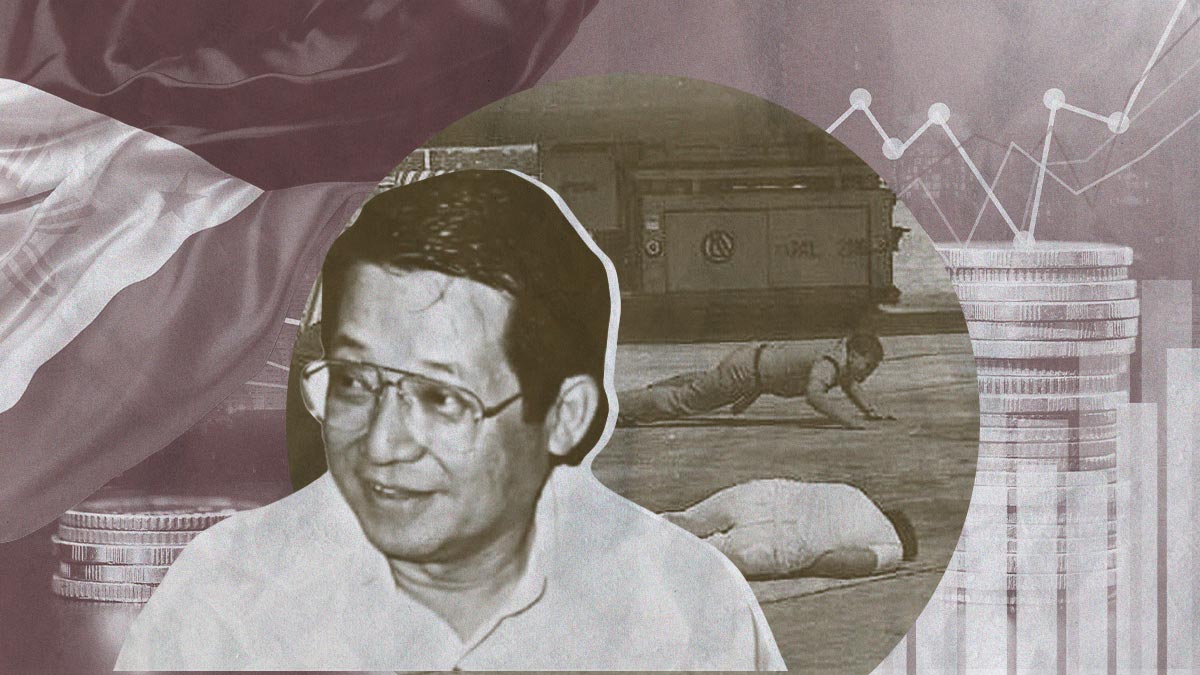
In most retellings of the assassination of Benigno “Ninoy’ Aquino Jr. on August 21, 1983, the cold-blooded killing is often credited for sparking widespread outrage among ordinary citizens previously cowed by over a decade of martial rule. A little over two years later, that outrage developed into a massive political movement that toppled Ferdinand Marcos Sr.’s dictatorship on February 26, 1986.
But the impact of the Aquino assassination wasn’t just confined to the political sphere. The killing of the popular opposition leader also had important economic consequences that were felt for years, if not decades, afterwards. The event exacerbated the regime’s outstanding economic ills and turned them into a full-blown economic crisis.
ALSO READ
Fact or Fiction: The Controversial Life of Ninoy Aquino
The economic impact of the killing became pronounced only months afterwards when the peso (vs the dollar) and real interest rate began a steep fall, and inflation shot upwards. Before August 1983, all three indicators were relatively stable. Afterwards, it all became volatile. (All infographics sourced from the World Bank).
Peso-dollar exchange rate in the Philippines (annual average, 1960 to 2022)
Real interest rate in the Philippines (1960 to 2022)
Inflation in the Philippines (annual percentage)
As the professors at the University of Philippines School of Economics put it in their 1984 report titled An Analysis of the Philippine Economic Crisis: “There is no doubt that, viewed as a historical event, the Philippines’ economic crisis was precipitated by the assassination of former Senator Benigno S. Aquino on August 21, 1983.”
To be sure, the report acknowledged that the country’s economic situation was already turning bad before the incident. Still, the death of Aquino created a major shock, which provoked the crisis, they said.
“With Aquino’s assassination, a crisis of confidence in the present government seized the foreign banks,” the UPSE professors said. According to the report, foreign banks refused to renew the short-term loans of the government, which it had been heavily relying on “for financing its deficit on trade and payments, in a strategy of ‘riding out’ the recession without making drastic changes in its income target growth."
In October 1983, two months after Aquino’s death, the government declared a 90-day moratorium on external debt payments for the first time, which stopped all official dollar trading. The moratorium was extended four consecutive times.
The government also cut the budget for 1984 and imposed restrictions on foreign exchange. “The October devaluation triggered inflationary expectations, which further raised prices,” the UPSE professors said. According to data from the Philippine Statistics Authority (PSA), inflation spiked from 10 percent to 63 percent in just a year.
The restrictions on foreign exchange trading encouraged the rapid growth of the black market for dollars, which were bought and sold for P27/$1 or more than double the official rate of P14/$1, according to an essay in the book Dictatorship and Revolution: Roots of People’s Power.
Annual GDP growth in the Philippines (!960 to 2022)
Annual GDP per capita growth in the Philippines (1960 to 2022)
The long-term consequences of the political and economic crisis triggered by the events in 1983 are laid bare in the other graphs, which show that the economic contraction in the mid-1980s were the worst the Philippines went through since the after the Second World War. It also caused a sharp fall in per capita GDP, an indicator of the average income per person, from which Filipinos only began to recover from only in the early 2000s.
This is a slightly edited article that first appeared on the now defunct Entrepreneur Philippines website.
