
Financial Adviser: 5 Cheap Value Stocks in 2023 Based on Benjamin Graham's 'Net-Net' Strategy and How to Profit from Them

Value investing has long been regarded as a timeless and proven approach to wealth creation, and at the heart of this philosophy lies the enduring wisdom of Benjamin Graham, the father of value investing who authored the widely acclaimed investment book The Intelligent Investor.
Of the various strategies he advocated, one that stands out for its simplicity and effectiveness is called the Net-Net Stock Strategy, a unique value investing approach that involves identifying and investing in stocks trading at a substantial discount to their intrinsic value, specifically focusing on the company's net current assets.
According to Graham, a net-net stock is a company whose market capitalization is trading at a significant discount to its net current asset value (NCAV).
The NCAV is a conservative measure of a company's intrinsic value. It is calculated by subtracting a company's total liabilities from its current assets. Graham recommended investing in companies where the market price is significantly below the NCAV per share.
By investing in net-net stocks, investors create a built-in margin of safety as they are acquiring assets at a discount to their liquidation value.
Graham believed that certain events or catalysts could trigger a reassessment of a company's value by the market. These catalysts might include changes in management, restructuring, or improvements in the company's operations.
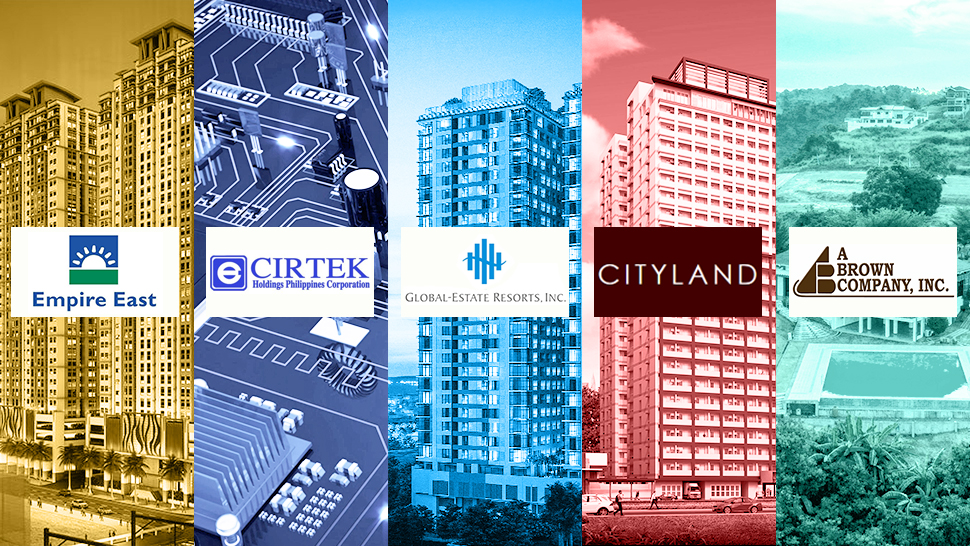
Applying Graham’s Net-Net Stock Strategy, we have identified stocks on the Philippine Stock Exchange (PSE) that are currently trading below their NCAV per share. In selecting the top five net-net stocks in the market, we considered only those with an annual net income of at least P500 million.
The Net-Net Stock Strategy requires a patient and long-term approach. Investors should be prepared to hold these stocks until their true value is recognized by the market.
Graham emphasized the importance of diversification to mitigate risks associated with individual stock investments. By spreading investments across multiple net-net stocks, investors can reduce the impact of poor-performing stocks on their overall portfolio.
Let’s look at the top five cheapest value stocks in the market this year and understand their financial health, valuation and prospects in the future.
ALSO READ
1| Empire East Land Holdings, Inc
Price: P0.129
Discount to value: 92 percent
Empire East Land Holdings (PSE: ELI) is one of the leading low-to-middle income property developers in the country. The company is 81.7 percent owned and controlled by business tycoon, Andrew Tan through his property company, Megaworld Corporation (PSE: MEG).
Some of ELI’s current projects include Empire East Highland City, an elevated 22.8-hectare township at the boundary of Pasig City; The Paddington Place, a four-tower high-rise condominium in Mandaluyong City; Mango Tree Residences, a two-tower condominium in San Juan City; and The Sonoma, a 50-hectare horizontal development in Santa Rosa City, Laguna.
ELI used to be a stock market darling when it was listed in 1996, but when the Asian financial crisis struck in 1997, the stock went downhill from a high of P8.77 per share to a low of P0.10 per share in 2003.
The share price of ELI has never recovered since then despite the steady growth of the company after the crisis. The highest that it has reached over the next 20 years was only P1.21 per share in 2013, which incidentally marked the beginning of its 10-year downtrend.
The fall in ELI’s stock price shrank its market capitalization from P13.5 billion to only P3.0 billion today, while its net income grew by 13 percent per year from P299 million in 2013 to P806 million in 2021.
Last year, ELI’s total revenues grew only by 3.0 percent to P4.7 billion from P4.5 billion in 2021, resulting in an 11 percent decline in net income to P720 million due to the recognition of higher tax expenses.
This year, ELI's total revenues for the first nine months of 2023 recovered by 7.0 percent, reaching P3.7 billion compared to P3.4 billion in the same period last year. This recovery led to a 16 percent increase in net income, reaching P579 million from P499 million in the previous year.
If we annualize ELI’s total revenues for this year and use the historical net profit margin of 15 percent, we can anticipate its net income for the year to be around P756 million. This figure represents a five percent earnings growth rate from last year.
At P756 million projected earnings, ELI’s Price-to-Earnings (PE) ratio stands at only 2.6 times, which is substantially lower than its three-year average PE of 5.7 times.
If we apply the net-net method to ELI, we can get the total current assets of the company as of September 2023 at P41.8 billion. If we deduct its total liabilities of P17.6 billion, we will get net current assets value of P24.2 billion.
Dividing this by the total shares outstanding of 14.6 billion shares, we arrive at a net-net value of P1.64 per share for ELI, representing a substantial discount of 92 percent compared to its current share price of P0.129.
ELI's substantial 92 percent discount to its intrinsic value offers investors a built-in margin of safety. At a minimum, the stock is expected to double in value in the long term as its PE multiple regresses to its historical average of 5.0x.
Buying ELI at P0.129 or lower means that you will be paying for the company’s current assets only net of all its liabilities and taking its fixed operating assets for free.
2| Cirtek Holdings Philippines
Price: P1.63
Discount to Value: 67 percent
Cirtek Holdings Philippines (PSE: TECH) is primarily engaged in the manufacturing of value-added, highly integrated technology products and semiconductor packages.
TECH's revenues, which are largely driven by exports and customer engagements from Europe and the United States, has maintained a steady growth. Over the past 12 years, the company has experienced an impressive average annual growth rate of 9.7 percent, transitioning from $23 million in 2009 to $70 million in 2021.
The consistent growth in TECH’s revenues enabled its net income to grow by an average of 19.4 percent per year to $8.1 million in 2021 from $963,000 in 2009.
Last year, TECH’s total revenues recovered strongly by 20 percent to $84.8 million, which resulted in a 39 percent increase in net income to $11.3 million.
But this year, TECH faced headwinds due to a deceleration in the US and European economies. The company saw a 10 percent decline in total revenue for the first nine months, dropping from $67.8 million to $61.2 million in the same period last year. The fall in revenues resulted to an 11 percent contraction in earnings falling to $7.6 million from $8.5 million in 2022.
If we annualize TECH’s nine-month revenues, we can estimate that its total revenues for the year will likely be around $77.5 million. Applying its average net profit margin this year of 12 percent, we can anticipate the company to achieve net income of $9.3 million, which represents an 18 percent decline from its earnings in 2022.
With an anticipated net income of $9.3 million, TECH's PE ratio currently sits at just 2.1 times. This figure significantly lags behind its three-year average PE of 17.9 times.
The fall in TECH’s share price this year by 53 percent from its high in January has reduced its market capitalization to roughly P1.0 billion. If we deduct TECH’s total liabilities of $79.2 million from its total current assets of $144.7 million, we will derive a net current asset value of $65.5 million.
If we divide this by its outstanding shares of $668.5 million, the net-net value per share for TECH would be $0.09 or approximately P4.98 per share at today’s exchange rate. This represents a 67 percent discount to its current share price.
A potential recession in the US and Europe might delay TECH’s short-term earnings recovery. However, the current share price presents an excellent value investing opportunity for the long-term.
With a substantial 67 percent margin of safety, the stock should at least double to P3.26 per share. At this target price, TECH’s PE ratio would be only 4.2 times, significantly below its historical double-digit PE average of 17.9 times.
3| Global-Estate Resorts, Inc
Price: P0.74
Discount to Value: 59 percent
Global-Estate Resorts, Inc. (PSE: GERI) is primarily engaged in the development of integrated tourism and leisure estates and integrated lifestyle communities consisting of residential, retail, hotel operations.
GERI, formerly known as Fil-Estate Land, was listed in 1995. In 2011, Alliance Global Group, Inc (PSE:AGI) led by business tycoon, Andrew Tan acquired a majority stake in the Company and consolidated it under Megaworld Corporation (PSE: MEG) in 2014.
Among GERI’s key developments are Boracay Newcoast in Malay, Aklan, Twin Lakes in Laurel, Batangas, Sta. Barbara Heights in Iloilo, Southwoods City in Laguna and Cavite, Alabang West in Las Piñas, The Hamptons Caliraya in Cavinti, Laguna, and Arden Botanical Estate in Trece and Tanza, Cavite.
Prior to the pandemic, GERI's total revenues had been growing at an average rate of 19.8 percent from P3.3 billion in 2014 to P8.3 billion in 2019. This consistent revenue growth translated to a 15.4 percent annual increase in earnings, rising from P726 million in 2014 to P1.5 billion.
During the pandemic, GERI’s total revenues fell to P4.9 billion in 2021, losing by 40 percent from its 2019 revenues while its net income declined by 12 percent to P1.3 billion from its net income in 2019.
Last year, GERI’s total revenues strongly recovered by 47 percent to P7.3 billion while its net income increased by 36 percent to P1.8 billion. This year, GERI’s total revenues for the first nine months of the year grew by 24 percent to P5.7 billion from P4.6 billion in the same period last year.
GERI’s net income, however, was almost flat with 1.0 percent increase to P1.47 billion from P1.44 billion last year due to higher cost of sales and operating expenses.
Moreover, a significant portion of GERI’s revenues this year was recorded as receivables. A look at the company’s operating cash flows reveals that it incurred a negative P1.0 billion, more than double the negative operating cash flows it reported last year at P456 million.
If we get GERI’s 12-month trailing income, we derive a net income of P1.9 billion, which implies a PE ratio of 4.3 times, which is significantly lower than its three-year average PE ratio of 7.8 times.
The slowdown in the property sector, particularly condominium sales, may delay GERI’s earnings recovery in the short-term, which could further push its share price lower.
Given ELI’s PE of 2.0x, GERI’s PE ratio of 4.3 times appears to be on the high end. It is possible that GERI’s stock price could fall further. At PE ratio of 2.0 times, we can probably pick up this stock at P0.39 per share.
If we deduct GERI’s total liabilities of P21 billion from its current assets of P40.6 billion, we will derive net current asset value of P19.6 billion. Dividing this amount by its share outstanding of 10.9 billion, we will derive a net current asset value per share of P1.79.
GERI’s net-net value of P1.79 per share currently offers a substantial discount of 59 percent. This is like buying the company at 59 percent discount of its net current assets value of P19.6 billion and taking the company’s non-current assets worth P20 billion for free.
But with the down cycle in the property sector, which could take sometime to recover, probably a couple of years, we can wait for this stock to fall further before accumulating it at a steep discount for the long-term.
4| Cityland Development Corporation
Price: P0.70
Discount to value: 44 percent
Cityland Development Corporation (PSE: CDC) is one of the leading developers of affordable housing in the country. Since its incorporation in 1978, the company has developed 48 condominium projects consisting of 31,317 units and 685 hectares of subdivision projects.
?CDC's projects include medium to high-rise office, commercial, and residential condominiums located in the cities of Makati, Mandaluyong, Manila, Pasig and Quezon; and residential subdivisions and farm lots in Parañaque City, Bulacan, and Cavite.
Prior to the pandemic, CDC’s total revenues had been growing by an average of 8.7 percent per year, increasing from P1.5 billion in 2014 to P2.4 billion in 2019. The steady growth in revenues translated to an annual earnings growth rate of 11.7 percent, progressing from P370 million in 2014 to P670 million in 2019.
During the 2020 pandemic, CDC’s total revenues plummeted by 30 percent to P1.7 billion, and its net income also saw a decline of 25 percent, amounting to P489 million.
But last year, CDC’s made a robust recovery in total revenues, nearly doubling its pandemic-era figures to reach P3.4 billion, marking the highest revenues in its history. This substantial surge in revenues translated into a notable 76 percent increase in its net income, reaching P1.0 billion.
This year, CDC’s total revenues for the first nine months slowed down with its total revenues declining by 7.0 percent from P2.6 billion last year to P2.4 billion. The reduction in revenues, combined with a higher cost of sales, resulted to a 22 percent decrease in its net income, which fell to P760 million from P978 million last year.
If we calculate the 12-month trailing income of CDC, we obtain a net income of P983 million, resulting in a PE ratio of 3.54 times based on the current market capitalization.
With the slowdown in the property sector, CDC, much like ELI and GERI, is anticipated to undergo a deceleration in its revenues and earnings growth. If we price CDC at the same multiples of ELI or GERI at 2.0x PE ratio, we should expect CDC to fall to as low as P0.40 per share.
CDC’s total current assets are more than its total liabilities. If we deduct its total liabilities of P2.4 billion from its current assets of P8.5 billion, we will derive a net current asset value of P6.1 billion.
Dividing this figure by its outstanding shares of 4.9 billion, we will derive net current asset value of P1.24 per share, which offers a 44 percent discount.
Buying CDC at its weakness should offer the largest margin of safety. If we target 70 percent discount to intrinsic value, which is possible, given its low market liquidity, we should expect the stock to fall near the P0.40 per share level.
5| A Brown Company, Inc
Price: P0.65
Discount to Value: 33 percent
A Brown Company (PSE: BRN) is primarily a property developer with a significant portion of its business, about 90 percent of its total revenues, focused in Mindanao such as Cagayan de Oro City; Intao, Misamis Oriental; Valencia City, Bukidnon; and Butuan City, Agusan del Norte.
In recent years, BRN has diversified its business interest in power generation, water utility, and palm oil production, which contribute roughly 10 percent of its total revenues.
BRN’s total revenues had been growing at an average rate of 29 percent per year before the pandemic, climbing from P484 million in 2016 to P1.03 billion in 2019. This robust revenue growth allowed BRN to transform its net income from a loss of P76 million in 2016 to a gain of P494 million in 2019.
During the 2020 pandemic, BRN experienced a 15.8 percent slowdown in total revenues, leading to a 40 percent decline in net income to P294 million.
In 2021, despite the gradual reopening of the economy, BRN’s revenues continued to fall, losing 17.8 percent to P710 million from P864 million in 2020. Total net income, however, increased by 35 percent to P397 million from P294 million in 2020 due to higher gross profit margins and increased earnings from affiliates.
Last year, BRN's total revenues staged a robust recovery, more than doubling the figures from 2021 to reach P1.5 billion. This substantial surge in revenues resulted in a 60 percent increase in net income, totaling P639 million compared to P397 million in the previous year.
This year, BRN’s total revenues for the first nine months sustained its growth momentum, growing by 27 percent to P1.1 billion from P865 million in the same period last year.
Higher revenues coupled with higher gross profit and lower operating expenses contributed to a 43 percent increase in net income, reaching P607 million from P422 million the previous year.
The increase in BRN’s net income, however, was not matched by the increase in its operating cash flows, which resulted to a negative P666 million. This is because, similar to GERI, most of its revenues were booked as receivables.
If we get the 12-month trailing income of BRN, we will derive a net income of P757 million, which translates a PE ratio of 1.97 times, 29 percent lower than its average PE of 2.74 times last year.
BRN’s total current asset is more than its total liabilities. If we deduct its total liabilities of P4.6 billion from its total current assets of P6.9 billion, we will derive a net current asset value of P2.3 billion.
Dividing this figure by its total outstanding shares of 2.37 billion, we will derive a net-net value of P0.97 per share, which offers a 33 percent discount at its current share price.
Considering the anticipated deceleration in both revenue and earnings growth due to the current downturn in the property sector, we need a larger margin of safety to make it compelling.
If we price BRN at the same discount of GERI at 60 percent, we can put our target buying price near the P0.38 per share level.
Henry Ong, RFP, is an entrepreneur, financial planning advocate and business advisor. Email Henry for business advice hong@financialadviser.ph or follow him on Twitter @henryong888
