
AirAsia Employee Seen Wearing Swastika Symbol at NAIA 3


ILLUSTRATION: Igi Talao
Airport ground crews are commonly seen with brightly colored vests, especially if they work in an environment where their visibility is crucial. AirAsia's ground staff, in particular, wear a black vest with yellow reflective strips that bear the red-colored AirAsia logo. But photos of one unidentified AirAsia employee at the Ninoy Aquino International Airport - Terminal 3 in Pasay City wearing a swastika patch on his hi-vis uniform have gone viral after they were posted on the r/Philippines subreddit on Friday morning, May 31.
AirAsia employee wearing swastika patch seen at NAIA 3

Comments were quick to point out the general association of the swastika symbol to the regime of Adolf Hitler under the Nazi Party in Germany, a grim period in world history. Others, however, noted that the swastika is also a sacred symbol in Hinduism, Buddhism, and Jainism.
ALSO READ
A Rare Look at the Glory Days of the Manila International Airport
What To Wear At The Airport, According To A Mission Impossible Actor
Another AirAsia employee put a cute sticker beside the AirAsia logo.

AirAsia's Statement on the Viral Photo
Upon clarification by Esquire Philippines regarding the incident, AirAsia released a statement on Friday afternoon:
"It has come to our attention that an AirAsia employee was observed wearing an unauthorized patch on his company-issued vest, as shared by a concerned individual on an online community forum. AirAsia Philippines promptly addressed the matter, reminding all employees to maintain the integrity of our uniform.
At AirAsia, we take uniform compliance very seriously, as it reflects our commitment to providing a professional service. We have taken steps to remind all personnel to adhere to these guidelines to ensure professionalism in our service," AirAsia Philippines Communications and Public Affairs Head and First Officer Steve Dailisan shares.
History of the Swastika Symbol
The swastika symbol features a cross with its arms bent at right angles, either left-facing or right-facing. Its origins lie far from the dark associations it garnered in the 20th century. The word "swastika" comes from the Sanskrit "svastika," meaning "good fortune" or "well-being." This hooked cross has been found in Eurasia, dating back 7000 years, often representing the movement of the sun through the sky. It remains a sacred symbol in Hinduism, Buddhism, Jainism, and Odinism, commonly seen in temples and homes in India and Indonesia. Swastikas also appear in ancient European artifacts, tracing back to pre-Christian cultures.
A Hindu swastika at Goa Lawah Temple in Bali, Indonesia
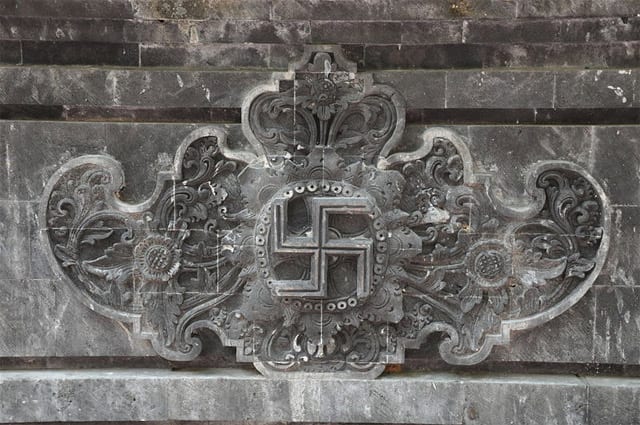
The symbol’s resurgence in the 19th century was fueled by European interest in ancient Near Eastern and Indian civilizations. German archaeologist Heinrich Schliemann discovered the hooked cross during his excavations at ancient Troy. He connected it with similar shapes found on German pottery, suggesting it was a significant religious symbol for ancient ancestors. This idea was adopted by European scholars who linked the swastika to a shared Aryan culture spanning Europe and Asia. By the early 20th century, the swastika was widely used in Europe, often symbolizing good luck.
Nazi Party's Use of the Swastika Symbol
The swastika's meaning took a dark turn when it was appropriated by racist groups in the early 20th century. These groups saw the swastika as a symbol of Aryan identity and German nationalist pride. This association is one reason the Nazi Party adopted the swastika as its emblem in 1920.
Flag of the Nazi Party (National Socialist German Workers' Party, NSDAP)
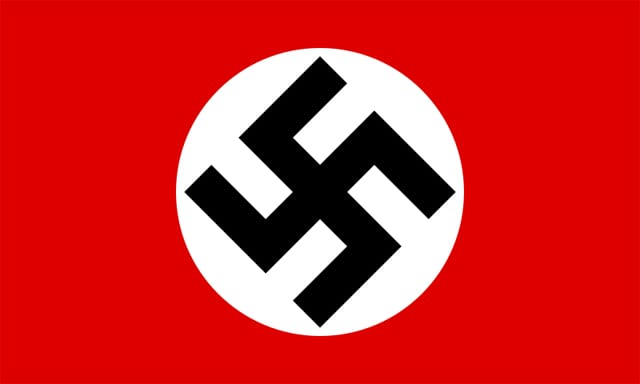
Adolf Hitler and his followers used the symbol to represent their goal of racial purification in Europe. They believed that the Aryan race, which they claimed was superior, should dominate the continent. This ideology led to the horrors of World War II, including the Holocaust, where millions of Jews and other marginalized groups were systematically exterminated.
Hitler described the flag in his book Mein Kampf. He wrote:
“I myself, meanwhile, after innumerable attempts, had laid down a final form; a flag with a red background, a white disk, and a black swastika in the middle. After long trials I also found a definite proportion between the size of the flag and the size of the white disk, as well as the shape and thickness of the swastika.”
The color scheme drew from the Imperial German flag, resonating with Germans who rejected democracy and the Weimar Republic. The swastika became a powerful logo for the Nazi Party, appearing on flags, posters, arm bands, medallions, and badges. It was intended to elicit pride among Aryans and instill fear in Jews and others deemed enemies of Nazi Germany.
After the Nazis gained power in 1933, they replaced the democratic Weimar Republic's (or German Reich's) black-red-gold flag with the swastika flag. This move symbolized the connection between Germany's imperial past and its nationalist rebirth. By 1935, the swastika flag became the official national flag of Germany. The Nazi regime also passed laws to prevent unauthorized use of the swastika in commercial goods, aiming to protect the symbol’s dignity.
The swastika's association with the Nazi regime has left an indelible stain on its history. In many Western countries, it is still viewed as a symbol of intimidation and racial supremacy. The icon's use has been outlawed in Germany, and it is frequently employed by white-supremacy groups and modern iterations of the Nazi Party. The symbol's once-positive connotations have been overshadowed by its use in promoting hatred and violence.
Despite its tarnished reputation in the West, the swastika continues to hold positive meanings in other parts of the world. In India, it remains a sacred symbol in Hinduism, Buddhism, and Jainism, representing divinity and spirituality. Native American tribes, such as the Navajo, also used a similar motif known as the "whirling logs" in their art and culture. This design, which symbolizes the sacred number four and various elements of life, was employed in weaving, silverwork, and basketry.
