

What a Beefed-Up Opposition Means for the Senate


Returning opposition mainstays Paolo Benigno "Bam" Aquino IV and Francisco "Kiko" Pangilinan have secured seats in the Philippine Senate after the May 12 polls, which could shift political tides in the country, especially ahead of pending priority measures and the looming impeachment trial of the Vice President.
Partial and unofficial results of this year’s midterm national and local elections as of May 13, 2:21 p.m., showed Bam Aquino placing second with about 20.6 million votes, while Kiko Pangilinan was the fifth highest with about 15.1 million votes.
"Kiko-Bam had a disciplined and well-executed campaign," Arjan Aguirre, who teaches political science at the Ateneo de Manila University, told Esquire Philippines.
He added that the two opposition figures had avoided the toxicity of the dynastic feud between the Marcos and Duterte clans, opting to stick to their platforms and priorities on the education and food crises, low-quality jobs, and developing the agriculture sector.
The Commission on Elections’ (COMELEC) website on Monday showed that it received about 99.03 percent of local election returns and 88.84 percent of overseas election returns, as of writing.
Reelectionist Senator Christopher Lawrence “Bong” Go topped the list with about 26.5 million votes, followed by Aquino, trailed by reelectionist and Duterte ally Senator Ronald “Bato” De la Rosa (20.3 million), ACT-CIS Party-list Representative Erwin Tulfo (16.8 million), and finally Pangilinan’s 15.1 million votes.
"They [Bam Aquino and Kiko Pangilinan] will join Senator Risa Hontiveros and most likely form a new bloc—independent-opposition bloc that might be composed of senators who do not want to be identified with either of the two warring factions," Aguirre said.
ALSO READ:
Do You Hear the People Sing?: The Political Opposition in the Philippines
When the Right to Vote Becomes a Privilege
Aquino is returning to the upper chamber after his previous term ended in 2019. After his time as a lawmaker, he served as the campaign manager of former Vice President Leni Robredo’s 2022 presidential bid, which her camp lost to President Ferdinand “Bongbong” Marcos by a large margin.
Robredo this year dominated the local elections in her hometown of Naga City, getting almost 84,000 votes or over 91 percent of the votes cast.
Pangilinan is making his Senate comeback after also losing by a landslide to Vice President Sara Duterte in 2022, who is currently facing multiple impeachment complaints before lawmakers.
"The sheer scale of Generation Z and millennial voters has allowed the withering away of traditional politicians and the election of national candidates based on principles and policy positions. Younger voters are not convinced by politicians who bank solely on popularity, merely dance or entertain crowds in pursuit of power," explained Terry L. Ridon, a former congressman and convenor of the think-tank InfraWatch PH, in an online exchange.
Registered Voters, By Generation (based on COMELEC's single-age data)
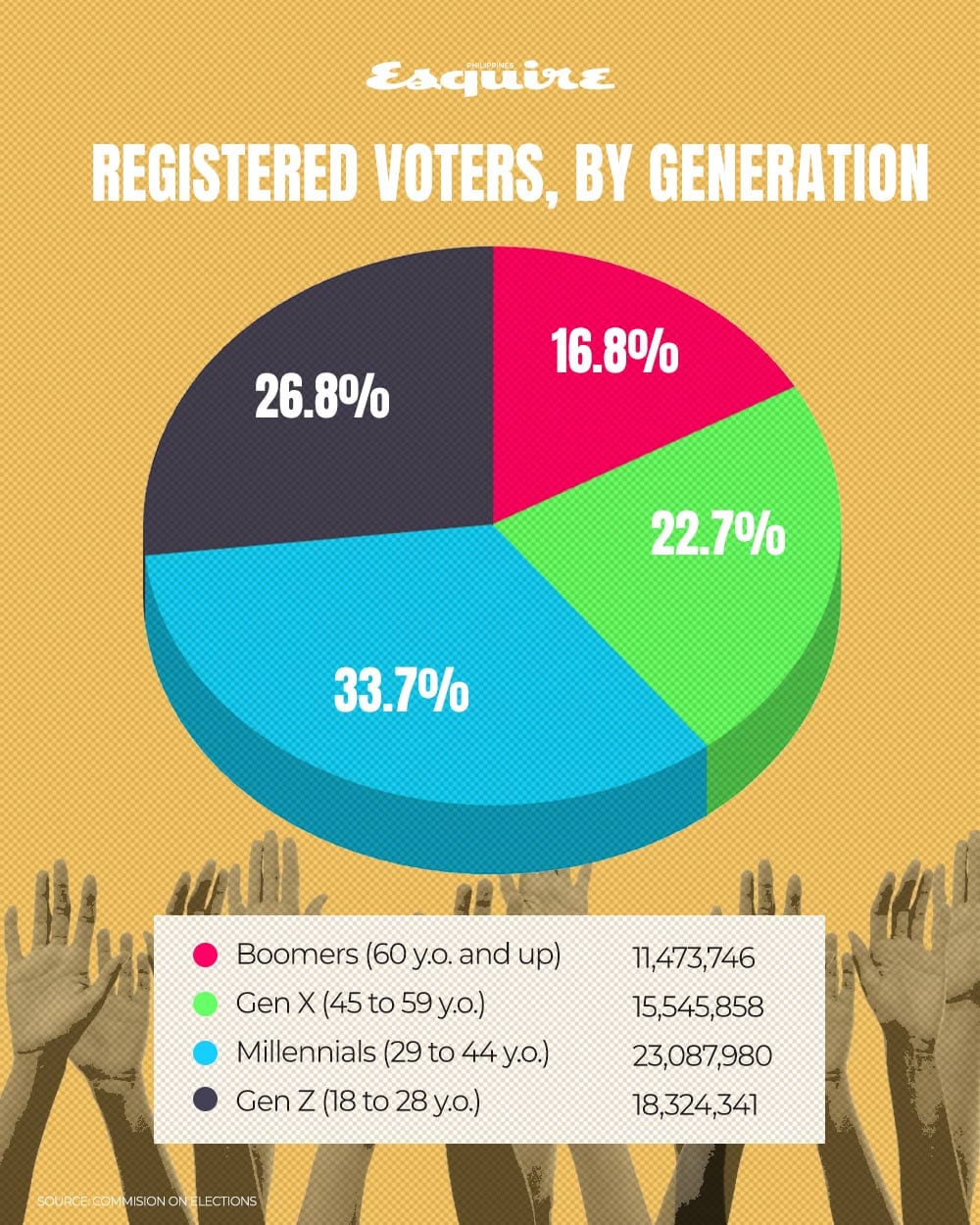
COMELEC data showed that six in 10 registered voters this year were either from the millennial or Generation Z demographic.
Prior to the elections, Aquino had been endorsed by the Iglesia ni Cristo church, a major voting bloc in the country with more than two million members.
Filipino voters on May 12 cast their votes to decide on 318 seats in the House of Representatives and 12 seats in the 24-member Senate, and the thousands of local posts up for grabs.
"Running an effective ground game, connecting with communities and local leaders, just talking about the gut issues, staying out of the Marcos-Duterte feud worked very well for candidates Bam Aquino and Kiko Pangilinan," Michael Henry Yusingco, a resident fellow at the Ateneo de Manila University Policy Center, told Esquire Philippines.
"They also benefited immensely from the rejection of celebrities and dynastic candidates by millennials and Gen Z voters."
The COMELEC on Monday dispelled claims of a failure of elections in this year’s midterm elections, even after reports of sweeping issues on malfunctioning automated counting machines, disinformation, and tensions in high-risk areas.
Election watchdog Kontra Daya and Vote Report PH said it received verified reports of these technical issues, including the unaudited software in these automated counting machines, with 557 reported cases.
The election body on May 13, Tuesday, convened as the National Board of Canvassers to start opening the certificates of canvass from global posts and local absentee voting. It aims to proclaim all 12 winning senators on the weekend or on May 17.
"There's an opportunity here to suggest that Filipino voters don't really vote based on party loyalties/slates anymore," Hansley Juliano, who also teaches political science at the Ateneo, told Esquire Philippines.
"They're still personalistic, sure, but it also means they're looking towards what people say about their track record, their values and also how this means voting for those dissatisfied with the admin."
In a statement on Tuesday, Senator Hontiveros said that the returning opposition lawmakers were voices that the Senate desperately needed to deal with issues on wages, spiraling prices of basic commodities, and affordable and quality education.
"The cry of the people is simple and clear: Raise the wage. Lower the price of the commodity. Make education within reach. And make sure that those in power are held accountable," she added.
How This Affects The Duterte Impeachment Trial
Maria Ela Atienza, a political science professor at the University of the Philippines, explained that though Pangilinan and Aquino secured these slots, it was not a perfect storm but was potentially caused by a strong youth vote, the infighting between the administration slate and the Dutertes.
"Opposition senators and reelected pro-impeachment legislators can still keep hounding Sara Duterte in terms of her accountability and the impeachment charges against her," she said, referring to Duterte’s impeachment trial on July 30.
The House of Representatives impeached the Vice President in February on allegations of sacred fund misuse, unexplained accumulation of wealth, acts of destabilization, and plotting the assassination of President Marcos, Jr. and his family, which Duterte has denied.
More than 200 congressmen signed off on the impeachment complaint, more than the one-third requirement under the law before it is to be transmitted to the Senate.
The Senate is set to approve the impeachment trial rules on June 2 when Congress resumes after its four-month recess.
Despite this, Ateneo de Manila economics professor Leonardo Lanzona said it won't really matter how opposition senators decide in the impeachment, as they should focus on their long-term goals, such as their anti-poverty programs.
"Unlike what was being portrayed by the administration, poverty has become widespread, and for the first time, voters who are not exposed to corrupt election mechanisms were more inclined to vote for long-term goals," he added, adding that anti-Marcos sentiment could have also led to their success in this year's elections.
"They need to make sure they are not distracted from the very reason they were elected."
Ahead of the final results, the House is still likely to stay under the influence of the President, as congressmen often align themselves with his policies.
House Speaker Ferdinand Marin Romualdez, who is also the President's cousin, said earlier this month that the lower chamber would prioritize passing job creation bills, those supporting smaller businesses, and others developing the agriculture sector.
"The senatorial result is a reality check for President Marcos because it exposed the limits of his political capital. Vice President Duterte is still a formidable rival because it appears her family can still hold sway in Mindanao," Yusingco said.
In recent surveys, Vice President Duterte has been a frontrunner for the 2028 presidential election amid her family's feud with the Marcos clan. If she is impeached from her post after the Senate trial, she won't be able to hold public office again.
Commenting on the partial unofficial results of the polls, President Marcos Jr. said that despite his slate not winning all of the seats, he urged incoming officials to work with his administration towards an "honest government."
In a Zoom press conference on Monday night, responding to the favorable results, Pangilinan said he was surprised by his high placement since he was not always in the Top 12 in past surveys.
"This for all Filipinos—a whole-hearted thanks to all, to God, and to those who trusted and leaned on our love for country," Aquino said in a separate statement.
