

Maria Ressa Warns of ‘Information Armageddon’ at Frankfurt Book Fair

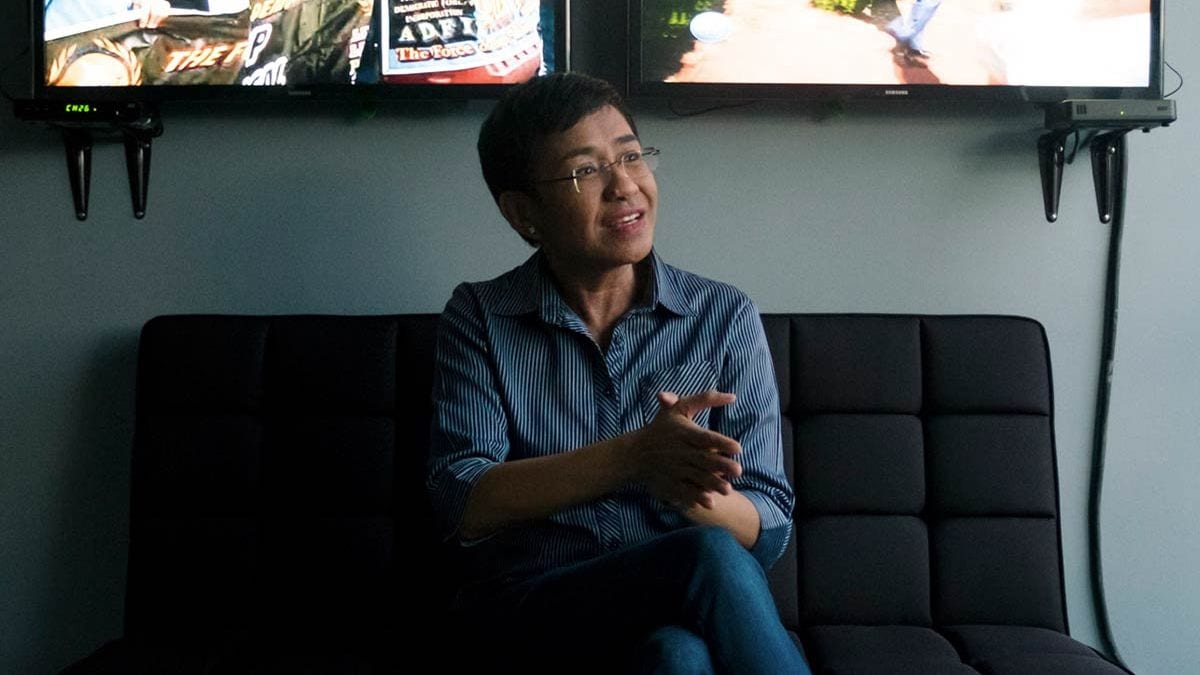
Nobel Peace Prize laureate Maria Ressa warned that the world is facing an “information Armageddon” as technology companies continue to spread disinformation for profit.
Speaking at the Frankfurt Book Fair on October 17, Friday, Ressa said large social media platforms have “pumped people full of lies,” fueling distrust and division across societies. “We are experiencing an information Armageddon,” she told the audience. “[Meta CEO] Mark Zuckerberg had broken democracy.”
Ressa joined former NATO Secretary General Jens Stoltenberg and Der Freitag editor Sebastian Puschner in a discussion titled “Security Policy and Human Rights – Scope for Action in Times of War and Crisis.” The panel examined how autocratic systems and disinformation threaten global stability and freedom of expression.
‘Lies Spread Faster Than Facts’
Ressa, said the design of social media platforms favors falsehood over truth. “By design, social media spreads lies faster than facts,” she said, citing a 2018 MIT study that found lies spread six times faster online.
“If lies spread faster, you cannot tell the difference between fact and fiction,” she added. “Without facts, you can’t have truth. Without truth, you can’t have trust. Without these three, we don’t have a shared reality.”
She warned that this “toxic sludge” of misinformation is changing how people think, feel, and act. “Our biology is hacked,” Ressa said. “It changes the way we vote. We are electing illiberal leaders democratically.”
ALSO READ
Maria Ressa: 'If You Don't Fight for the Truth, Then You Give up Your Future'
"I think every President I’ve covered has really not liked our coverage. But that’s part of it!"
Impunity in the Real and Virtual Worlds
Ressa, who authored the book “How to Stand Up to a Dictator,” said the same impunity that drives wars also exists in the digital world. “The biggest problem in our world today is impunity,” she said. “The question we have to ask is, does rule of law still exist?”
She compared the actions of leaders like Vladimir Putin, President of Russia, and Benjamin Netanyahu, Prime Minister of Israel, to those of technology executives. “The tactics they’re using are also being used by the CEOs of the tech companies that are running our lives,” she said.
“Every one of us on social media can now be reached in one place,” Ressa continued. “Data shows us that many of us may no longer have agency.” She cited a report from V-Dem Institute showing that “72 percent of the world today is under authoritarian rule.”
Lessons from the Philippines
Reflecting on her experience as co-founder of Rappler, Ressa recalled how social media was used to attack journalists during former President Rodrigo Duterte’s administration.
“In 2016, during Duterte’s campaign, a Facebook page targeted a student who asked about the killings in Davao City and threatened him with death,” she said.
“For six years in a row until 2021, Filipinos spent the most time online and on social media globally. Facebook was literally our internet back then,” she said. “Women in the Philippines in 2017 were attacked online at least ten times more than men.
Ressa said her newsroom became a target. “I have a very young team — our median age was 23, and we were 62 percent women. My company was under attack,” she said. “I feel like the West and Germany — I’m worried about you. I feel like you’re going to go through what we went through.”
Hope Through Action
Despite the dangers, Ressa said she remains hopeful. “Hope comes from action,” she said. “You have to know you are being manipulated, protect yourself, demand better, and organize your communities.”
She pointed to new international efforts to protect information integrity led by countries such as Brazil, Chile, and Spain, and supported by the United Nations. “Every country now agrees there need to be AI red lines,” she said. “Now we need to push that further.”
Ressa said the challenge of defending democracy is both collective and personal. “What are you willing to sacrifice for the truth?” she asked. “Because those are the times we live in.”
She closed her talk with a heartfelt call to action: “Democracy is fragile, and we must hold the line. This is it — the last two minutes of the basketball game [as we Pinoys call it]. Let’s do it.”
