
NASA Astronauts Sunita Williams and Butch Wilmore Are Still at the ISS

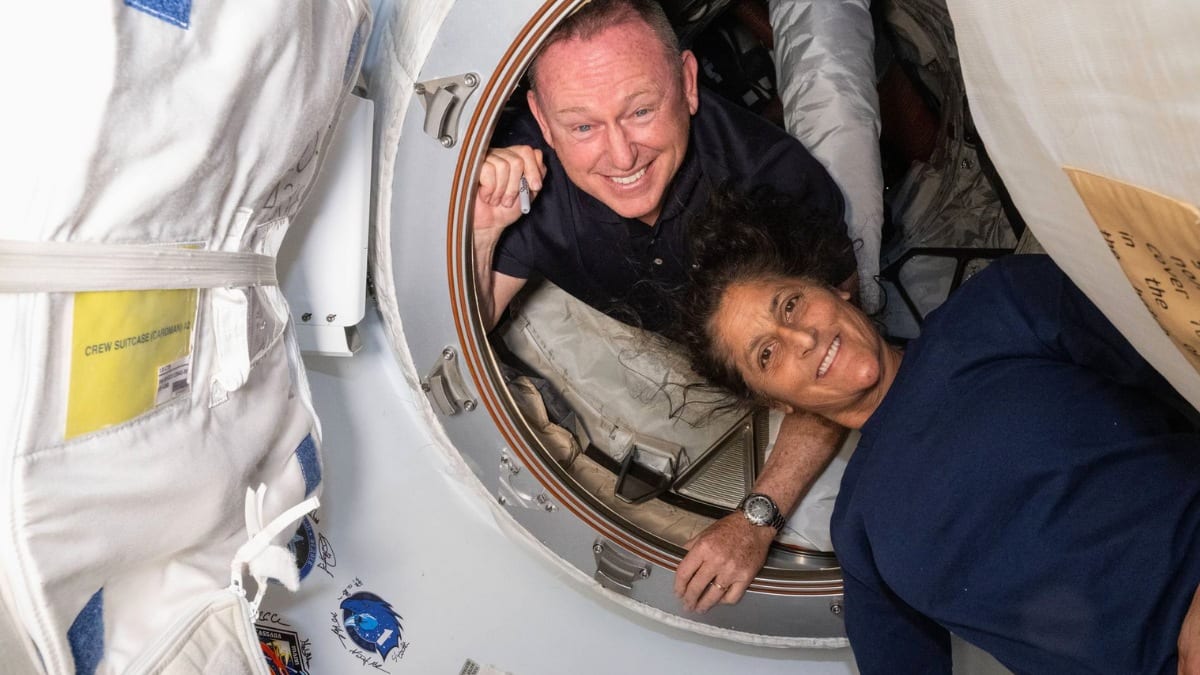
When NASA astronauts Sunita William and Barry E. Wilmore left Earth on June 5, 2024, aboard the Boeing Starliner, they were meant to hang out in space for only eight days. But it's been more than two months, and they're still out there at the International Space Station (ISS).
The mission was supposed to be a proof of concept for American manufacturer Boeing to venture into reusable spacecraft with the National Aeronautics and Space Administration (NASA) as its lead customer. The Boeing Starliner is designed to transport crew to and from the ISS and other low-Earth-orbit destinations, essentially rivaling Elon Musk's SpaceX, which has been sending astronauts to the ISS since 2020.
ALSO READ
The Song of the Universe: NASA 'Sonified' the Discovery of 5,000 Exoplanets
Presenting Space Couture: NASA Debuts Its Revamped Spacesuit for Moon Missions
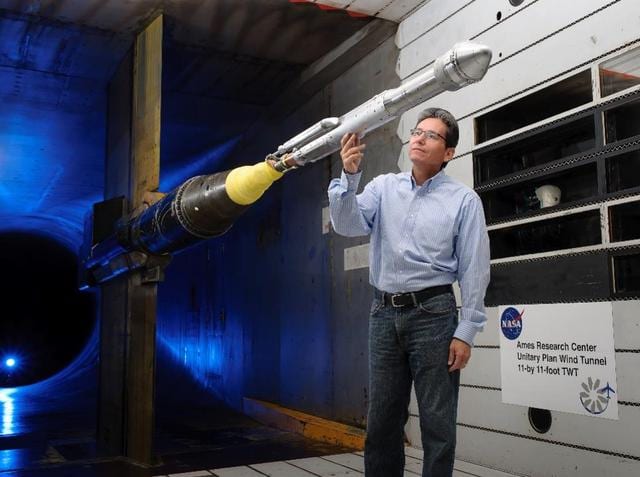
In this photo from 2016, an engineer works with a model of a United Launch Alliance Atlas V rocket with a Boeing CST-100 Starliner capsule inside a wind tunnel at NASA's Ames Research Center in California.
What happened to the Boeing Starliner flight of Sunita William and Barry E. Wilmore?
Boeing Starliner (CST-100) has had two unmanned Orbital Flight Tests, the first on December 20, 2019, which was concluded as a partial failure, and the second on May 19, 2022.
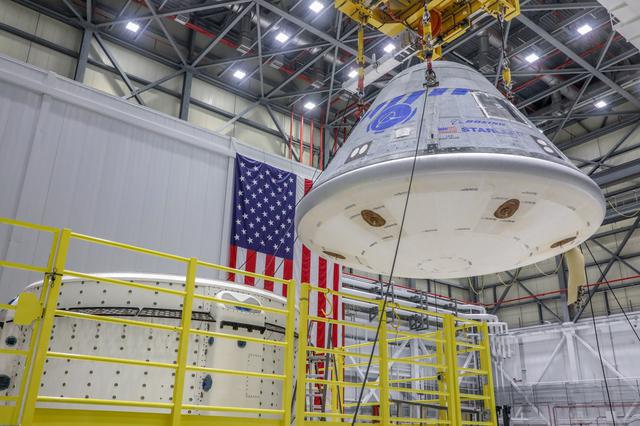
A new service module was mated to a Boeing CST-100 Starliner crew module to form a complete spacecraft on March 12, 2022, in Boeing’s Commercial Crew and Cargo Processing Facility at NASA’s Kennedy Space Center in Florida.
The flight of William and Wilmore, Boeing Crew Flight Test, is the capsule's first crewed mission. It was supposed to launch on May 6, 2024, 10:34 p.m. EDT, but was aborted two hours before planned liftoff "as teams evaluate an oxygen relief valve on the Centaur Stage on the Atlas V," NASA said in a tweet. Atlas V, an expendable launch system manufactured by United Launch Alliance, has flown missions since 2002 with a 100% success rate.
On June 1, 12:25 p.m. EDT, another launch was attempted but was aborted with less than four minutes to go on the countdown. According to Tory Bruno, CEO of the United Launch Alliance, the official scrub was caused by a "faulty computer card."
Hours before this, it was reported that there was an apparent communication issue between the launch control and two valves responsible for topping off propellant in the liquid oxygen and hydrogen tanks in the Atlas-Centaur second stage. The Centaur part of the whole system is a cryogenic vehicle fueled with liquid hydrogen and liquid oxygen.
On their final 20 minutes before the supposed liftoff, United Launch Alliance flight controllers observed a discrepancy in the errant temperature sensor reading, but after deciding that it was not needed for launch, the sensor was deactivated.
With less than 11 minutes to launch, Wilmore reported a suit fan warning light; this was eventually swapped out.
Ultimately, liftoff was scrubbed due to the aforementioned faulty computer card.
Another attempt was scheduled on July 2, at 12:03 p.m. EDT. However, the team decided to forego the schedule "to give the team additional time to assess a ground support equipment issue."
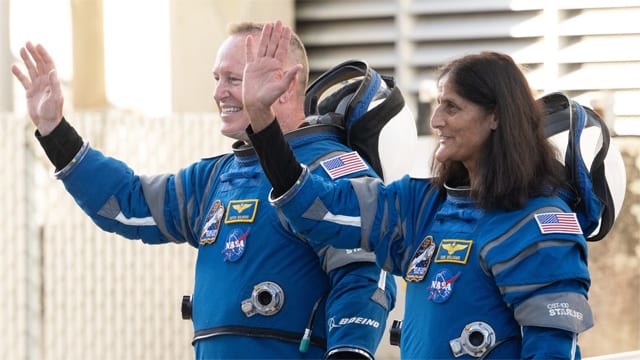
NASA astronauts Butch Wilmore, left, and Suni Williams, wearing Boeing spacesuits.
Finally, the Boeing Starliner was launched from Space Launch Complex 41 at Cape Canaveral Space Force Station in Florida on June 5, 10:52 a.m. EDT. It was scheduled to dock with the ISS on Thursday (June 6) around 12:15 p.m. EDT, which was 25 hours from launch. As part of their test flight, Williams and Wilmore performed initial tests on the Starliner while en route to the ISS.
However, on docking day, the Starliner had more helium leaks, one of which was larger than the one found on the spacecraft in pre-flight. They also had to troubleshoot issues associated with the spacecraft service module's reaction control thrusters. Having missed the 12:15 p.m. EDT docking schedule, they had to wait for the next available schedule at 1:33 p.m. EDT and had an official docking at 1:34 p.m. EDT. They were welcomed by the seven members of Expedition 1 aboard the ISS at 3:45 p.m. EDT.
William and Wilmore were supposed to fly back to Earth aboard the Boeing Starliner on June 13 since they had only signed up for an eight-day mission. The spacecraft was supposed to parachute to Earth and land somewhere in the southwestern United States. The Starliner was designed to be a reusable spacecraft that can clock in up to 10 missions.
However, the departure was scheduled for June 18 to prevent an overlap between the Starliner's launch back to Earth and a spacewalk by a different crew aboard the ISS. The date was later changed to June 22 to allow the crew to continue the on-orbit capabilities of the spacecraft as well as additional checks on the helium leaks and thrusters. This was again postponed and moved to June 26 to allow "a little more time to look at the data."
On June 29, NASA said that Boeing Starliner is extending the mission again. "We're not going to target a specific date until we get that testing completed, and we look at the fault tree, and then we understand the path for it."
Williams and Wilmore aboard the ISS
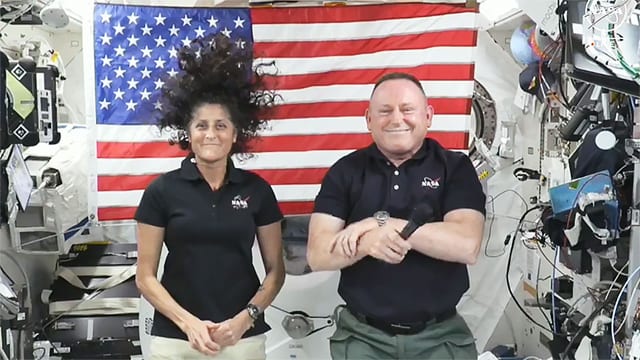
In a press conference, NASA emphasized that the two astronauts were not stranded or stuck on the ISS. "Our plan is to return them on Starliner and return them home at the right time." Steve Stich, manager of NASA's Commercial Crew Program, told reporters. Considering that this was a test flight, the two astronauts were expected to expect the unexpected. However, work is still ongoing, especially on the five of its 28 reaction control thrusters (RCS) that misfired during docking with the ISS.
Their stay at the ISS was also in conflict with the arrival of SpaceX Crew-9, which was scheduled to launch on August 18. This was later postponed to September 24. NASA is considering sending only two astronauts on Crew-9, which will fetch the two Starliner astronauts for a return in February 2025.
Considering that this is part of Boeing's bid to join the space industry, having a competitor save the day doesn't bode well for its rep.
