
The New International Airport in Sangley Point Will Finally Start Construction This Year—Remulla

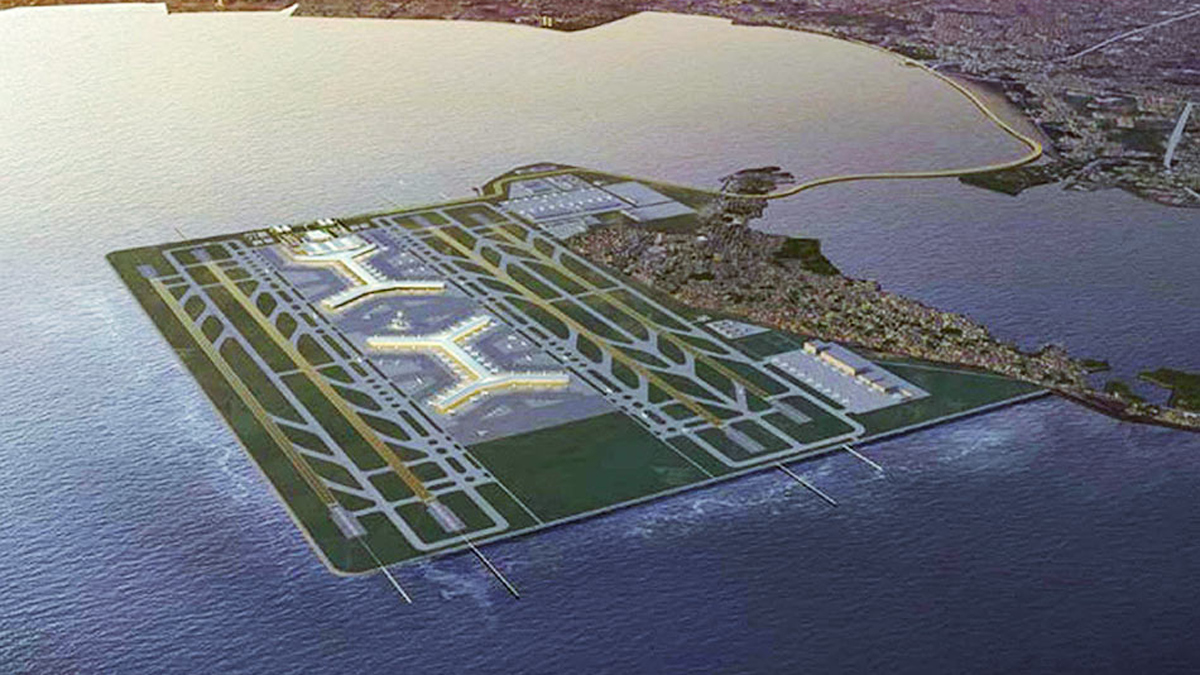
After years of delays, construction on the Sangley Point International Airport (SPIA) is expected to commence this year, with a target to complete the first phase by 2027.
According to Department of Interior and Local Government Secretary Juanito Victor “Jonvic” Remulla, SPIA is intended to be a premier international airport after the end of life of the Ninoy Aquino International Airport (NAIA).
Remulla, who is a former governor of Cavite where SPIA is located, said the first phase of the airport project is expected to be completed in two years, or by 2027, at a cost of about $2 billion. The first phase involves a runway upgrade, a reclamation component to extend the airport’s current 2.1-kilometer runway to 3.4 kilometers that will allow a Boeing 777 to land, as well as the construction of a passenger terminal. The B777 aircraft line is the largest twinjet and most-built wide-body aircraft in the world, and can accommodate up to 368 passengers.
Also included in the plans for the first phase of the airport project is a dedicated access road from Cavitex direct to Sangley.
“It will just take 20 minutes from [Entertainment City in Parañaque] to the airport using Cavitex,” the DILG chief said during an interview, adding that the completion of the SPIA will be an immense boost to visitor arrivals in the country due to the overcapacity of NAIA.
ALSO READ
Cavite Accepts Proposal to Develop Sangley Airport from Lucio Tan, Yuchengco Group-Led Consortium
Is the $550-Billion Peso Sangley Point International Airport Project in Trouble?
Remulla also said the new airport is not intended to compete with the Bulacan International Airport, which is currently being built by a unit of San Miguel Corp. of tycoon Ramon S. Ang.
“We’re just one runway,” he said. “We’re not competing with them [Bulacan]. We’re just the alternative runway.”
When asked about his relationship with Ang, Remulla said, “We’re good.”
Besides chairing SMC and building the new airport in Bulacan, Ang leads the New Naia Infrastrucutre Corp. (NNIC), which won the right to modernize NAIA facilities and improve its services over 15 years. With improvements, NAIA’s passenger capacity is expected to rise from 43 million to 62 million annually.
Up to 25 million more passengers can be accommodated with the completion of the first phase of SPIA project, which would ease the burden on NAIA.
“That’s the number one complaint of airports, they don’t have enough landing rights,” Remulla said. “NAIA is now servicing 38 million passengers, but it was just built for 30 million, so it’s already 20 to 25 percent overcapacity.”
Remulla also noted that carriers from India, the United Arab Emirates, South Korea, Japan, and the United States are asking for more flights to Manila, “except we just don’t have the slots anymore and nobody wants to land in Clark because it’s too far. Sangley is the option we have today.”
A source in the Department of Transportation has said, however, there is no timeline yet for the SPIA as the project proponents have yet to submit the project design and its environmental compliance certificate.
What is the SPIA
The SPIA is a public private partnership (PPP) between the Cavite government and a consortium composed of the Virata-led Cavitex Holdings Inc. and the Yuchengco-led House of Investments.
However, the initial phase of the SPIA project was previously awarded to a consortium composed of the Lucio Tan-owned MacroAsia Corp., and the Chinese state-owned China Communications Construction Co. Ltd. (CCCC) in February 2020.
“We are partnering with GMR [Airports] and the Yuchengco group,” said Remulla, who has been involved with the project since his term as Cavite governor.
Upon completion of the SPIA, with a projected cost of $11 billion, there will be four runways and terminal facilities that can accommodate 75 million passengers annually.
However, in an email, the SPIA Development Consortium clarified that GMR Airports is not a SPIA Devt. Consortium member. “In the previous Naia PPP tender, GMR assembled their consortium along with Cavitex Holdings Inc. and House of Investments. The consortium has received interest from other parties to participate [in the SPIA] as well, but the equity partners have yet to make a decision on this matter.”
The SPIADC added that construction of SPIA “will begin once the negotiations with the Philippine Navy (PN) for the use of land have been completed. Positive discussions between the PN and the parties are ongoing.”
“In the first week of July, we (Cavite) will be signing a MOA (memorandum of agreement with DND (Department of National Defense), that’s the last stumbling block” in the project’s commencement.” Remulla said.
