
Be Warned: A Ticket Scam on Social Media Involves Identity Theft

As much as we want to avoid scalpers, reselling tickets online is nothing new. Sure, it does have risks, but it does give results (er, tickets). Going through unofficial channels is particularly tempting, especially when a show is sold out. Resellers offer tickets to basketball games, concerts, and—most recently—musicals.
However, a particular scam has emerged, taking those risks to another level. Fraudsters posing as legitimate ticket sellers don't just disappear with your money—they go a step further by stealing the online identities of their victims. Using these hijacked profiles, they continue the cycle of deceit, scamming others in the process. A group of online buyers, who found themselves sharing the same story of what looks like a well-oiled scam machine, recently figured out this modus.
ALSO READ
Is It Ethical to Resell Concert Tickets for Much More Than What You Paid?
How Concert Ticket Prices Are Set and Why Filipino Fans Pay More Than Our Asian Neighbors
Ticket Selling Through Social Media
"I'm used to buying and selling tickets online and usually go to the FB Marketplace. So I simply typed up 'One More Chance tickets,' and the FB group came out," Makati-based, 29-year-old V (not their real name) told Esquire Philippines in a quick chat.
They were referring to a Facebook group created over a year ago. Its name would change depending on which show is big at the moment or which tickets people are looking for. As of writing, its identity is listed as "One More Chance BUYING AND SELLING TICKETS/PHILIPPINE TICKETS," with the poster of the Filipino musical as its banner.
One More Chance, the Musical, had a sold-out run from April to June at PETA Theater Center. The production has warned against buying from resellers and suggested getting tickets only from official channels like Ticketworld or from show buyers.
Still, resellers emerged online, whether because of having to cancel catching the show, buying too many tickets, getting seats they did not want, or other reasons. Fans were quick to grab any opportunity to get the sought-after tickets. PETA is again restaging the musical this September and October, and tickets are already 75 percent sold.
"The number of followers made me believe the group page was legit, more than 20,000. So naisip ko, 'Ah, okay. It has following so baka marami nang gumagamit nito.' But what sealed the deal for me for the seller was that his post had endorsements from the FB Page admins! As in nagko-comment sila sa selling post niya na "legit," "100% legit seller," "I bought my tickets from him," and super dami. So ayun, agad-agad ako naniwala and nag-transfer. Turns out, even the page admins and those who commented—all fake accounts, all stolen identities," V continued.
For 34-year-old P (not their real name) from Quezon City, it was the first time they tried to buy tickets through a reseller. "I usually purchase tickets for concerts and musicals through official ticket outlets." But, at the time, they needed tickets on the same day for a sold-out show. Like V, a quick online search suggested the same Facebook group that resells tickets.
When asked what made them trust the page and the reseller, they said that page engagements made them believe the account's legitimacy. "There [are] a lot of comments and responses, not knowing those were also part of the scam. And the backstory of the seller saying [that the money] will be used to help mom's medical support."
The Cycle of Scamming
P and V eventually found themselves in an unlikely alliance. They found more people, like Van (not their real name), who corroborated what they experienced. The group sent an e-mail of complaint to Facebook's Help Center, but we know where those complaints often end up—nowhere.
Based on their incident report, here's what happened:
"While searching for VIP tickets for the musical play One More Chance, I came across a Facebook Page named One More Chance, the Musical Buying and Selling Tickets, which claimed to have 21.3k members.
After receiving no response to my inquiry within the group, I noticed posts by a user named J** M** K**. Before contacting [the user], I reached out to the admin of the Facebook Page to verify the legitimacy of the seller. Unfortunately, the admin endorsed the seller, citing past successful transactions, which later turned out to be misleading information. The admins were also part of the orchestrated scheme.
I proceeded to message J** M** K** regarding the availability of a ticket for the following day, to which she confirmed.
Initially, the transaction appeared legitimate, and I sent the first payment of P6,000. Subsequently, J** M** K** requested an additional P959.52 for a 'guest name change,' which I obliged, assuming it was standard procedure. However, the situation escalated when she demanded a further P643.84 for ticket transfer, citing system requirements. It was at this point I realized I was being scammed.
Despite my confrontation, J** M** K** persisted, even requesting my ID for purported ticket transfer processing, which I regrettably provided out of disbelief and fear of further consequences.
Realizing I had been duped, I ceased communication."
This happened sometime in June. After a ticket seller gets the information from a buyer, that seller creates a Facebook profile with the buyer's name, and the cycle continues.
Sellers have the same script of asking buyers to add some P400 for changing the name on the tickets.
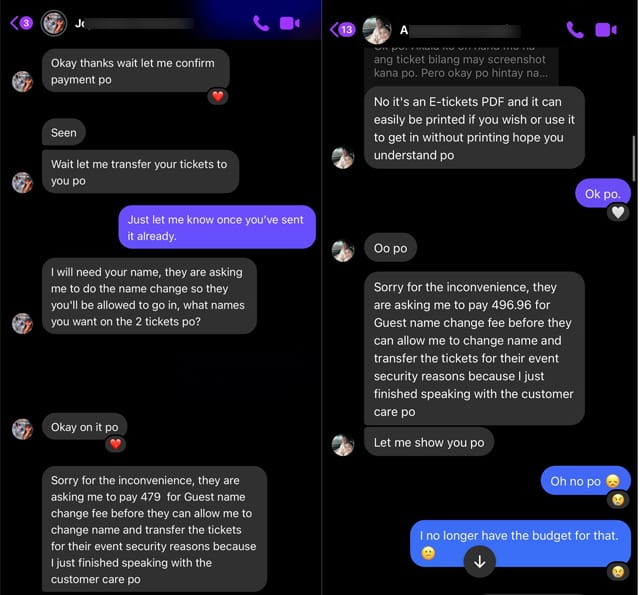
V, one of our interviewees, said that it was still happening months later: "There's a certain pattern, so they seem like they're active accounts. They post 'stories,' but all the stories look the same: random backgrounds with music/lyrics or text overlay."
"I definitely think there is a bigger system at play here mainly because the process is replicable—meaning they have this system of scamming that they methodically do with other victims. Same language, same key messaging, same flow of process. And madami na po kaming nabiktima. I can go even so far as to say that those behind these are not Filipinos because they always use English and just use 'po' in all their responses. And that's across all scamming accounts I know from the community of scammed users I've met," V added.
"We found out that there [are] a lot of FB accounts being used to make it look [like] the page [has] a lot of trusted sellers and satisfied buyers, but actually, they are all connected in one group. It's lucky when I posted [on] the page, some victims saw it and approached me before they blocked and removed me from the group. And so we are able to connect all information and figured [out], it's all a scam," P concurred.
V admitted, though, that what happened was primarily on them. "Hindi naman talaga dapat nag sa-scalp, and Ticketworld always reminds its users not to. But I think there should be more safeguards from both Meta and GCash," they explained.
How to Avoid Getting Scammed by Ticket Sellers
There's really no other way around it: Transact only with official ticketing channels like Ticketworld, Ticket2Me, Ticketnet, SM Tickets, and Live Nation.
Sometimes, plays and musicals have show buyers, who can either be an individual or an organization that has initially bought a whole show's seats for a specific date. They resell the tickets at the exact cost of official ticketing channels, usually minus the convenience or online fees. Transactions with show buyers are generally done through e-mail or mobile numbers, and modes of payment can be via online bank transfers or e-wallets. You usually know they're legitimate because the production company has endorsed their names and contact information through their official social media page.
Lastly, be careful when sending photos of your ID. And, never-ever share an OTP.
Scammers usually target high-demand events, exploiting fans' desperation. But it's really up to us to not give them a chance.
