
No More Masters

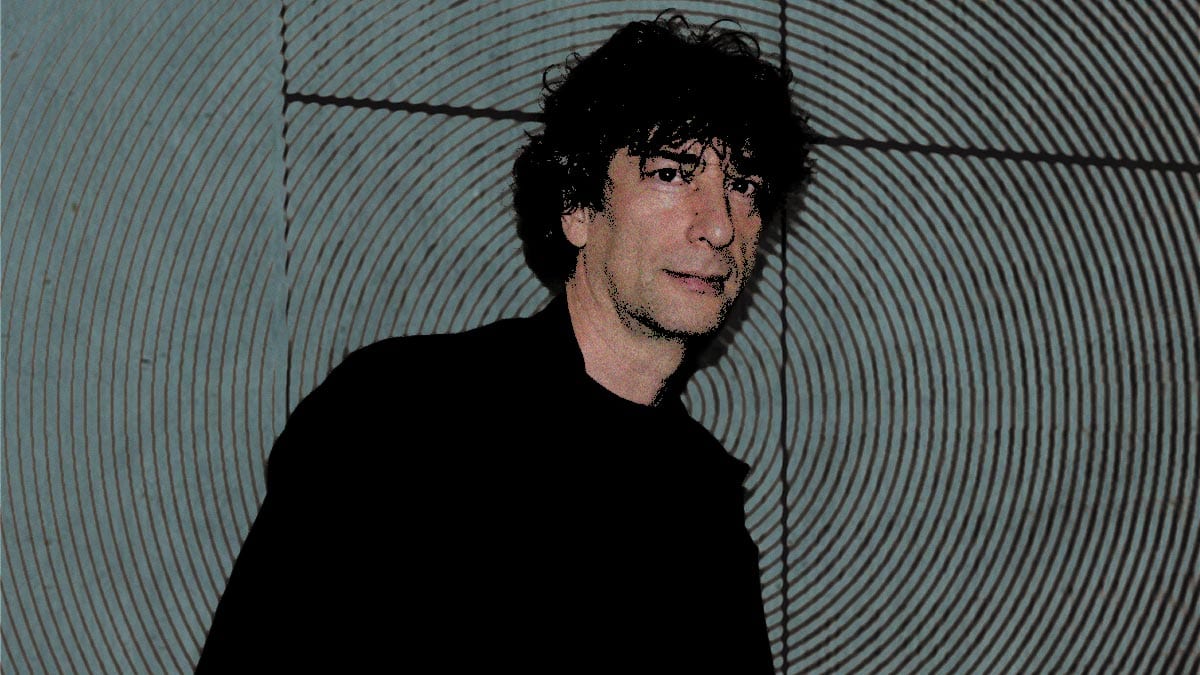
“There Is No Safe Word,” the Vulture article that tells the story of multiple women whom author and fantasist Neil Gaiman sexually assaulted, is a harrowing read. Written by Lila Shapiro, it contains highly graphic accounts of abuse that The Sandman author has perpetrated, such as forcing many of these women to call him “master,” and raping one woman while Gaiman was in the same room as his child. The piece focuses in particular on Scarlett Pavlovich who, in her early 20s at the time, was invited by Gaiman’s ex-wife Amanda Palmer to work as the family’s nanny, unaware of Gaiman’s dark history with young fans and hired help.
With his wealth, and the goodwill he accumulated over the years as a self-styled ally and storyteller revered for his portrayal of gender-based injustice, Gaiman wielded his power to take advantage of vulnerable women while covering up his crimes with close friends who can wrongfully vouch for his moral character, and NDA’s. In the words of Gaiman himself: “I’m a very wealthy man, and I’m used to getting what I want.”
*
Over the past few years, the #MeToo movement, which rose to prominence in 2017 amidst reports of abuse perpetrated by American film producer Harvey Weinstein, seemed to wane and weaken as a post-pandemic world regressed into reactionary manosphere politics. However, the collective online response to the Gaiman story, characterized by a mix of rage and grief, seemed to function as a shot in the arm, reigniting the fight and exposing anew just how prevalent sexual abuse is in Hollywood, in the literary world, and even in one’s closest circles. Not even a half-assed non-apology statement from Gaiman himself can quench these fires.
Many expressed dismay regarding Gaiman’s ex-wife Amanda Palmer. Though they both have championed themselves as allies and feminists for much of their career, Palmer enabled Gaiman to abuse his power while pretending not to see anything, acting insouciant even when Pavlovich approached her. (Some have even taken to comparing Palmer to Ghislaine Maxwell, who aided Jeffrey Epstein in trafficking young girls.)
One can watch many Gaiman fans recalibrate their worldview in real time, reckoning with how formative Gaiman’s works were in their lives while condemning his actions—the exasperating song and dance that transpires when any artist is exposed as a sex pest. There has been a surprisingly lack of motherfuckers denying or downplaying the stories of the survivors, which is rather refreshing, considering how survivors who come forward in the court of public opinion are normally treated. (See: the Depp v. Heard trial.) Epstein and Depp may not be the main characters of this story, but this is what a shot in the arm does—it reawakens a sense of urgency, and widens the breadth of one’s conviction.
*
Still, there is something deeply insidious about the fact that Gaiman is a capital W writer. He wove tales for an audience of children and nerds who identified as outcasts, then demonstrated the same cruelties of his stories’ villains. It calls to mind gender-based abuses committed by those in literary circles at large, but especially the literary scene here in the Philippines. After all, everyone has a story about pederasts in faculty that prey on their students, or padrinos who manipulate the young women they encounter in writing workshops. There is a reason Shapiro cites the character Richard Madoc, a writer who rapes the Greek muse Calliope in Sandman issue #17—Gaiman himself may not see the resemblance between him and Madoc, but the trope of the literary abuser who abuses their status of mentorship is known, even practically accepted as a fixture in academia, a famously male-dominated space.
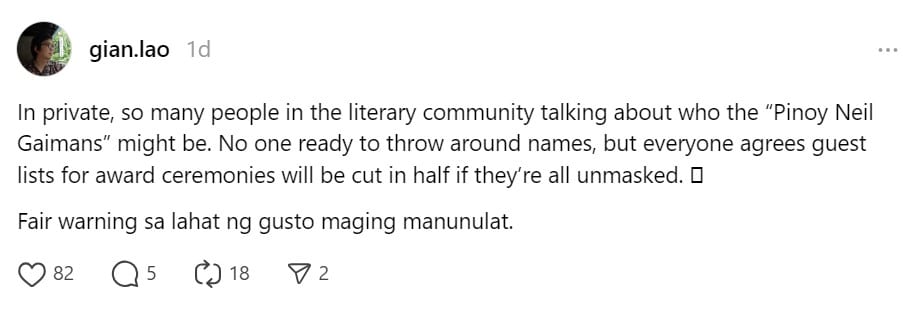
Adrienne Cacatian, an instructor in the Sociology Department of UP Diliman with a background in reporting and fighting against gender-based violence, untangles the nuances of why and how predators can thrive in artistic circles, even though subconsciously we do not expect them to be there.
“Because writing entails emotion, it entails a certain sense of vulnerability. There’s this sense na, oh [...] he’s not like the other guys because they’re more in touch with their feelings, they can actually communicate, they’re in touch with their emotional histories and experiences,” says Cacatian. They continue: “There’s an assumption that you can feel feelings, and admit to feeling feelings and communicate that you feel those feelings, you’re probably someone who has mastery over your feelings. But that’s not necessarily the case, diba?” It calls to mind the softboy archetype, a boy in an artistic field who might weaponize a facade of sensitivity to commit abuse. Even though the archetype is commonly associated with young men, Lord knows that old men, too, can act like softboys.
ALSO READ
The Filipino Connection in Jeffrey Epstein's Sex Crimes
23 Powerful Men Who Were Accused of Sex Crimes
Not for nothing, these allegations have reignited discourse on abusers and sexual predators in the music scene, from a band guitarist's being exposed for groomer behavior, to a musician's proclivity for preying on 20-somethings. In some subcultural pockets such as local music scene communities, or the literary circles of certain universities, manipulators, groomers, and predators can thrive by taking advantage of the position and clout they’ve gained with their art.
But what makes Gaiman’s actions especially heinous is that for many years, Gaiman actively interfaced with his readers. Fans of his work will remember a time when Gaiman was frequently answering questions on Tumblr, giving advice to aspiring writers, and hanging out with young people. Kendra Stout, another survivor who came forward with her story in “There Is No Safe Word,” was one such fan, who met Gaiman in the signing line for an event. They began a correspondence, and three years later, Gaiman flew her out to Orlando, and proceeded to abuse her.
There is one wrinkle in the discourse which desperately needs pleating however—a certain contingency of Twitter users that regurgitate the rhetoric of “I’ve always known this person was a creep—just look at their art!” I personally think it’s rather vacuous to fabricate a pseudo-high road position, one that insinuates that you, personally, can detect any abuser at any time, because good looks a certain way, or evil looks a certain way. The truth is, abusers and predators are able to get away with their actions because they manipulate, and there is no such thing as a person who is inherently immune to such manipulations. Employing such rhetoric also implies a one hundred percent certainty that one wouldn’t be caught dead hanging out with an abuser, when part of our responsibility as allies is to accept the possibility that predators might be closer to us than we think.
So we agree that the art and the artist are not necessarily one and the same. Is separating the art from the artist the next logical step? As Cacatian puts it: “Ang hirap i-separate ng artist doon sa art na ginawa niya precisely because the reason the artist has power over so many people is because of and through their art. And I’m not just saying this because of the emotional connection [to the audience] but also because their claim to fame is literally through their art! They build their personality, their brand, their reputation, their wealth, on the art.”
*
With “There Is No Safe Word” acting as a wake-up call, we are invited to imagine—as allies, as feminists, as creators and enjoyers of art—how we can preserve momentum and keep the fight against gender-based violence going strong. It has been heartening to see many people disavow their former admiration of him as fans, and reject his work on principle, but it cannot stop there.
“Disavowal should necessarily be part of a bigger picture, but disavowal is not sufficient solidarity,” as Cacatian puts it. For the UP Diliman instructor, though disavowing a predatory artist’s work is an important first step in solidarity, it is one thing to reject the art of an abuser, it is another thing to commit to the work of building safe spaces, or re-examining our personal biases, or simple intervening in the big and small violences we see everyday, for the work of solidarity is always building up to the bigger systemic picture.
In the Vulture article, there is one passage where Pavlovich, in trying to make sense of the abuses she was experiencing, Googles the search terms of “Me Too” and “Neil Gaiman,” trying to find some evidence of a behavioral pattern, though searches at the time did not yield then what they yield now. Today, Pavlovich can be in community with fellow survivors and allies who can assure her that she is not alone. I personally hope that similarly, other predators are watching these exposés unfold and frantically searching for their names, just to see how cooked they are. Their time is coming. There is no place to hide.
