
Carlos Chan: Wealth, Business Empire, and Life Outside Work

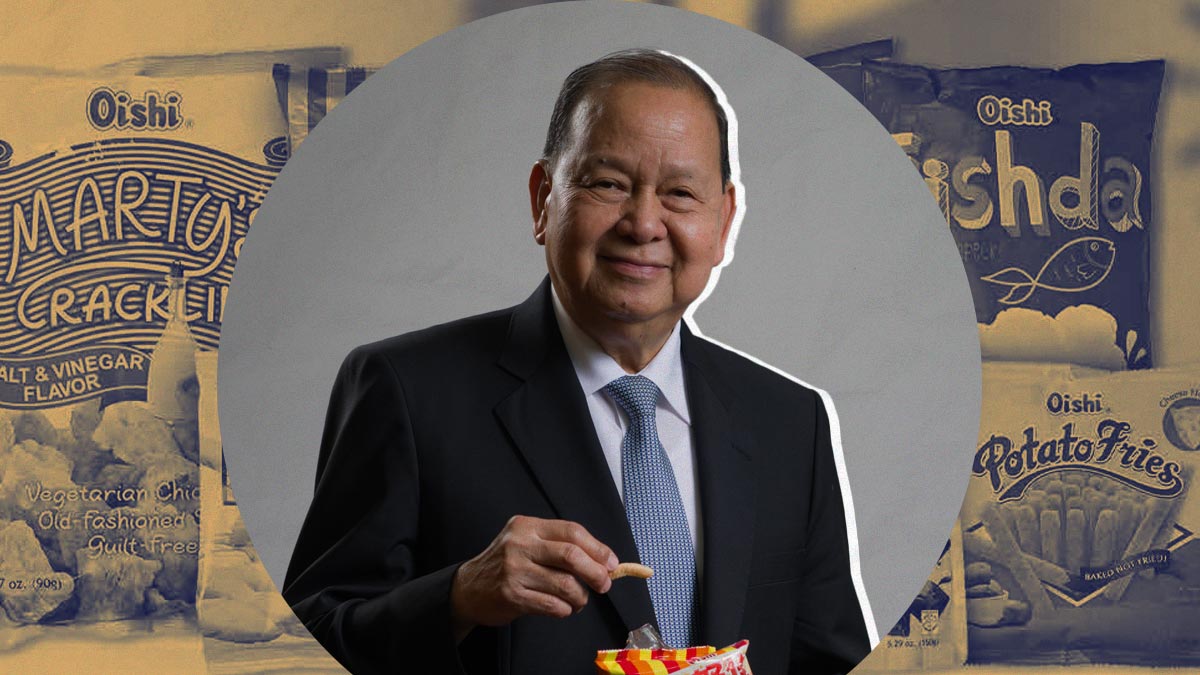
Carlos Chan owns Oishi, the global snack empire which he started in 1974. As of August 7, 2024, Chan has a net worth of $375M. He is the 35th richest according to Forbes’ 2024 Philippines 50 Richest list.
Net Worth: $375M
Age: 83
In His Youth
Carlos Chan’s story began not in boardrooms or massive factories, but in the modest streets of Manila. Entrepreneurship for the Chan family back then was less about growing an empire and more of a means to survive.
In 1914, his father, Chan Lib, moved to the Philippines from their hometown in Fujian Province, People’s Republic of China. After settling in Manila, Chan Lib started a modest business repackaging cornstarch (or gawgaw) and coffee under the brand name Liwayway, which means "break of dawn" in Tagalog, symbolizing hope and new beginnings. His mother, See Ying, was also an entrepreneur herself, selling okoy (fried shrimp fritters).
Growing up in a family business environment instilled in Chan a strong work ethic and entrepreneurial spirit. As a child, he witnessed his father’s resourcefulness and resilience, often helping with small tasks related to the business. These formative years deeply influenced his later approach to leadership and innovation.
As one of eight siblings, Chan understood the importance of collaboration and shared responsibility. In 1963, the siblings formally incorporated Chan C. Bros., a family venture that diversified into lighting and bathroom fixtures.
By 1966, Liwayway became Liwayway Marketing Corporation, which distributed candles. It was then managed by Chan’ younger brother, Manuel, while the other siblings started their own businesses–one of them is Ben Chan, who founded Bench, the local clothing company.
Chan’s true calling emerged when the family business ventured into snack foods in the 1970s.
ALSO READ: Liwayway Gawgaw: From Cornstarch Company to a Global Behemoth
Carlos Chan's Business Empire
Liwayway's strategic pivot to snack food manufacturing in the 1970s proved transformative. In 1974, the company introduced Oishi, a brand name derived from the Japanese word for "delicious." The first product, prawn crackers, became an instant hit among Filipino consumers. To meet the growing demand, the company established a factory in Imus, Cavite, which remains a cornerstone of its operations.
While political unrest in the Philippines during the 1980s posed challenges, Chan saw opportunities elsewhere. Inspired by China’s economic liberalization under Deng Xiao Ping, he entered the vast uncharted Chinese market in 1993. Partnering with state-owned companies, he leased warehouses and invested $3.5 million in his first factory in Shanghai. This calculated risk laid the foundation for Oishi's remarkable expansion across China.
Today, the Liwayway Group operates an impressive network of 15 factories across China and additional facilities in Vietnam, Myanmar, Thailand, Indonesia, Cambodia, India, Uzbekistan, and Bangladesh. Most notably, they also built manufacturing plants in Johannesburg, South Africa in 2015. "We were the first Filipino company to invest in this region," Chan said during his acceptance speech for the MAP Management Man of the Year 2021.
In the Philippines, the company’s production network spans key regions, including satellite plants in Cebu, Iloilo, Cagayan de Oro, and Tarlac, ensuring nationwide distribution. Oishi’s diverse product line, from chips to candies, has become a staple in pantries across the region.
Beyond snack foods, Chan has diversified into hospitality through a partnership with the Chinese hotel brand Jin Jiang and the Indonesian J.CO Donuts chain. These ventures demonstrate his acumen for identifying emerging market trends and leveraging synergies across industries.
Impact on Philippine Society and Economy
Carlos Chan’s entrepreneurial journey represents more than just business success–it’s a blueprint for national economic transformation. Through the whole family’s efforts to convert a local cornstarch-repacking business into a multinational conglomerate, the Chan family exemplifies the Filipino entrepreneurial spirit. After all, the Liwayway Group’s operations have created tens of thousands of jobs, not only in the Philippines but across the world.
Oishi’s export activities have positioned the Philippines as a competitive player in the global snack industry. In fact, in 1996, it was dubbed a "Shanghai Famous Brand," the first non-Chinese company to achieve this. By 2001, it was named a "China Famous Brand," and Chan was declared an honorary citizen of Shanghai four years later.
It’s no wonder then that Chan has been appointed as a special envoy to China several times under various presidents: Gloria Macapagal-Arroyo, Benigno Aquino III, and Rodrigo Duterte. His latest appointment, in particular, was meant to improve ties with China and resolve the maritime dispute over the West Philippine Sea. Not to mention, it boosts trade between the two nations.
"I am a Filipino-Chinese and was born in the Philippines. Both the Philippines–my motherland, and China–my ancestral country, hold special places in my heart. These two countries are separated by a strip of water and have a brotherly relationship that has lasted for centuries," Chan remarked upon receiving the Chinese Government Friendship Award in 2024.
Chan’s and Oishi’s societal impact extends beyond their trade and diplomatic efforts. In partnership with Adarna House, Oishi has created reference books for children, making facts fun with the book series "100 Questions Kids Ask." Another literary venture is their work on a series of books that aim to educate children on finances, "Peso-Smart Kids." Lastly, in partnership with Kabalikat sa Kaunlaran ng Baseco Inc., Urban Poor Associates, and Maraming Bayani Foundation, Oishi supports "Habi Bags"–creating bags, accessories, and containers out of scrap packaging material. This environmentally-friendly initiative also helps provide a livelihood to the people of Baseco.
Outside the Boardroom
Despite his remarkable success—a net worth of $375 million and ranking 35th on Forbes' 2024 Philippines 50 Richest list, Chan remains remarkably grounded. He attributes his success to family, humility, perseverance, and patience. He’s instilled these principles in his six children, who now manage various facets of the family business.
His eldest son, Carlson, oversees new business ventures, while Larry leads the group’s Chinese operations as the chairman of Liwayway. Archie heads research and development while also heading the Philippine company of Liwayway Marketing, Rinby focuses on packaging and development innovation, and Ozen heads their division in other Asian countries. Lastly, the youngest child, Shera, leads marketing. The family’s collaborative dynamic has been instrumental in sustaining the growth of the Liwayway Group across generations.
Chan is also a firm believer in the power of relationships. His efforts to maintain close ties with employees, partners, and friends have earned him admiration and respect in both business and diplomatic circles. When he received the Management Association of the Philippines’ prestigious Management Man of the Year award in 2021, he dedicated it to his family and team, recognizing their collective contributions to his achievements.
"With great pride, I must share this award honor and success with my beloved wife Priscilla, who is my inspiration and stead. She stood by me during the most challenging times of our business. More importantly, she holds the strings and the pulse, which without doubt is crucial in the success of a business," he said in his speech.
"I also owe it to my children, who unselfishly support and give their best talents and effort for the company to grow, prosper, and compete in the global market. My children Carlson, Archie, Rinby, Larry, Oszen, and Shera are living proof that the third generation can very well continue and grow a family business started by the first and second generation. My wife and children are my priceless treasures. And I thank God for blessing me with a wonderful family."
Chan’s journey from supporting his father’s humble business to orchestrating a global success is a testament to the power of family and unwavering determination. With the Oishi empire, he continues to shape industries and uplift communities–and who wouldn’t be proud of such a legacy?
