
What Albert Einstein's Relationship With J. Robert Oppenheimer Was Really Like

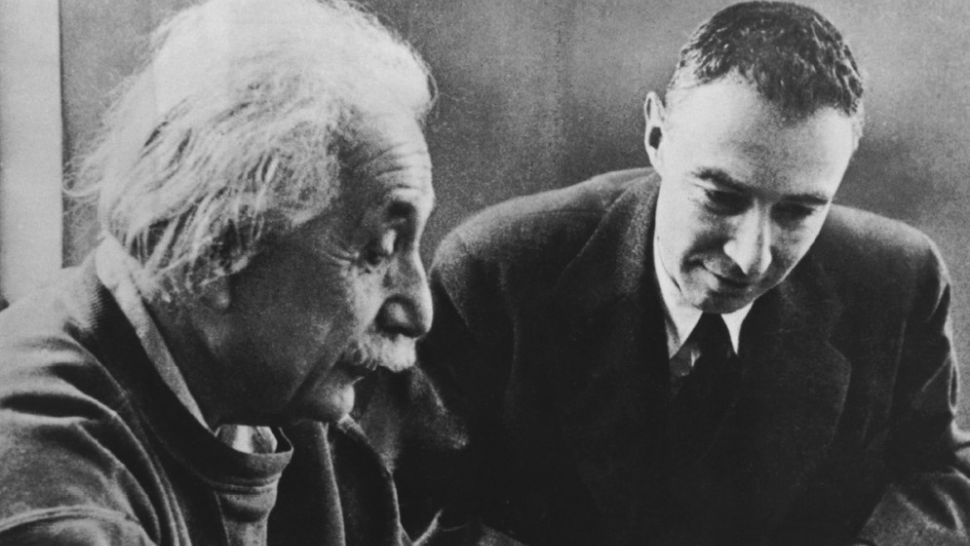
Watching Cillian Murphy’s J. Robert Oppenheimer and Tom Conti's Albert Einstein interact in Christoper Nolan's Oppenheimer film, we can't help but think of the nature of the two scientists' relationship in real life. Think about it: two of history's most important physicists happened to be neighbors at Princeton University for eight years. Who knows how many of those lakeside talks really transpired? They were different generations of genius, after all.
It was Einstein who first found a home in New Jersey back in 1933. At the time, the rise of Adolf Hitler and Nazi Germany was on the horizon, and Einstein knew it would be a bad idea to come home, to say the least. Princeton’s Institute for Advanced Study, which focuses on theoretical research, offered him a resident scholarship, which included his own home on the Princeton grounds. He would decide to stay in the United States two years later, becoming a citizen by 1940.
Einstein had made quite a contribution to the Institute for Advanced Study at the time. He would prove to be an influential figure on foreign soil. In 1938, he even wrote to President Franklin Roosevelt about the possibility of a super weapon. This was the year that German scientists had split the uranium atom, which meant that a much more destructive bomb was coming sooner rather than later. And in the hands of Hitler, that would be catastrophic.
ALSO READ:
A Sneak Peek at Christopher Nolan's Oppenheimer, Suspected to Be His Magnum Opus
Yes, Oppenheimer poisoned his tutor's apple while at Cambridge.

Enter Oppenheimer, who was at the forefront of the Manhattan Project. We, of course, now know what happened next. As the leader of the Manhattan Project, Oppenheimer was a star in the scientific community. So much so that he received various offers to head departments across America. He came to Princeton by way of Lewis Strauss, one of the university's trustees. He was in direct competition with another man named Wolfgang Pauli for the Institute for Advanced Study's director gig. When Einstein was asked who he would choose between the two geniuses, he reportedly found Oppenheimer too dominant.
Of course, Oppenheimer eventually became the director of the Institute for Advanced Study. The move had him moving his family into Olden Manor, which was just a few kilometers away from Einstein's own home. Oppenheimer and Einstein became colleagues and good neighbors.
They were said to have visited each other's homes from time to time. Oppenheimer was thoughtful enough to have a radio installed in Einstein's residence so that he could listen to classical concerts. But that doesn't mean they were friends. Among their many disagreements were their ideas about quantum physics. Oppenheimer thought of the field as the foundation for modern theoretical physics while Einstein continued to challenge its standing.
Einstein, however, defended Oppenheimer when he was summoned by the state for his alleged communist ties. The physicist sympathized with Oppenheimer's predicament and was outraged by the whole "witch hunt," as the genius reportedly called it. He advised him to think about the government's treatment if that was a worthy reward for the Advanced Study director's service.
Oppenheimer nevertheless went through with the biased interrogation, which ended with him having his security clearance revoked in 1954. When Einstein heard of the news, he reportedly responded with a laugh, according to the Oppenheimer book, American Prometheus. “The trouble with Oppenheimer,” Einstein claimed, “is that he loves a woman who doesn’t love him — the United States government.”
Oppenheimer reportedly thought of Einstein as a "landmark" not a "beacon," according to a note about a Time magazine article in the 50s by American Prometheus.

A year later, Oppenheimer returned to teaching. Einstein, on the other hand, fell ill and declined treatment, leading to his eventual demise. More than a decade later, Oppenheimer stepped down as director of the institute in 1966, but continued to live in the Olden Manor until his death in February 1967. To this day, the homes where the two lived still stand as private residences.
In Oppenheimer, it was Einstein who warned the physicist that the applause was never going to be for him once his time for state recognition came. Well, he was right, wasn't he?
