
Fly Me to the Moon Is a Reminder That Valuing Truth Is Truly What Made America Great

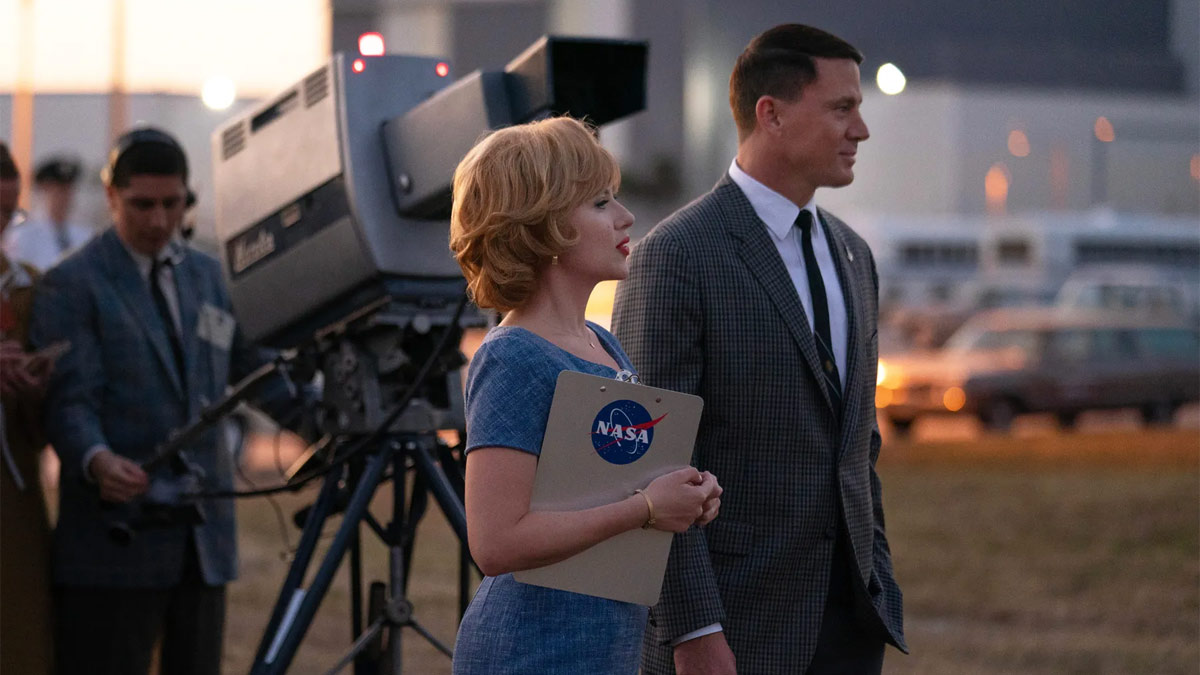
At some point in human history, we put a man on the moon. In what is arguably the greatest dick-measuring contest of the modern age, the United States of America and the erstwhile Soviet Union upped each other in what was called the Space Race. The two world powers, one the shining beacon of democracy and the other the looming juggernaut of communism were engaged in the Cold War, and the exploration of space was just another arena for saber-rattling. The Soviets led that race for a long time, scoring hits for historic landmarks, such as being the first to send a satellite into space and the first to successfully send a man to orbit the planet. The United States had fallen so far behind that in May 1961, and President John F. Kennedy publicly claimed that the U.S. would send a man to the moon before the end of the decade. Good times.
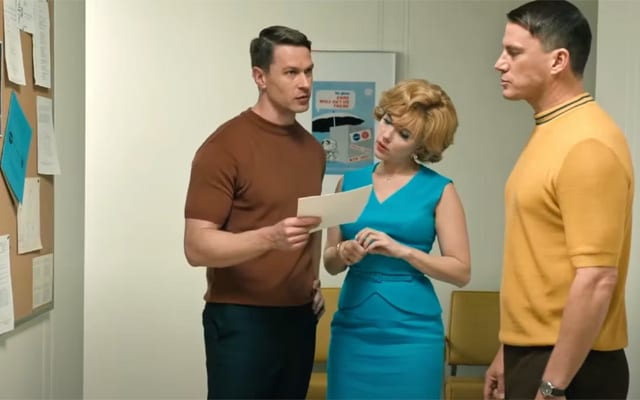
Fly Me to the Moon is the fanciful, fictitious tale of the story behind NASA’s moon landing, which effectively won and ended the space race. It stars Scarlett Johansson as PR maven Kelly Jones and Channing Tatum as NASA launch director Cole Davies, venturing into period rom-com territory with a 1960s backdrop.
ALSO READ
Buzz Aldrin Isn't Happy That 'First Man' Doesn't Show This Iconic Moon Landing Scene
Did Neil Armstrong Really Leave His Daughter's Bracelet on the Moon?
It’s 1969, nearly a decade after Kennedy’s pronouncement and seven years after he was assassinated. Nixon had just been sworn in, America had sent over half a million soldiers to Vietnam, and Americans had started to lose interest in space and had even less interest in keeping a dead man’s promise, or some would say boast, to the world. Jones is an amalgam of several PR experts and the personification of NASA’s real efforts to revamp its image and boost support for its lunar mission. Space exploration is an expensive endeavor, and getting a man on the moon meant that NASA had to convince the American people to spend as much as four percent of the national budget on sending a handful of guys to rock around 384,000 kilometers away. In order to do that, NASA had to sell one hell of a story.

Johansson’s Kelly Jones is effusive and charismatic, a fast-talking advertising and marketing genius who would give Don Draper a run for his money. She contrasts the straight-laced Davies, who plays by the rules she’s never afraid to break. While this gives the pair a natural tension and chemistry, their contrasting stances on truth are what ultimately drive the entire plot of the film. Jones isn’t above fabricating lies or twisting facts in order to sell a product in the name of advertising and PR. Fly Me to the Moon makes it clear that the only way NASA managed to get things done was through an unprecedented advertising campaign that wove the dream of space into the fabric of America’s everyday life. From product placements to getting astronauts on television, magazine covers, and cereal boxes, NASA almost literally sold America the moon.
Things come to a head when shady government agent Moe Berkus (Woody Harrelson), who recruited Jones in the first place, demands that she fabricates a successful moon landing because the stakes are now so high that America simply couldn’t be embarrassed on the world stage. It’s a plot point taken from the real-world conspiracy theory that the moon landing was a hoax, a lie so audacious and huge that the idea stuns even Jones, for whom lying is already second nature. Jones had no qualms employing more photogenic and charismatic actors to play the parts of NASA scientists in televised interviews, she wasn’t concerned that the astronauts weren’t really going to wear Omega watches into space or that they really didn’t drink Tang. So, faking the moon landing was just another advertising challenge, wasn’t it?
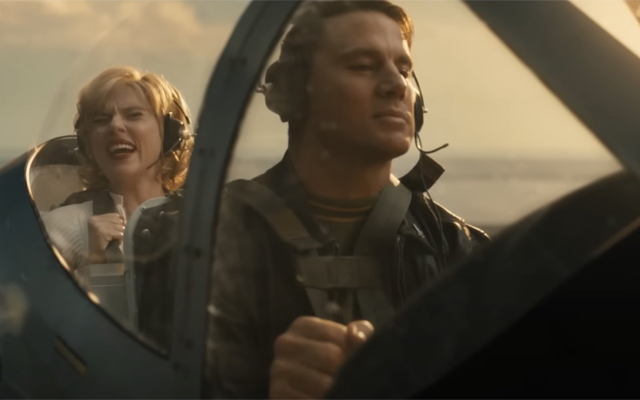
Besides, Berkus had a point. It was no longer about just sending a man to the moon. It was about the United States planting its flag and rubbing it in the Soviet Union’s face. There was no room for failure. Fly Me to the Moon spends its third act building up a fake moon landing that unravels into a moral dilemma. How important is the truth? Is there a point to a live broadcast if it’s all just a set in some secret soundstage in Florida? Davies doesn’t think so. He believes in the truth so strongly that he sticks out as a relic of a bygone America. Once upon a time, America valued truth. Once upon a time, America was truly so great that it put men on the moon.
The caveat in that statement, of course, is that America was only ever truly great if the moon landing was true. Otherwise, America’s greatness is a lie. This is the paradox faced by conspiracy theorists, who are often the same people who want America to be great again. Today, America can hardly be called great, and the Soviet Union no longer exists. Once the bastion of democracy and the leader of the free world, today’s America is in real danger of falling into a Christofascist rule, and all that remains of the U.S.S.R. is a country led by an autocrat who bullies his way into wars. NASA has faded from glory, and the only Americans fascinated by space are billionaires who use rockets as proxies for their dicks in an inconsequential contest.
Fly Me to the Moon is directed by Greg Berlanti, award-winning producer and creator of popular television shows like the CW’s Arrow and Supergirl and Red, White, & Royal Blue on Amazon Prime. Berlanti’s shows all have a distinctive joy and lightness to them, and this signature touch suffuses every frame of Fly Me to the Moon. There are no dull moments in its 132-minute runtime, propelled by a snappy pace, endearing characters, and a clever script that never talks down to its audience except, perhaps, towards the very end to deliver the film’s entire point just in case anyone missed it. When Davies tells Jones that the Soviets were accusing the United States of faking the moon landing, she tells him it doesn’t matter, "The truth is the truth even if nobody believes it. A lie is a lie even if everybody believes it." Words to live by.
