

Theater Review: Once on This Island Shines With Catchy Songs, but Falters in its Narrative

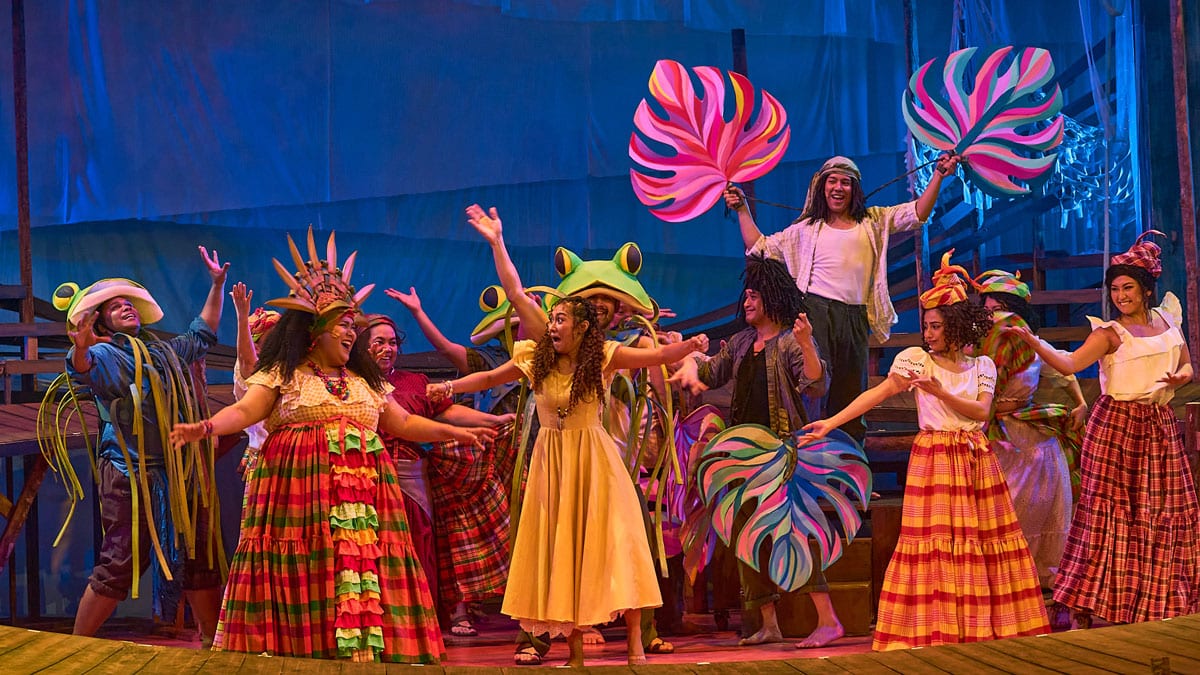
The picturesque Antilles islands of the Caribbean evoke an image of turquoise-blue waters lapping against soft, white shores, lined with tall trees; verdant peaks rising in the background; and vibrant hues of tropical fruits mingling with the aroma of spices. However, such tranquil scenery contrasts sharply with the stories of hardship and oppression that have long plagued this region.
ALSO READ: Once on This Island Is a 9 Works Favorite—They Hope It Becomes Yours, Too
History of the French Antilles or French West Indies
French explorers arrived in the Caribbean in the early 17th century, establishing settlements in Guadeloupe and Martinique. The fertile soils were transformed into tobacco and sugarcane plantations that relied on enslaved Africans for labor. This created a binary system where French colonists were at the top, and slaves from West Africa were at the bottom. Although slavery was abolished in 1848, oppression continued, with peasant laborers now occupying the lowest rungs of society.
This historical backdrop is the stage for the 1990 musical Once on This Island. The coming-of-age one-act stage musical is based on the 1985 novel My Love, My Love; or, The Peasant Girl by Rosa Guy, which is a retelling of Hans Christian Andersen's 1837 fairy tale The Little Mermaid. Produced by 9 Works Theatrical, it is currently running at the RCBC Plaza in Makati.
Once on This Island, with a book and lyrics by Lynn Ahrens and music by Stephen Flaherty, shines with its catchy songs, filled with LSS-inducing rhythms and joyful lyrics. Most of the cast members heightened the audience members' enjoyment of these songs by delivering Broadway-style performances, as promised by Artistic Director Robbie Guevara. Radha and Garrett Bolden are deserving of special mention, whose powerful voices match their characters as gods.
The 9 Works Theatrical production also boasts an awe-inspiring and visually striking set design by Mio Infante. The circular catwalk is a sight to behold as if we're really brought to one island. It could get crowded, however—unless that's the physical interpretation of the clashing of "two different worlds of one island." The cloth overhead often moves with a staged wind, a clever technique, especially since weather plays a huge part in the story.
Yet, beneath this colorful world, the narrative seems to perpetuate troubling racial and gender dynamics.
The Story of Once on This Island
The musical opens with the lyrics, "There is an island where rivers run deep. Where the sea, sparkling in the sun, earns it the name 'Jewel of the Antilles.' An island where the poorest of peasants labor—and the wealthiest of grands hommes play." This introduction not only sets the stage for the picturesque setting but also hints at the historical and political tensions underlying the story. It contrasts the grands hommes, with their pale brown skins and French ways, who own the land and control their destinies, with the peasants, black as night, who are at the mercy of the wind and the sea, as in the song "We Dance."
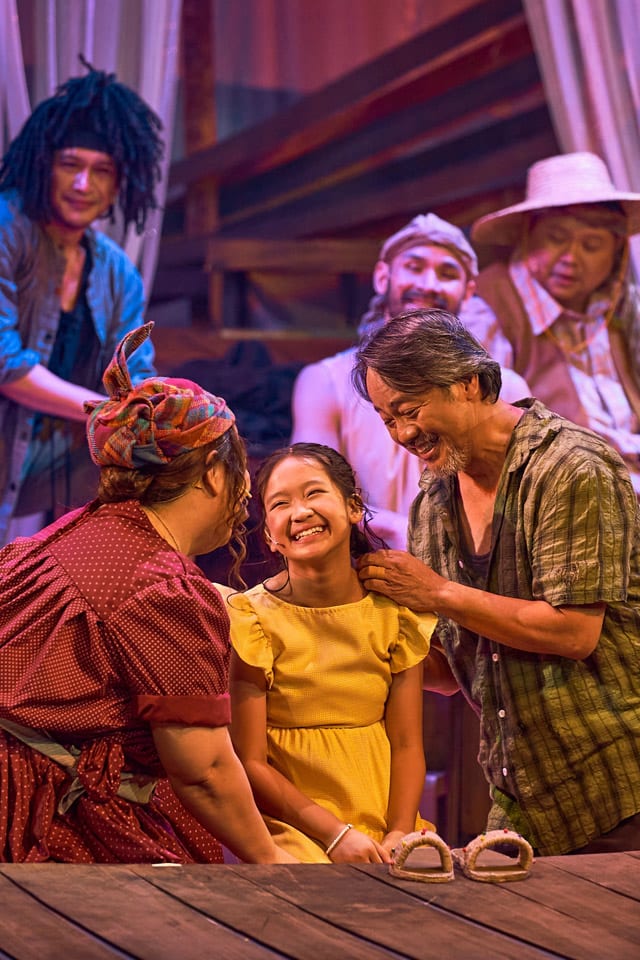
The narrative focuses on Ti Moune, a peasant girl orphaned during a great flood and raised by an elderly couple, Mama Euralie and Tonton Julian. As she grows up, Ti Moune dreams of a stranger arriving to change her life, as expressed in the song "Waiting for Life." The gods—Asaka, Mother of the Earth; Agwé, god of Water; Erzulie, goddess of Love; and Papa Ge, demon of Death—listen to her wish for "a grand homme to carry her away" ("And the Gods Heard Her Prayer/Rain").
The grand homme in question is Daniel Beauxhomme, a descendant of French colonizers. Their fateful meeting is orchestrated by Agwé, who conjures a storm that causes Daniel's car to crash.
Ti Moune nurses Daniel back to health, believing that the gods have destined them to be together despite her parents’ and the village’s objections. Convinced of her love and Daniel’s need for her, Ti Moune makes a wager with Papa Ge, willing to die for her grand homme.
This is where the narrative becomes problematic.
While the musical frames Ti Moune’s story as one of hope and determination, it is difficult to ignore the dynamics of female subjugation at play. Ti Moune is depicted as a damsel-in-distress, waiting for a knight-in-shining armor. Her love for Daniel is fueled by his charm, wealth, and privilege—attributes she lacks, revealing an unconscious legacy of colonialism and the allure of white supremacy.
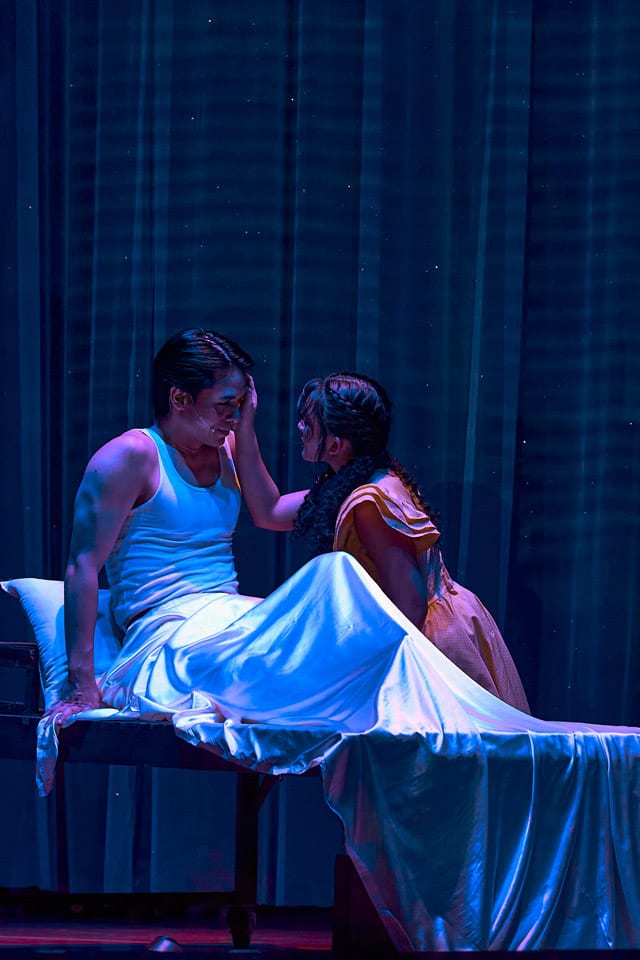
Ti Moune sees salvation in Daniel and chases him when he is taken to the Hotel Beauxhomme. She sacrifices everything, abandoning her family and embarking on a tumultuous journey to the hotel, motivated only by her obsession. When she arrives, Daniel does not recognize her and orders her to leave. However, he eventually becomes kind to her after she heals him with an exoticized portrayal of power rooted in her ancestral heritage.
Stripped of her agency, as she now only exists in relation to him, Ti Moune’s plight worsens when Andrea Devereaux persuades her to dance at the Hotel Beauxhomme’s ball. The guests enjoy her unique movements, highlighting her exoticness and otherness (see: Orientalism). It is later revealed that Andrea and Daniel are already promised to each other in a fixed marriage. Furthermore, Papa Ge reappears, demanding Ti Moune kill Daniel—a task she cannot complete due to her undying love.
We never see a happy ending, at least in terms of the "love story" between Daniel and Ti Moune. Daniel marries Andrea Devereaux, while Ti Moune, expelled from the hotel for attempted murder, waits outside the gate for two weeks without food. When Daniel sees her, he places a silver coin in her hand and leaves. Ti Moune dies outside the gates and is transformed into a tree—-as if the erasure of her identity was not enough.
The tree is said to have "cracked the walls of the Hotel Beauxhomme so that its gates could never close again" and "lived forever, sheltering peasant and grand homme alike." It also becomes a symbol of love between the descendants of Ti Moune and of Daniel. While this ending is emotionally charged, Ti Moune’s tragic fate is romanticized rather than presented as a critique of the unjust system. The narrative ultimately suggests that gender, racial, and class divisions are immutable, and Ti Moune’s futile devotion is framed as noble rather than deeply problematic.
Note: This author saw Once on This Island on September 7 (7:30 p.m.), which is the production's third show since it opened on September 6. It featured Thea Astley as Ti Moune, Jef Flores as Daniel, Krystal Kane as Andrea, Jasmine Fitzgerald as Erzulie, Raul Montesa as Tonton Julian, and Bianca Estacio as Little Ti Moune. Rounding up the cast are Lorenz Martinez as Papa Ge, Garrett Bolden as Agwe, Radha as Asaka, Lani Ligot as Mama Euralie, PJ Rebullida as Armand, and Fay Castro, Jordan Andrews, Sam Libao, and Jonjon Martin as the storytellers.
The roles of Daniel, Erzulie, Tonton Julian, Andrea, and Little Ti Moune are alternately played by Sam Concepcion, Shiela Valderrama-Martinez, Noel Rayos, Shanaia Gomez, and Reese Iso.
Once on This Island runs until September 29 at Carlos P. Romulo Auditorium, RCBC Plaza, Makati. Tickets, which are priced from P2,200 to P3,900, are available through Ticket2Me.
