
How the Nazareno Devotees Opened My Heart

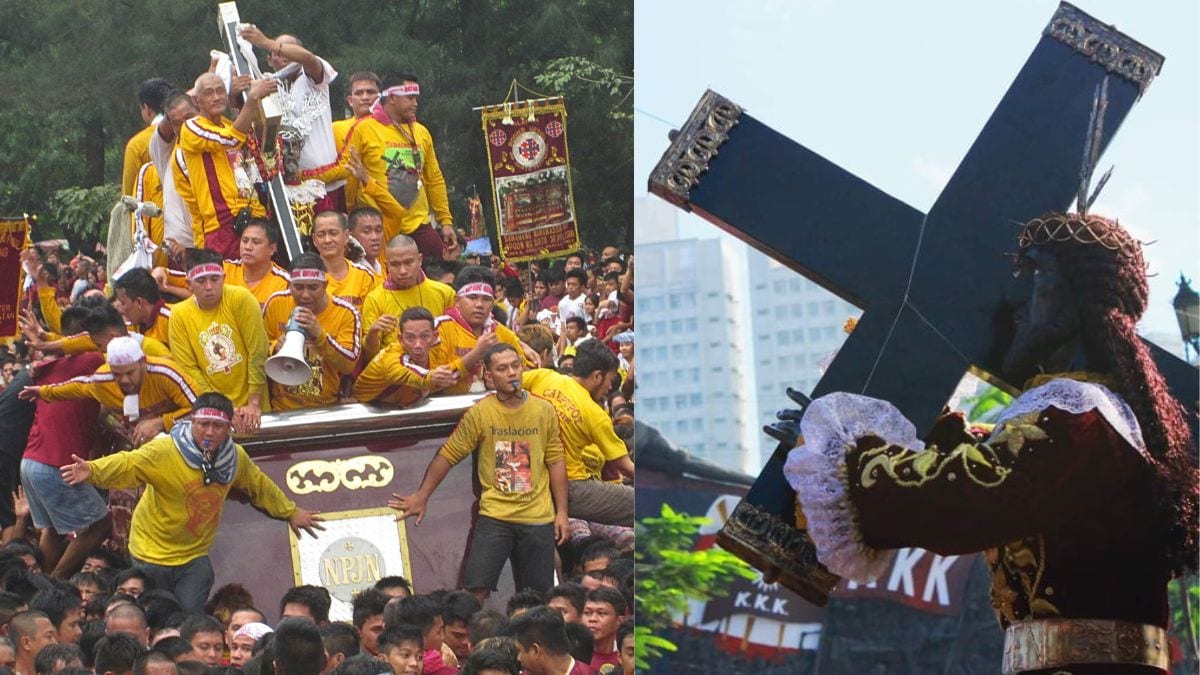
“Fanatical, crazy, exotic!”
“The Jesus Nazareno devotees are poor people, that is why they are obsessed with the suffering Christ; they are a beggar people.”
“We are poor because religion is still strong in this country. Faith makes people weak and unfree.”
These are some of the things in the discourse every time the Procession for the Jesus Nazareno (also known as the Black Nazarene) comes annually every 9 January.
I became a Born-Again Protestant Christian when I was in grade school, having been enrolled in a Baptist school. At some point in my life, I was also one of those who criticized these devotees. But I took social sciences classes in college and learned about cultural relativism, which teaches that we should respect the different religions and cultures of people other than ourselves. That in the study of culture, no culture is superior or inferior to another.
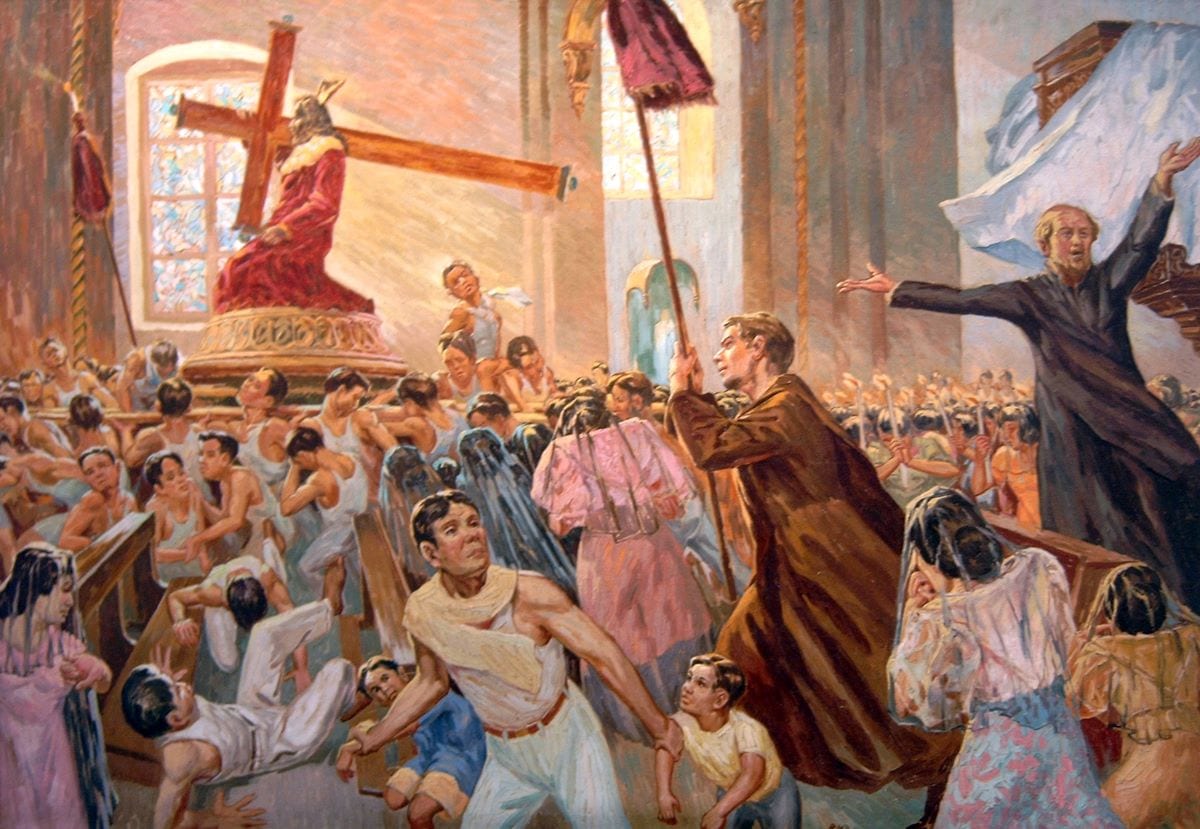
Ricarte Puruganan's Black Nazarene of Quiapo (1937)
When I became a newly graduated teacher, I was able to talk to my dorm mate and colleague, Dr. Lars Raymund Ubaldo, who is a "mamamasan" (carrier of the rope). He showed me that there is more to what appears to be chaos. The devotees have a subculture, using terms and hand signals exclusive to them to communicate instructions in a large crowd: "salya" (push to put the andas or the carriage into order), "otso" (intertwining rope to be straightened), "pasan" (to carry the rope), "sampa" (to climb and reach the image in the andas), and "kadena" (to form a chain to organize people). I also learned from Sir Lars about how the Nazareno culture blends our ancient beliefs in the power of objects with Catholicism. This is why we have the act of wanting towels to be touched by the Nazareno to transfer bisa, potencia, or gahum (power), so we can wipe it on our bodies to achieve "kaginhawahan" (comfort, well-being, good life) and "kagalingan" (healing).
I tried to communicate this idea in the years that followed when I became a public historian and would be interviewed on television. But after many years of explaining, I wanted to delve deeper. As I journeyed through my Ph.D. studies in Anthropology and struggled to choose a dissertation topic, I realized, why not focus on the Traslacion of the Jesus Nazareno?
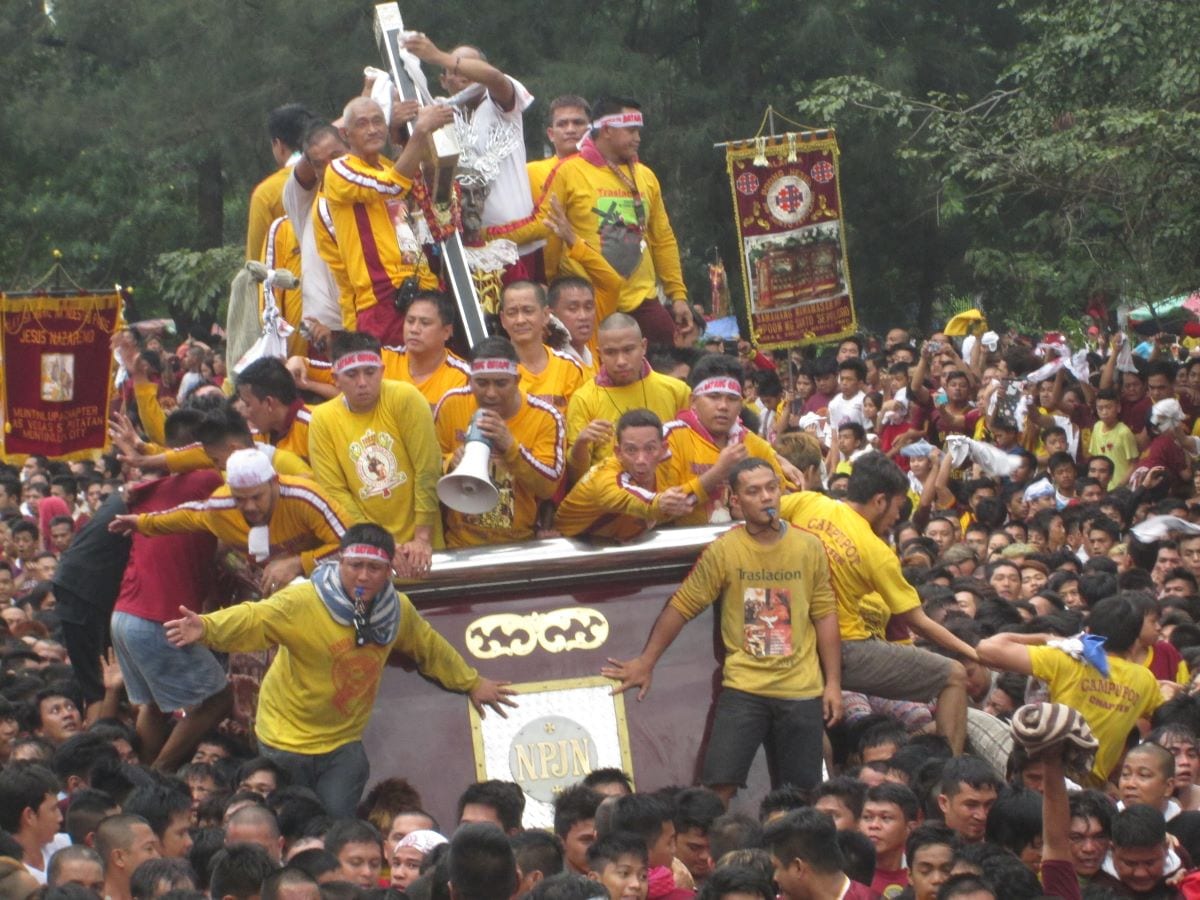
Traslacion 2015.
Equal in the Eyes of God
I started with the Nazareno devotees or "mamamasan" of nearby Pandacan, Manila in 2014. When I interviewed them, they explained how "pamamasan" and "pagsampa" actually work, not as frenzied chaos, but as something more systematic. It is better to come in balangays (groups) so someone can "balya/salya" them to go under the rope. Once under, they can raise their arms to cover their hearts to avoid suffocation and harming others. They wear no shoes or sandals, remaining barefoot not only for the safety of others but also as the greatest respect for Jesus, our Lord. It also reminds them that they are all equal in the sight of God, whether rich or poor, young or old, male, female, or others. They follow the "indayog" (the flow of the crowd from left to right) so they won’t be hurt.
ALSO READ
Today I Learned: The Black Nazarene Has Always Been Black
These Filipino Celebrities Have a Deep Connection With the Black Nazarene
We also see "sampa" as a form of crab mentality—stepping on another so one can climb the Nazareno. But I learned that those who stand beside the andas are actually called "pingga" (an old term for the handle of the andas), and they allow their shoulders to be stepped on by devotees to help them climb. This does not indicate selfishness and chaos but rather embodies bayanihan and pakikipagkapwa-tao (community spirit and empathy). While excesses do occur, they seem to be the exception rather than the rule. When the Pandacan devotees placed a replica of the Poong Jesus Nazareno on their street, gang wars ceased, and many joined their balangay.
I used to think that the processional image Vicario and the main altar image Venerado were in the church every day, yet people still came to queue for the pahalik every Friday (12 hours during each Traslacion) and to gather around the andas. I later learned from anthropology that when people perform rituals together, they replicate their everyday struggles together and achieve communitas, which revitalizes them after the ritual. In this sense, on the one day they can be with the Nazareno, they actually feel free.
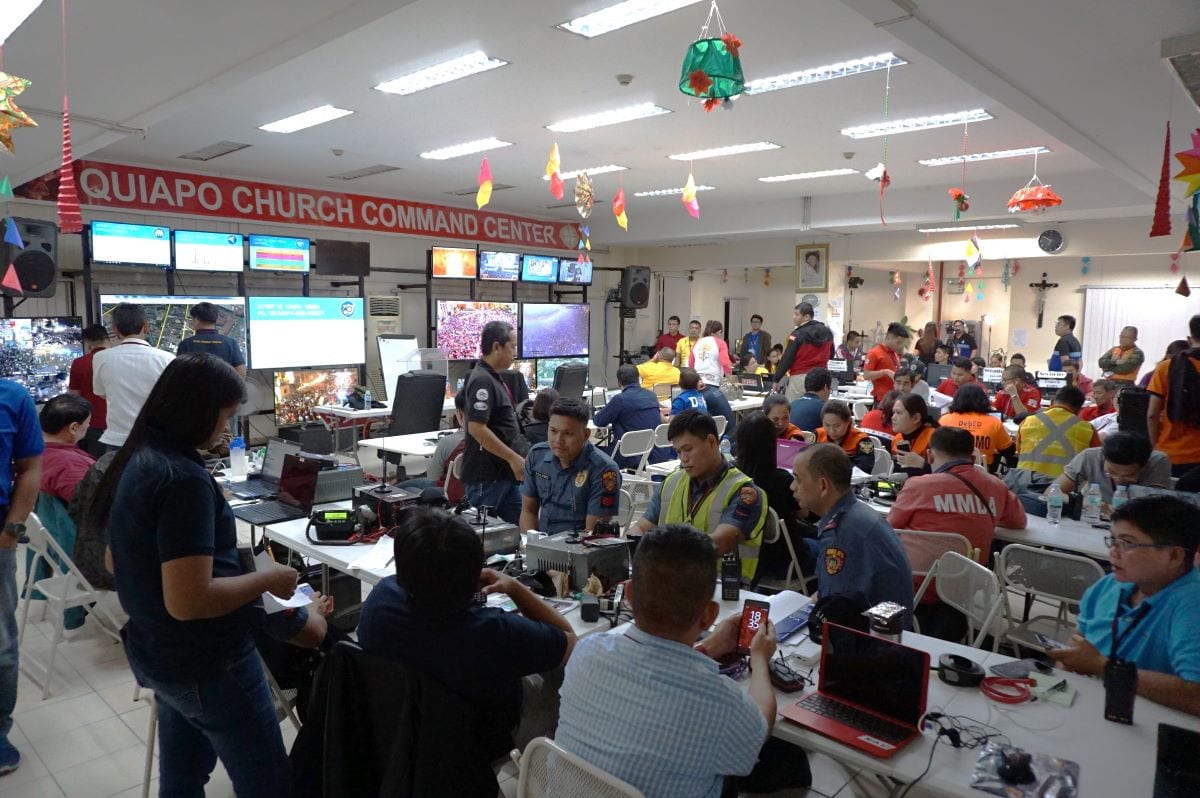
The Quiapo Church Command Center
Bayanihan at Work
I had the impression and assumed that Quiapo Church was unwelcoming to researchers due to the frequent misrepresentation of devotees. But I decided to seek permission to conduct my ethnography and anatomy of the feast, and show that my intent was not to exoticize the devotees. Surprisingly, Monsignor Clemente Ignacio, whom I refer to as "The Father of the Traslacion," gave me the green light. I was allowed to attend meetings at the Department of National Defense, the City Government of Manila, and the Metro Manila Development Authority in preparation for the Traslacion of 2015. Kuya Bong Grajo of the Emergency Response Integration Center, Ate Minnie Seculles, and Father Ricardo Flores Valencia guided me throughout the process, showing how the Traslacion was planned not just as a church event but as a national event.
During Traslacion 2016, I was allowed to observe inside the Quiapo Church Command Center. I saw how the church, the City Government of Manila, the Metro Manila Development Authority (MMDA), the National Disaster Risk Reduction and Management Council (NDRRMC), uniformed personnel, various government agencies, and non-government organizations (NGOs) were integrated in one place to monitor how plans developed over months were implemented. This demonstrates that it is not just the devotees but the entire bayan that pushes, or salya, the Traslacion to its safe and glorious conclusion. It is "people power" and "bayanihan" at work.
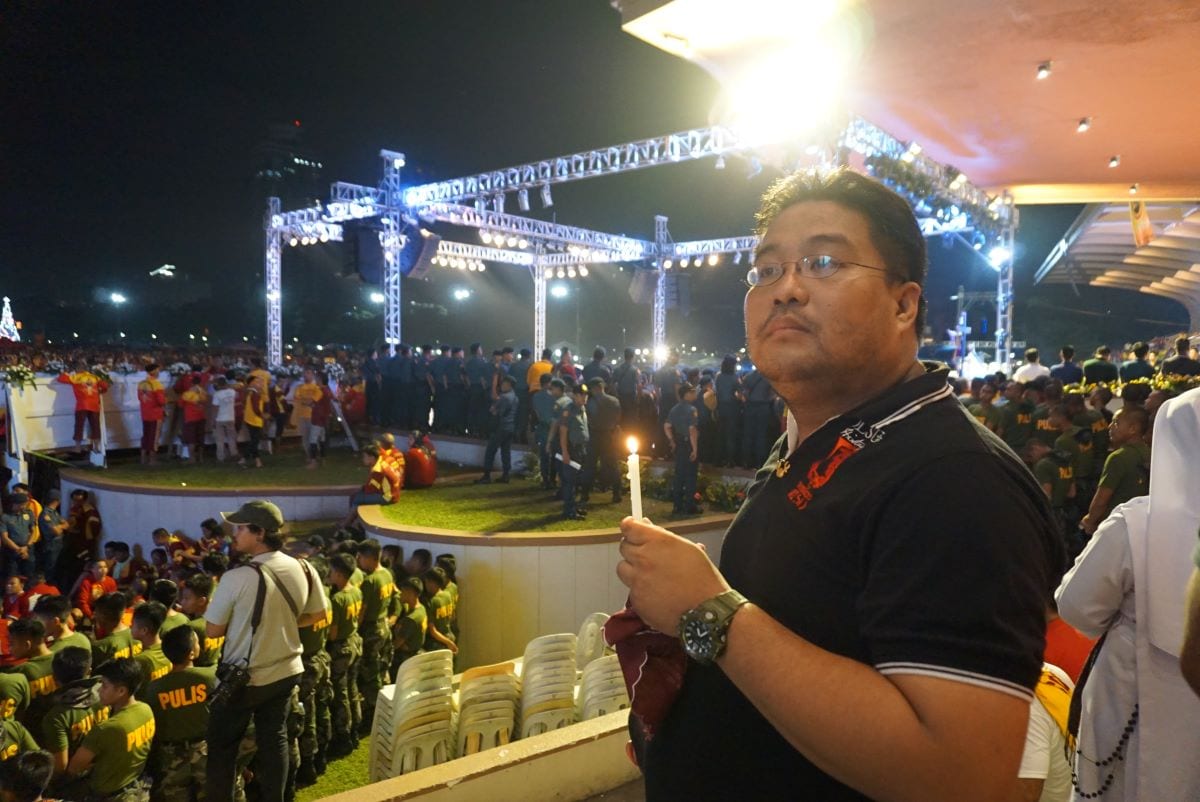
Xiao Chua at the Quirino Grandstand for the beginning of Traslacion 2018.
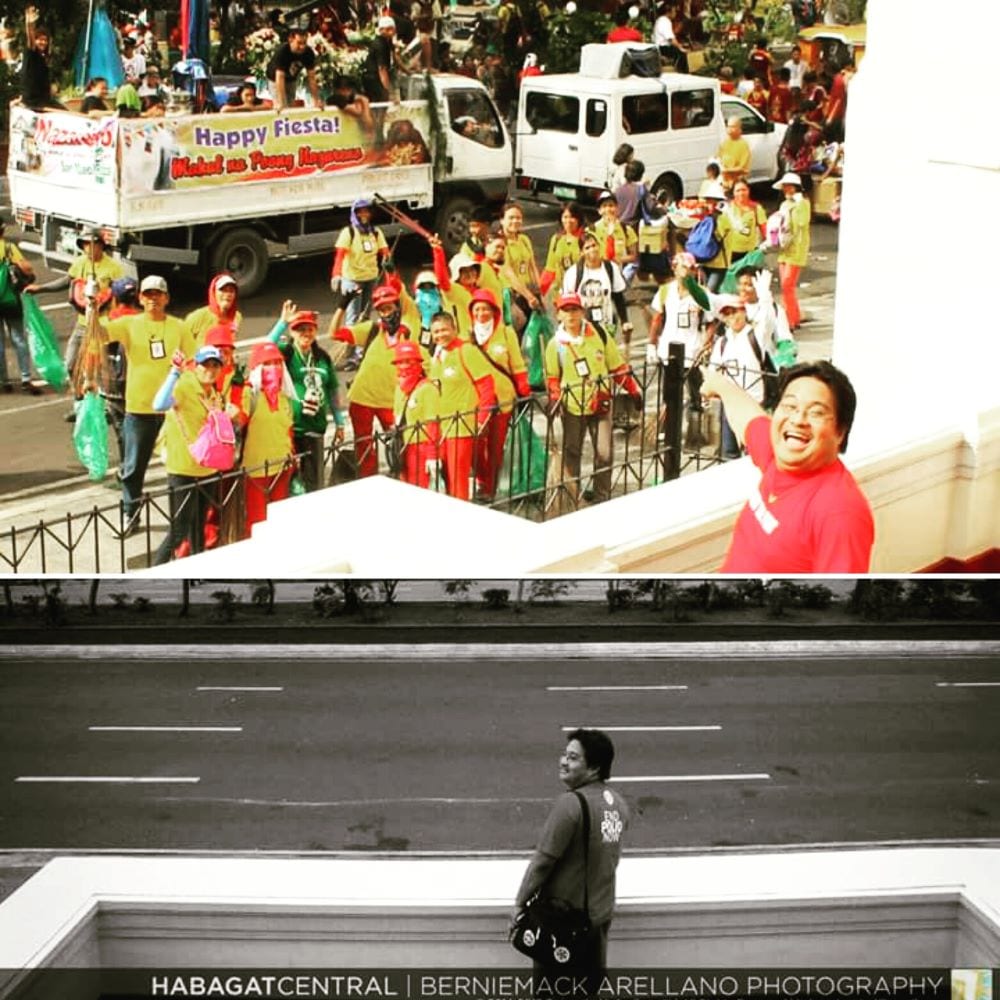
But what about the trash left during the Traslacion, which critics use to troll the devotees? They even insult the devotees with terms like "Trash-lacion." These intelligent people should know better—there is context to the trash issue. Devotees are not encouraged to bring bags and are dressed in the bare minimum without footwear. Of course, they need to eat, drink, and consume, but trash cans are prohibited along the route because they can be used to hide bombs. With millions of people, I do not believe any number of trash bins would suffice. What is not covered by the media is how government agencies such as the MMDA, the city government, and volunteers from the devotees' Green Brigade clean up everything, and within an hour or so after the procession, it is as if nothing happened. This exemplifies true private-public partnership, or bayanihan.
I saw how Quiapo Church learned from each year to improve systems for the safety of the devotees, from the time of Monsignor Clemente Ignacio, Monsignor Hernando Coronel, and Reverend Father Rufino Sescon, Jr., to how it adapted during the COVID-19 pandemic. I finished my Ph.D. in 2024 after 12 years, ten of which were devoted to researching the feast from various perspectives and locations each year. But humbly, comprehensive as it is, I still do not understand everything; it is but a small glimpse of the vastness and enormity of the Filipino experience during Traslacion.
After the Procession; (below) The Green Brigade cleaned up everything immediately after the procession, it's as if nothing happened.
Lessons from Devotees
But I owe the devotees for whatever I have learned because, despite being an observer, I was treated as family in Quiapo. I experienced more pakikipagkapwa and felt the love of the Lord more profoundly from them than from some of those I consider brethren, who do nothing but flaunt their self-righteousness. They opened their hearts to me, and in the process, they opened my heart too.
"There was a Xiao Time episode I did in 2013, before I embarked on my dissertation journey, in which I concluded with, "Faith without works is dead." I was thinking of what some people derogatorily call "debote." I used to say I hoped our rituals would extend into our everyday lives even after January 9."
But Dr. Lars Ubaldo reminded me, as a loving kuya, "Who am I to assume that their faith is without works? I do not know their everyday struggles. What makes me a better person to assume that they do not live out their expression of faith after the Traslacion?" I looked at myself and saw a sinner in need of the Savior too.
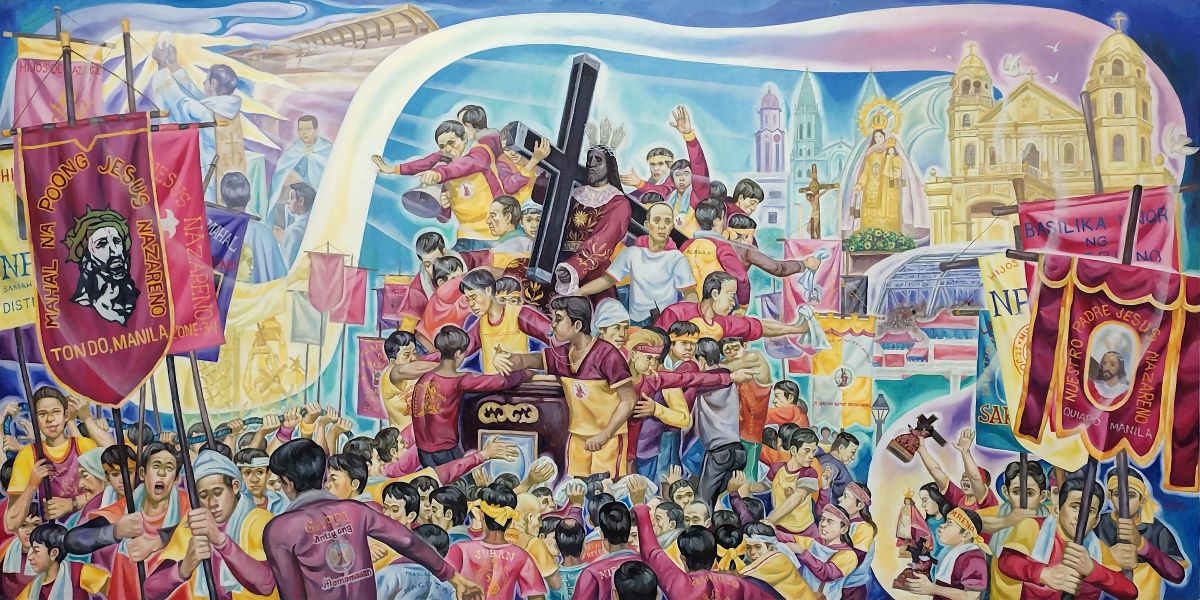
TRASLACION (8 ft x 4ft, Oil on canvas, 2023) painted by Derrick Macutay, featuring the late President of the Hijos del Nazareno Central Arnel Irasga and his older brother Alex Irasga of the Traslacion Technical Working Committee
As a Protestant, our worship services are straightforward and simple. Some non-believers even suggest that we should do away with rituals altogether because they cause inconveniences like traffic. But through this study, I now appreciate why people participate in the Traslacion or believe that Jesus himself is present in the bread and wine during mass. The world is reasonable, yet it cannot solve all its problems. Many of us practice religion not to fully understand but to feel the divine, to experience the transcendental, to find something that provides the one essential thing needed to continue fighting the struggles of life.
"Ang Hari at ang Pangulo ng Haring Bayan"
As one young writer, Karen Garcitos, posted: "So, the next time you question someone's expression of faith, it might be wise to pause and reflect on these questions: What gives you hope? In moments of despair, where do you find strength? Saan o kanino ka kumakapit? And if you're reading this in a state of hopelessness, know that the cross has already been carried for you. Know that the grave has been conquered for you. Because, after all, hope does not disappoint."
The Pahalik of the first Traslacion, 2007
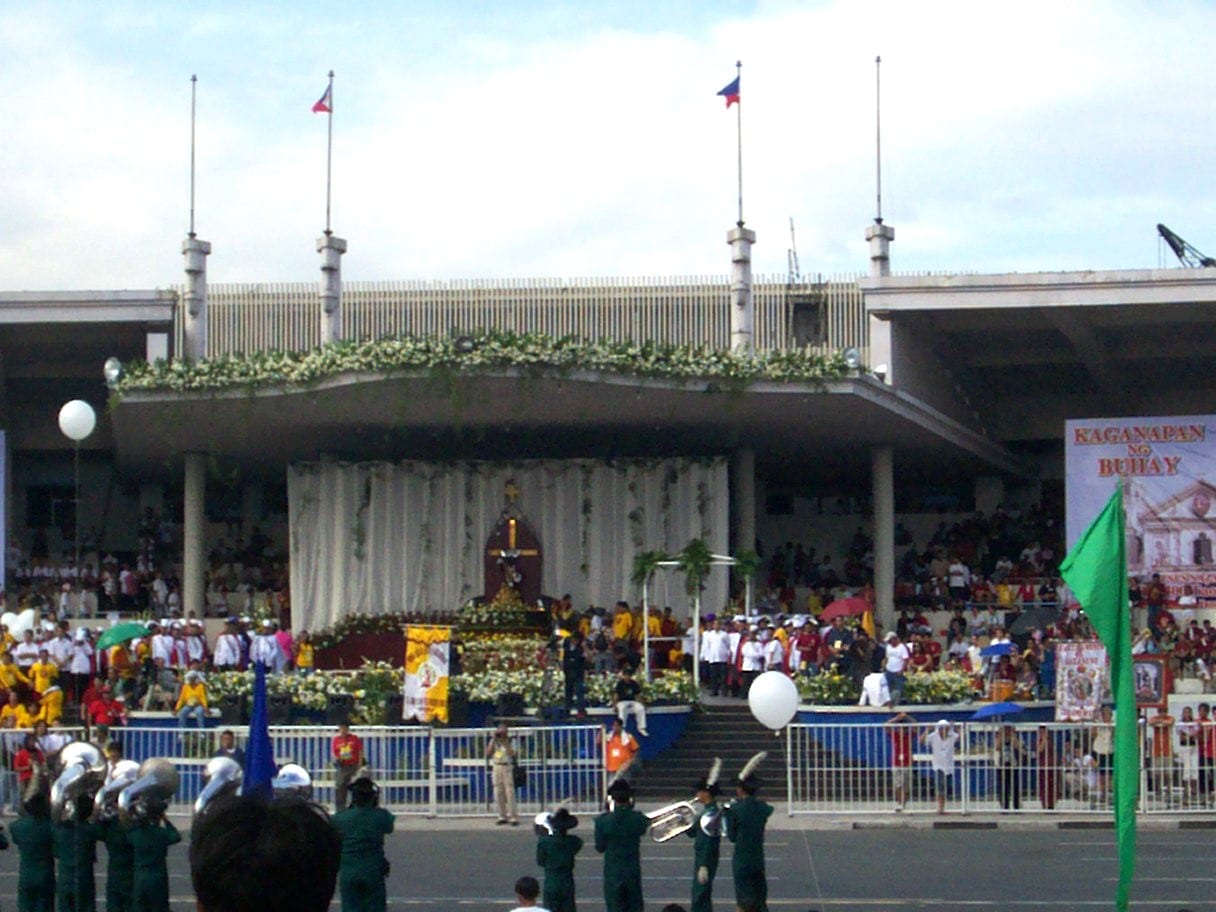
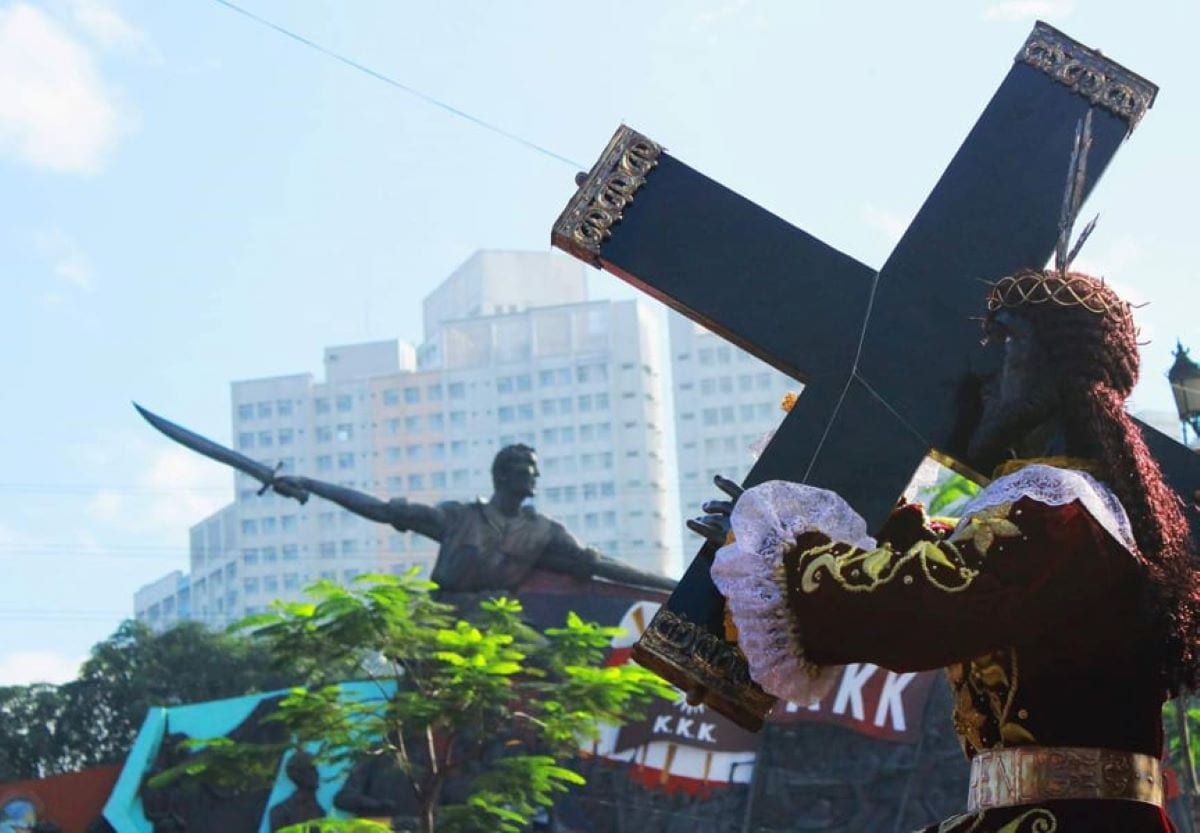
It is the hope that is offered by the image of a falling Christ from the weight of the cross, knowing that this is not the end of the story, but the glory of the resurrection. The image that gave Filipino revolutionaries the hope that, like Christ, our “bayan” will someday be free; that somehow, the black image of Christ looks like us, Filipinos, and therefore understands us and will help us carry our crosses, if not take them away.
But we are not just poor Filipinos who just rely on the transcendental; we all work every day to help the Lord answer our own prayers. When we receive what we prayed for, we do not forget the Lord; we tell others of His power, especially the new generation. That is why the Traslacion will go on, attracting new followers.
Most of the devotees I talked to told me that more than asking for anything, they perform their "panata" on a regular basis because, although they still have prayer requests, they mainly want to thank the Lord for a wish granted years ago.
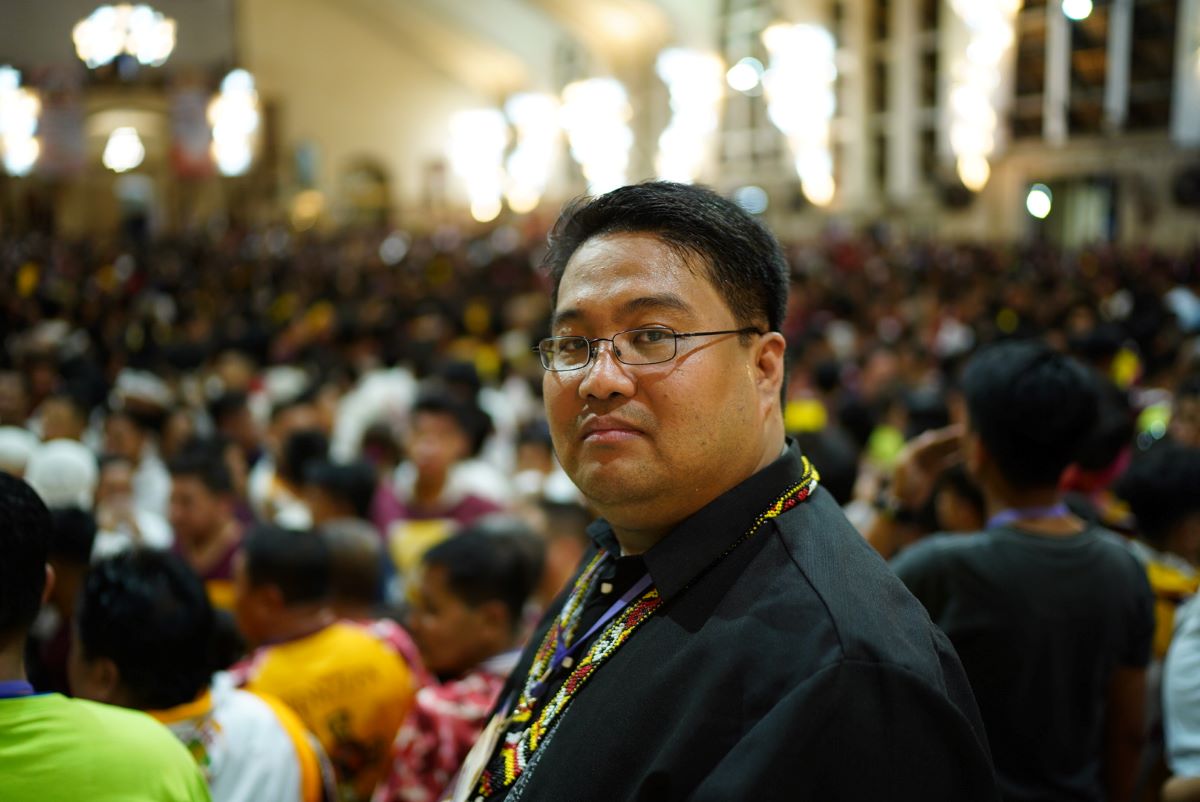
Xiao Chua at the Quiapo Church altar mayor during the end of Traslacion 2020.
In the Bible, the woman who bled for twelve years said, "If I only touch His cloak, I will be healed." I cannot question an act of faith; it is between a devotee and our Lord. But this is what I can tell you: the Traslacion is a mirror of Philippine society. The journey through our history seems chaotic and hopeless, but despite the imperfection, we actually demonstrate through the hardest times our "bayanihan" and "pakikipagkapwa-tao" towards true "kalayaan" and "kaginhawahan."
In the devotees, I found the heart of the Filipino.
Xiao Chua, Ph.D. is a Filipino public historian and an Associate Professor of History at the De La Salle University Manila. He was one of Esquire's 100 most powerful Filipinos in 2022.
