

Today I Learned: The Black Nazarene Has Always Been Black

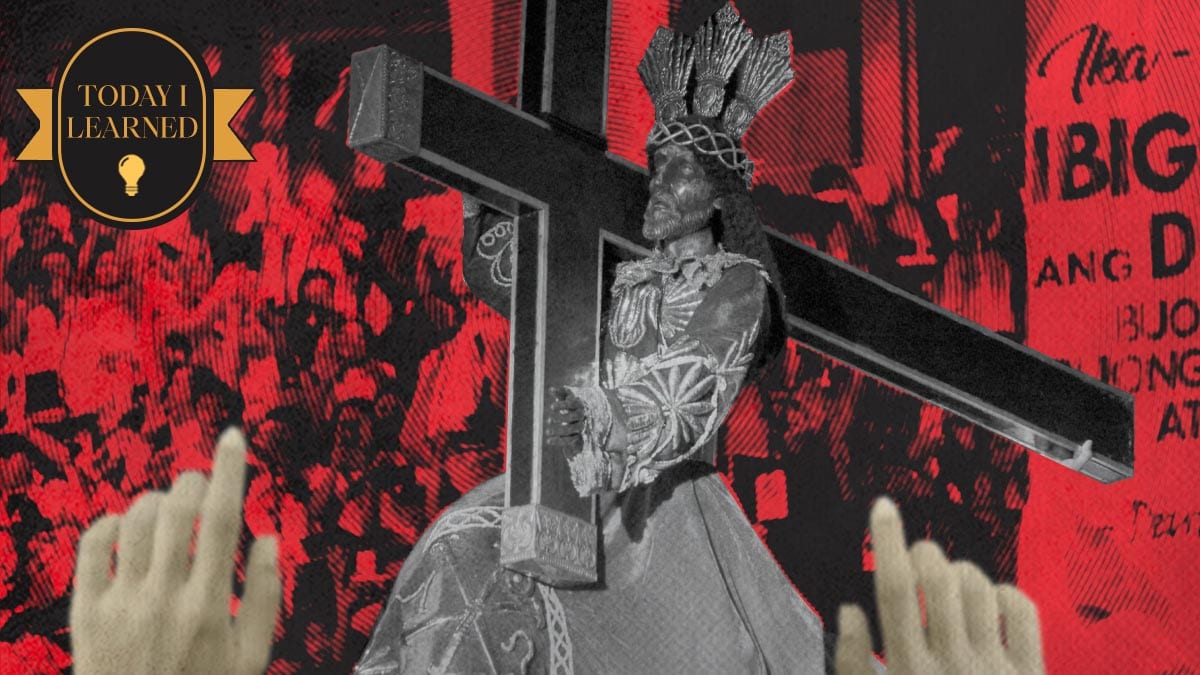
Every January 9, millions of the faithful are drawn to the vibrant streets of the Philippine capital to participate in the timeless tradition known as the Traslacion. This annual event is a spectacle of devotion that sees barefoot pilgrims carry a revered image of the Black Nazarene through the city. The life-sized icon, also referred to as Mahal na Poong Jesus Nazareno, is deemed unique for its depiction of Jesus Christ with a dark complexion, draped in maroon-colored robes, and carrying the True Cross en route to his crucifixion. The venerated image is enshrined in the Minor Basilica and National Shrine of Jesus Nazareno in Quiapo, Manila.
Historically, the Traslacion commemorates the transfer of the Black Nazarene from its original home in Luneta to Quiapo in 1868. The event has weathered many challenges, with the statue itself surviving fires, earthquakes, and even wartime bombings. This resilience mirrors the unwavering faith of its devotees, who, despite the pandemic's disruptions, have continued to hold the Black Nazarene in high regard.
ALSO READ:
These Filipino Celebrities Have a Deep Connection With the Black Nazarene
Black Nazarene: The Tale of Traslacion
The Complexion of the Black Nazarene
There are several theories and accounts on why the Black Nazarene is, well, black.
The most popular one is that the image was charred black due to a fire on the ship when Augustinian Recollect missionaries brought the statue from Mexico to Manila in 1606 during the Manila-Acapulco galleon trade. The image was burnt but not consumed by flames. Believers see its scorched appearance as proof of its divinity, having survived adversities like fires, earthquakes, and even bombings of World War II. This is why touching the statue is believed to bring divine intervention and miracles, with many devotees trying to get as close to the Nazareno as possible amid swarming crowd, rain or shine.
Others believe that the dark complexion makes this depiction of Jesus Christ more Filipinized, almost brown-skinned (kayumanggi).
But in a 2015 interview by GMA News, theologian Msgr. Sabino A. Vengco, Jr. of the Loyola School of Theology explained that the Nazarene was actually never white.
"In my research—and I have been to Mexico for this purpose—the wood that they used, popular among Mexicans at that period, was the wood of the tree called mesquite. The core of this wood is black like the Philippine kamagong," he said.
The mesquite tree, commonly found in the American Southwest, stands anywhere from a modest shrub to a towering tree. Its wood is prized for its durability and beauty, and it is often used in high-quality woodworking projects. The dense, hard nature of mesquite wood makes it resistant to rot and decay, making it ideal for outdoor furniture and other durable goods.
Vengco said that a similar material was used for the image of the Lady of Peace and Good Voyage, also known as the Virgin of Antipolo, which was brought to the Philippines from Mexico via the galleon El Almirante in 1626. He explained that this is why the Lady of Antipolo is also black.
He added: "Hindi sila nasunog. Yung wood na ginamit ay black, mesquite."
In addition, a 2013 scholarly work titled "The Burnt Christ: The Filipinization of a Mexican Icon" by Fernando N. Zialcita, published in El Cuaderno Internacional de Estudios Humanísticos y Literatura (CIEHL), included an anecdote by Narciso Maglaqui, the sculptor who does repairs on the church statue. He was also commissioned by the parish to make a replica of the head and body in the 1990s. So, the image that we know today has two versions: one with the original head mounted on a replica body made from the Philippine hardwood, molave; and the second, the original body with the replica head made from a soft Philippine wood, batikuling. The first stays at the altar of Quiapo Church, while the second is the processional image.
Zialcita wrote: "According to Maglaqui, if the original had been burnt, the wood would have been like carbon. But the wood remains smooth. Thus, the story about the tale of fire is really a legend."
The Minor Basilica and National Shrine of Jesus Nazareno itself, through its website, supported Vengco's claim.
The church added: "There was also a time in Europe when statues of Jesus were colored Black. The message being conveyed by this practice was to manifest the truth conveyed by the Apostle Paul in his letter to the Philippians that Christ Jesus, 'though He was in the form of God did not deem equality with God something to be grasped, but rather took the form of a slave, being born in the likeness of men..' Those days, slaves were dark-colored. Christ Jesus teaches us the virtue of humility and his compassion reaches out to the lowliest of peoples. This practice of portraying black images of Christ can also be seen in the Black Christ of Portobelo in Panama."
Zialcita's research interprets the Nazarene's blackness to be associated with sea and fire, destruction and survival, life and death, and the dignity of being non-white. "The Black Nazarene of Quiapo comes from a long line of representations, both within and without the Catholic Church, that conceptualize the divine as black," the study concludes. While the story of the accidental fire is refutable, the devotees' identification with the dark-skinned Nazarene makes the image relatable (being non-white) and the ambiance of His church more attractive to ordinary people.
