
Adrien Brody’s Art Sucks—Here's Why

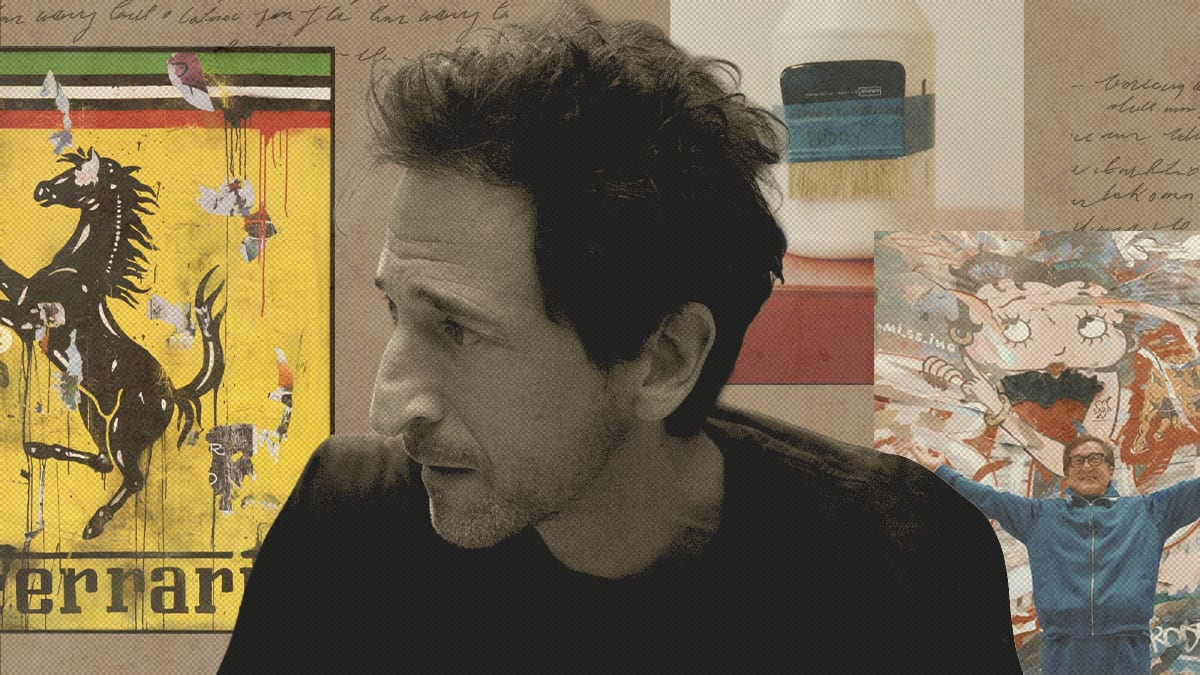
ILLUSTRATION: Art by Igi Talao
Had you walked through the doors of Eden Gallery in Manhattan just last month, you would have stumbled into a tornado of symbols, signifiers, and allusions that very pointedly convey the decay of the modern West. Mythic figures such as Marilyn Monroe and the Hamburglar are mired in erratic streaks and flourishes, their visages besmirched to make a statement. But unlike graffiti, these paintings and collages are hung up on exhibit walls, and are getting sold as high as over $400K. This is “Made in America” by Academy Award-winning actor Adrien Brody, and the whole thing kind of sucks.
I’m not the only person who feels this way. Alex Greenberger for ARTnews criticizes the exhibit’s “faux naïve aesthetic and its mediocre production value.” Kayleigh Donaldson of Pajiba writes of Brody: “He’s bereft of skill and originality, with pieces that look like police officers’ attempts to fake graffiti to arrest some kids.”
There is a certain futility to calling Brody’s art trash, especially in a world where Chat GPT hallucinates weird visuals daily, microform content reigns, pop art has been consigned to memehood, and the art world looks more unapproachable than ever. Lambasting the paintings of a celebrity who’s never been formally trained on painting would have as much impact on the world as tweeting about a YouTuber. At the end of the day, Brody earns money from attaching his name to catscratch for auction, and some anti-art, Elon-loving lout in the general X-sphere will measure the effectiveness of the art by how much money it makes. As an institution, the art world presents itself as a sophisticated arbiter of taste, but will occasionally bank on the clout of celebrity to keep the industry’s wheels greased. That’s how you get art like Richard Gomez’s painting of a jaundiced penis. Still, we are called to pay attention, because the overt messages of “Made in America” forcefully call us to take it all seriously. And so we will–this is a courtesy we can give to any artwork, good or bad.
ALSO READ
Pop Goes the Fable: Catching Up With Sean Go in Paris
The subjects of Adrien Brody’s investigation are iconic American symbols that have been repeatedly investigated and problematized in art history, whether it’s Andy Warhol parodying hyperconsumption, Banksy making hackneyed but nonetheless evocative depictions of war, or even Kaws making bank by drawing X’s for eyes to portray powerlessness and death. Brody’s biggest influence seems to be be Jean-Michel Basquiat, a figurehead of New York’s street art and expressionist scene, who has inspired many a copycat, those who think a chaotic arrangement of jagged brushstrokes is enough to mimic Basquiat’s secret sauce.
Notice however that confident linework and strong color sense are what underpin Basquiat’s anti-authority sensibility. Beat-you-over-the-head references to the most obvious Hollywood icons are left to the parvenues. It is absolute rookie hour, to take a pseudo-mythic figure like Mickey Mouse–whom the public already synonymizes with bottomless capitalist hunger–and “desecrate” it with gore, or profanity, or other “adult” themes. Brody gleefully makes muses of America’s most loaded symbols: The Simpsons, the mermaid on the Starbucks logo, the Statue of Liberty… if today’s artist is interested in subversion, either they pick a different, less examined subject-turned-symptom, or do something new.
In his essay “Biennal Art vs Douchebag Art,” writer Jeff Magid gets at the appeal of Adrian Brody’s art and the kind of audience it caters to. He writes: “Adrien Brody, Mr Brainwash, even George Condo and Adrian Ghenie make art that is intentionally ‘iconic,’ filled with easy to grasp references to well known images from famous artworks and popular culture. That can be a shortcut for new viewers to have the ‘visceral experience with art’ that we’ve all heard of but rarely experienced.” The douchebaggery of the art comes from the easy iconography that Brody cheaply deploys. He uses pop culture references the same way an Instagram poet like Michael Faudet might milk a turn of phrase.
Presumably, this kind of art entices the kind of viewer exasperated by more contemporary, untraditional art, like that banana taped to a wall, and prefer simpler expression of beauty, the kind you find at those gimmicky art exhibits that use projection mapping. But I no longer subscribe to the idea that crappy art is redeemed by virtue of its accessibility. At the risk of sounding like that one Family Guy meme, I’m perfectly fine with art that insists upon itself, as long as it has something substantive to say. Although for my money, I’d rather engage with the Biennal pretentiousness of Ai WeiWei dropping a Han Dynasty urn, than buy whatever the hell Brody is selling.
