
Carlos Rediscovers the Quiet Joys of Sculpture in Stop.Motion

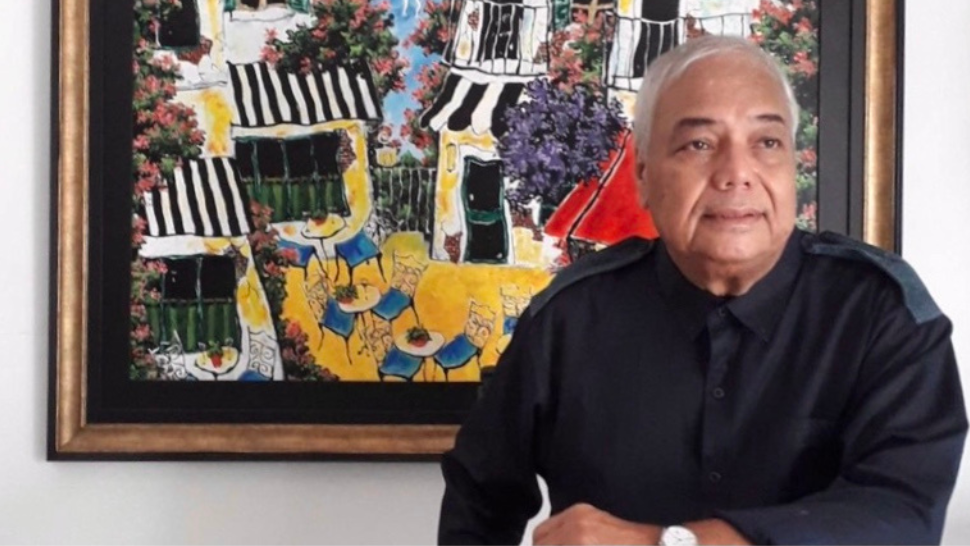
Most of the time, we catch Carlos' paintings in a state of siesta. The artist has a penchant for rendering the quiet sublime in his work, we may have observed. Whether they're still or they're moving (thanks to motion designers), most of his art is scenes straight out of idyllic Mediterranean settings. We're taken to a studio in, say, Nice, in the South of France. Thoughts of Dufy's and Matisse's studios come to mind. The feel of these still-lifes captures slow days inside an apartment on the Amalfi Coast. Ideas of dreamscapes plague us. All are depicted in a fantastical combination of color. Each of them describes the brilliance of silence in the mundane, how it oozes when we stare at these vistas long enough to see them for what they truly are.
Carlos is decidedly a Fauv who grew up with modernist sensibilities. It's something he might have picked up from his father, architect Julio Victor Rocha, along the way. Architect Rocha was voted the Industrial Architect of 1949, soon becoming the youngest dean of the University of Santo Tomas, the first of the Colleg of Architecture. He's been cited as one of our great standard bearers in the architectural progress of the Philippines. Among one of his more famous designs was the 1936 pre-war Teves-Montenegro Mansion, a gorgeous abode by the sea that would soon be lost to the Japanese Imperial Army. The architect was a product of a country in constant transition.
"The Magic in Music"

In this passing in the middle of the 20th century, Rocha had become friends with fellow Filipino modernists like Vicente Manansala and Victorio Edades, as well. Carlos was said to have always been the "artistic" one in the family, heavily influenced by his father's pedigree. These connections would come to inform his style, characterized by vividness and an allegiance to brighter days and brighter hues.
Before Carlos became a painter and recently, a non-fungible token artist, he started as a hobbyist with an interest in sculpture. In the '80s, right in the middle of the then-contemporary boom that saw the likes of Arturo Luz, Jose Joya, and Lao Lianben, to name a few, dominate, Carlos was right there. His wife was the owner of Galeria Mia, a gallery that was located in what used to be Pasay Road (now Arnaiz Avenue), where some of these artists broke new ground.
ALSO READ:
A Trip to Gravity Art Space, Infinity, and Beyond With Indy Paredes
The Anguish of Mythmaking and Entanglement in Julie Lluch's Chronicles on Skin
The gallery was a big supporter of up-and-coming visual artists. Among them would be Carlos. The reception to his work, suffice it to say, was brilliant. With a little push from his partner and from some generous collectors along the way, he'd establish himself as quite the artist in the next 40 years of his life. From there, he's had shows at venues like the Ayala Museum and the Rockwell Center. He exhibited elsewhere, too, with stops in great art cities like San Francisco, Hong Kong, and Brisbane.
It's been a while since he's really focused on sculpture. But his new exhibit with Galeria Paloma hopes to rekindle some of that youthful flare. Seemingly returning to his roots, Carlos' Stop.Motion will feature some new pieces, made with resin and steel. With it, we find more clues of the artist's art practice, his family's cultural cache, and his creative enlightenment.
"Blue Dancing" and "The Violinist"

"I started creating sculptures in my spare time in the 1980s, more purposefully than I did previously, in which it was a minor hobby," Carlos says of the early days of his sculpture-making. "When I switched to being a full-time artist over twenty years ago, I focused mainly on paintings. I produced fewer sculpture pieces, except for commissioned projects. But I never tired of making them."
Resin gave him the perfect medium to interpret the precise moment these figures break into motion. He hopes to apply the same principle he adheres to in his painting to his sculptures. "I try to create an environment that encourages the viewer to examine within their own lives a feeling of appreciating life and the moments we tend to take for granted. Sometimes, we have to stop and take it all in."
Stop, we do. We see here the usual men and women at work, the artist's usual subjects: these are you fishermen, vendors, bullfighters, and more. It was never about the toil of labor for Carlos, but rather, for the nobility in it. All of us are just trying to find a way to be useful, aren't we? We get a sense of people in limbo, dedicating themselves to the profundity of their respective practices. "The Violinist" showcases the euphoria of rhythm. For "The Harvester," it's a celebration of the poignant divine that we reap and we sow. Meanwhile, "Blue Dancing" (a personal favorite of mine) captures the jubilation of the dancer caught in the spectacle of theater.
"Blue Cafes and Red Umbrellas"

Of course, Stop.Motion will feature his signature joyous canvases, which are motion-designed by IJ Cacnio. "Blue Cafes and Red Umbrellas" speaks of the earthly delights of leisurely walks through community centers in Montmarte. "Finding Magic," on the other hand, provides us with some shades of gorgeous harbors in Bergamo and Tuscany. In this exhibit, we see his trademark zest coming alive, something that is pronounced in both mediums. Carlos likes to think of his approach to them, too, as related in a sense.
He notes of this relationship between the two: "My thesis about my paintings, which is to create scenes that inspire joy and gratitude about both the little and big, amazing things in life, run parallel to my thesis about my sculpture, which is also to evoke positive feelings–pride in one’s work, camaraderie in working together with others towards a goal."
Galeria Paloma's Stop.Motion by Carlos exhibition will be held from July 7 to 9, 2023 at the North Court of Power Plant Mall.
