
This Recipe Book Preserves Vital Flavors of Filipino Culture

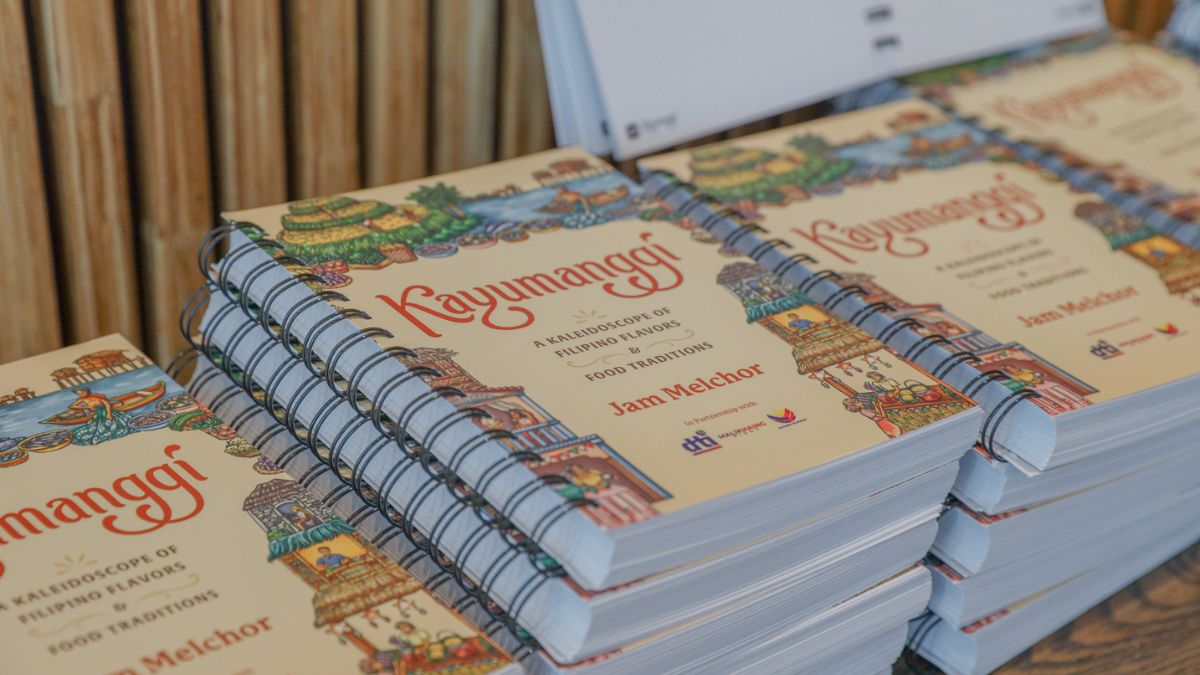
Chef Jam Melchor’s recently launched recipe book "Kayumanggi: A Kaleidoscope of Filipino Flavors and Food Traditions" features 150 of the most familiar and staple Filipino dishes from all over the country. From the more familiar Adobo sa Puti, Mechado, Dinuguan to more locally available Asadong Matua, Hardinera, Kilayin, and Kinalas, the book covers what’s mostly served among generations of local households.
It's not only an instructional and easy-to-understand cookbook but it could also be a valuable archive of the country's local food culture. If we are diligent enough, it could lead us to understand the stories of various communities, the interrelated food traditions, geographies, and agricultural practices, and written or oral histories (kwentong bayan) of localities where these dishes belong.
As food historian Felice Sta. Maria remarked during the launch: “Filipino gastronomy is indeed worthy of acclamation…Every sip and every bite into a Filipino meal, as Jam underscores in Kayumanggi, are ways we can celebrate and keep alive what we like as Filipinos, what we admire, and what we respect in Filipino heritage. Jam's book reveals a Filipino compilation of the artist's passion and innovation that define Filipino cuisines throughout the provinces.”
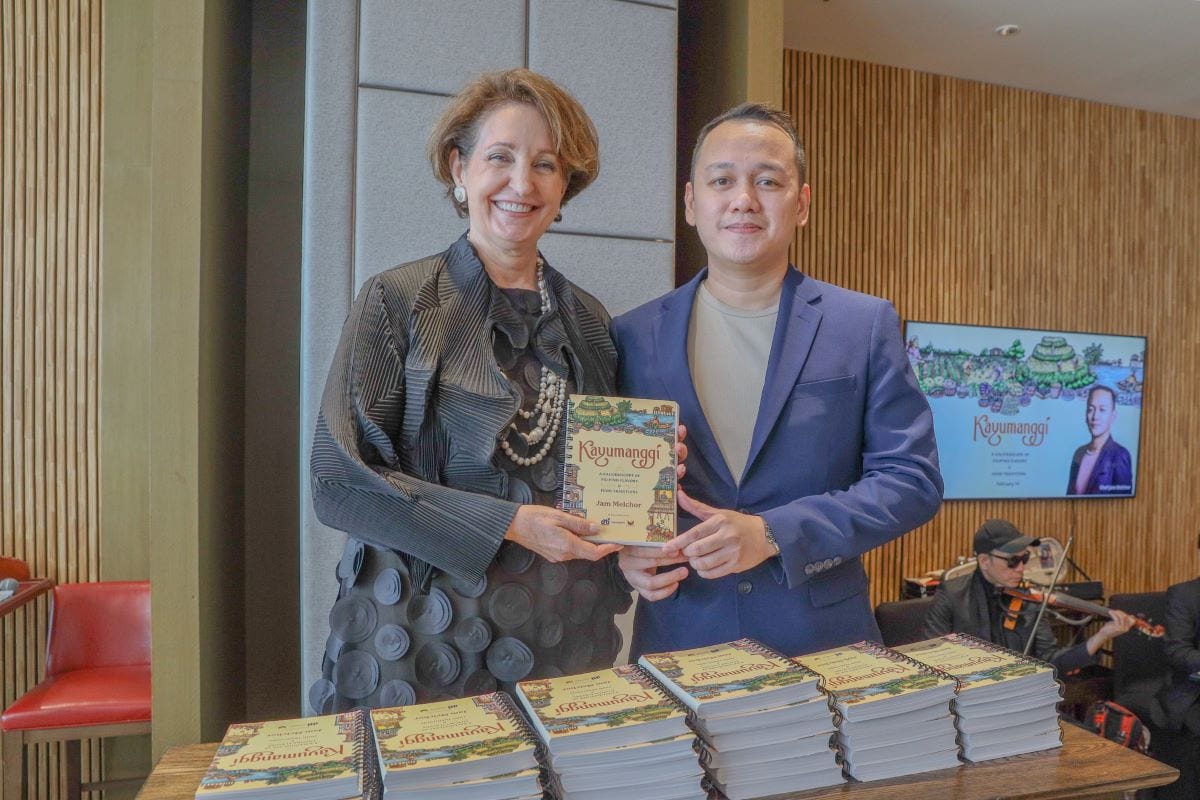
United States Ambassador to the Philippines MaryKay Carlson and Philippine Culinary Heritage Movement Founder Chef Jose Antonio Miguel “Jam” Melchor
The 200-page cookbook opens with an introduction by Sta. Maria. Every dish is introduced by recipe headnotes and complemented by food illustrations by Katrina Laurice Cruz, who also designed the book cover. Apart from informative sections on the historical development of Filipino cuisine, from prehistoric culinary traditions to the various stages and amalgam of influences from Chinese, Spanish, and American cooking, it also delves briefly into regional cooking and the food traditions of Muslim Mindanao and indigenous peoples. Committed to imparting the practical skills of Filipino cooking, "Kayumanggi" also devotes detailed sections to traditional ingredients, basic cooking tools, and methods commonly used in Filipino dishes.
The author, Jam Melchor, a restaurateur and who also served as the private chef to the US Ambassador is the founder of the Philippine Culinary Heritage Movement, a non-profit organization dedicated to preserving Philippine culinary heritage and gastronomy. He also serves as the country head of the Slow Food Youth Network Philippines, part of the global Slow Food International organization, which promotes sustainable changes in the food system toward good, clean, and fair food.
From 2013 to 2015, he served as the culinary envoy for the Department of Agriculture of the Philippines, promoting the country's cuisine to ASEAN countries. Following this, he represented the Philippines at Terra Madre Salone del Gusto in Turin, Italy, in the 2016, 2018, and 2022 editions.
ALSO READ
This Filipino Chef Is in the Running for the James Beard Award
How Chef Miko Calo Is Challenging Culinary Norms
In 2018, he was appointed as the Philippine representative at the Eating City Food Sustainability Camp in Paris, France. In November 2019, he was appointed as a Philippine Chef Ambassador, as part of the Philippine delegation at the World Travel Mart in London, United Kingdom, by the Department of Tourism Philippines and the Tourism Promotions Board. These are a few of his notable contributions to the local food movement.
The "Kayumanggi" book is a passion project that was stalled for a while, but for good reasons. The delay led to the birth of the Philippine Culinary Heritage Movement, which Melchor founded. Through his and his fellow advocates' tireless work in the promotion of Filipino gastronomy on several fronts, they were able to get the nod of the government for their restorative agenda on local food. One of the positive yields and gains thus far is the signing of Presidential Proclamation 469, declaring April as the Buwan ng Kalutong Filipino or Filipino Food Month.
Caveat: It should be noted that this is not just a recipe book but a cultural cache and a manifesto meant to champion the Filipino identity through heirloom dishes. Within them are also stories, traditions, flavors, and other parts of our intangible heritage that define our identity as Filipinos. These cooking traditions must be handed down to the next generations if we are to continue learning and enriching the Filipino soul.
Our dwindling memory and appreciation of our heritage cuisine is deeply frustrating and alarming. We ought to thank food culture champions like Melchor, who continues to remind us of our culture and history through food. As Mexican chef Enrique Olvera once said, “When you realize the richness of your own culture, you become stronger.” We must all heed this.
"Kayumanggi" was published and printed with the help of the Department of Trade and Industry, and its launch was in partnership with the Sheraton Manila Hotel. Staying true to its advocacy of promoting Philippine gastronomy, the book is intended to be distributed freely through social media.
