

Ironies of Colonialism and Diaspora in Contemporary Art

Colonialism is an important point in thinking about Philippine fine arts, especially since the concept of fine arts began as a foreign concept during the Spanish colonial era. The Philippines, in all its diversity, is a highly visual culture—with art and design embedded into everyday life and objects. But there is no denying that the idea of fine arts, including painting and sculpture, came with the colonizers. Filipinos would transform the practice to reflect the realities and sensibilities of local culture, as is the nature of art—but to disentangle its history from colonialism is not possible.
Seeing colonialism along its conceptions and embodiments in contemporary art, not to hide or even assert a distilled Filipino identity, is refreshing. Kanluran ng Kanluran: West of the West, a curatorial project headed by Nicolei Buendia Gupit, unpacks and critiques the concepts of colonialism and the ideas of the West through the works of Raffy Ugaddan, Hannah Nantes, Chad Montero, Jericho Moral, Jonathan Madeja, and Mac Eparwa. Admittedly, the setting and context of the exhibition may appear suspect. It was launched on April 2 at the Francis Colburn Gallery at The University of Vermont in the United States; and was co-curated by Nicolei Buendia Gupit and her class for Counter-Memory as Art. Is it possible to critique colonialism, imperialism, and the conception of the West through curation from the West?
ALSO READ
Pacita Abad Celebrated at Her First Retrospective at the San Francisco Museum of Modern Art
Silverlens Gallery Is Opening a New Space in New York
Strength in the Attempt
The exhibition’s strength is in its attempt to do so and to confront the narratives outside of the main idea of benevolent assimilation of American colonization. American culture is deeply embedded in Filipino culture that it becomes nearly impossible to untangle imperial agendas. English is widely spoken, and young children learn English much easier than the Filipino language. American culture dominates the entertainment industry—movies, television shows, music, the Internet, streaming services, social media, and many others. Despite the freedom from colonization gained less than a hundred years ago, soft powers managed to catch the country's imagination in its trappings.
Jodie Jose wrote the exhibition text, giving a framework to the artworks and curation, which was presented to a large number of American university students. The narrative is different from the perspective of the United States, which largely represented their presence in the Philippines as positive and benevolent. The idea of the West (Kanluran) combines the romanticized American dream and the weight and baggage of a former colony.
"Direction for Teachers" (2024) by Hannah Nantes


Hannah Nantes’ "Direction for Teachers"(2024), an artist's book of lino cut prints recreating a typical textbook during the American colonial period, resonates with the ideals of the American occupation while peeling away the veneer and revealing a loaded reality. One of the most indelible aspects of the American occupation was the shift of the educational system, where colonizers brought in American teachers and effectively changed the public school system. Though the idea of expanding public education was good, it came at a steep price of changing the ways Filipinos learn, think, and imagine. English became an official language and, informally, the language of the educated and the upper class. This is a stereotype Filipinos struggled with and embraced as we become one of the key places for business process outsourcing anchored on the English-speaking populace.
Rethinking American Colonial Photography
Chad Montero’s ink and watercolor on paper works "Divine Distortion" (2024) and "Butterfly Sleeves" (2024) look into the representation and, in many ways, continuing colonization through photography. Numerous photographs taken during the American colonial period subtly reinforce the Filipinos’ need for guidance, education, and development—thus justifying the American colonial agenda.
"Divine Distortion" (2024) by Chad Montero

"Divine Distortion" (2024) distorts the Filipino, often wearing indigenous clothing, while standing to a fully clothed, taller, and fairer American person. Montero further distorts the image—putting into question whether the work critiques the American lenses that captured images of indigenous Filipinos or enhances such discomfort.
The same can be said of "Butterfly Sleeves" (2024), based on photos of American women posing with Filipino women. In distorting the heads of the Filipino female figure, does the image do what it intended—to confront and critique American colonial photography? Or does it play into the stereotype of representation?
"Butterfly Sleeves" (2024) by Chad Montero

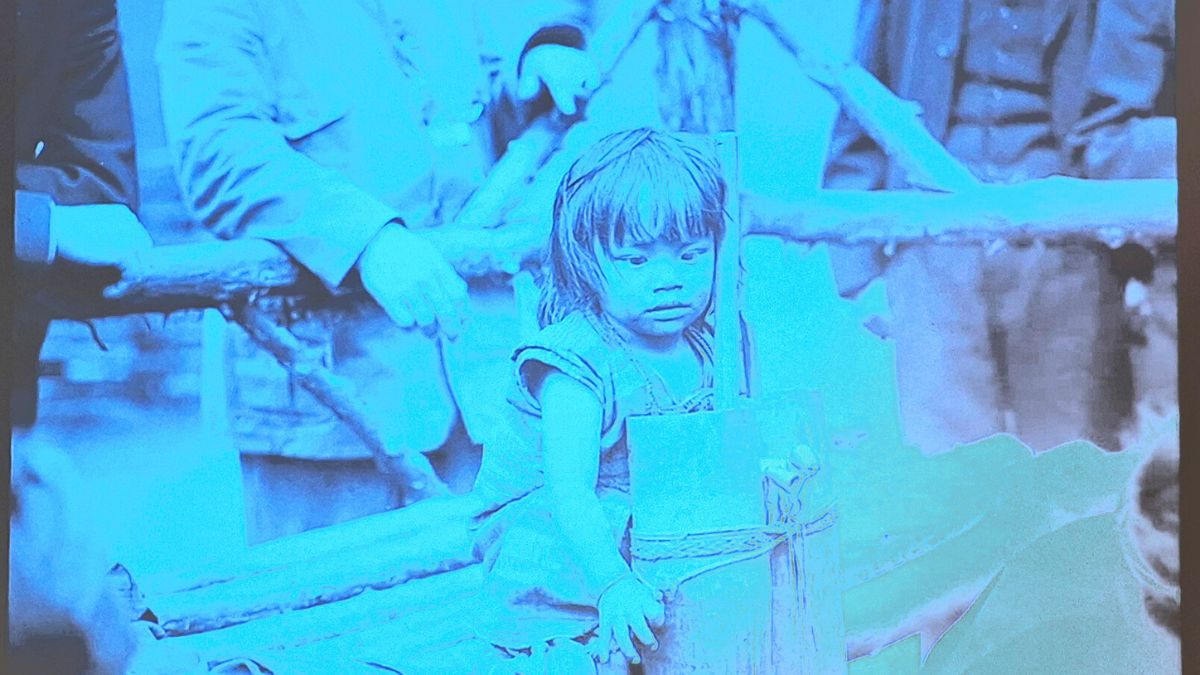
Re-examining archives and confronting colonial narratives are continuing processes. It does not, and can not end with a few artworks and exhibitions. Mac Eparwa’s video "Nikimalikas" (2024) uses images from the 1904 St. Louis World’s Fair, where, instead of just bringing objects and memorabilia from the colonies, the Americans brought living indigenous people to display akin to animals. They were made to perform traditional ceremonies outside of their spatial context and made to live outside of their natural environment.
"Nikimalikas" (2024) by Mac Eparwa

Indigenous clothing and lifestyle were unsuited to the United States, resulting in many getting sick and dying while being on display for the colonial viewers. Though awareness of the World Fair has increased over the years, it is still not as common knowledge as hoped. Placing the exhibition back in the United States for American viewers gives it a full-circle moment—hopefully with a realization of the horrors of colonization despite bringing teachers and building bridges in the colonies.
Reframing the Colonial Experience
Despite the contentious relationship, many Filipinos eventually migrated to the United States from the mid- to late 20th century onwards. For countless reasons, most commonly heard of are the search for a better life, a greener pasture, and building the foundation for the American Dream. Given the many difficulties in the country, poverty, and lack of opportunities, the promises of the former colonial power appealed to the struggling Filipinos. Even in the present, the idea of migration to the United States, seeing Disneyland and snow, endures in the mind and sensibilities. The Filipinos' relationship with their colonizers is complicated.
Projects such as Kanluran ng Kanluran: West of the West are important when navigating the complicated. Nicolei Buendia Gupit, herself a Filipino-American, anchors her artistic and curatorial practices with the ties of the migrant experience and the realities of the diaspora. Putting the exhibit together confronts the uncomfortable experiences of Filipinos in the Philippines and the diaspora. Further discomfort is brought about by the reality that the exhibition is a class project—from, unfortunately, western (kanluranin) lenses. In itself, it does not invalidate the approach, but realistically embedded are sensitive power dynamics in the presentation.
Unease in the Diaspora
There are innumerable Filipino-American artists enmeshed in the diaspora. Artist, printmaker, and community organizer Cecilia Lim traveled back to the Philippines in the past few months, exploring and expanding her print practice. Her ongoing project, Remember Y(our) Connections, investigates her and her artistic practice’s place in the diaspora, as well as the flux of moving places.
Cecilia Lim at the Manuel Antonio Rodriguez Sr. (MARS) Center for Printmaking, Philippine Women's University


During her months in the country, she explored different locales and looked into the ties and connections between land, water, and people. She also worked on her prints at Manuel Antonio Rodriguez Sr. (MARS) Center for Printmaking in PWU, giving a workshop to their students and hosting public workshops in alternative spaces–Tara! Magsulat tayo! Join Remember Y(our) Connection / Tandaan Ang Ating Ugnayan with Good Food Community and Pagpapahalaga sa Pagkalinga: Care Work in/as Creative Practice at 98B.
Similar to the reservations invited by Gupit’s Kanluran ng Kanluran: West of the West in the United States, there is also the tension of a Filipino-American’s intervention back in the Philippines. The lack of personal experiences and contexts might initially cause discomfort. Yet, the search for connections and transformation of identity continues. Curatorial and artistic projects looking to unpack the uncomfortable, even the possible disconnects, are valid. Though the question of diaspora artists often encounters critical explorations and notions of identity, the beauty is in the attempt, much like in the projects of exploring coloniality and diaspora amidst challenging circumstances.
Continuing the Project
Continuing to unpack the issues of coloniality and diaspora seems unending. As it is, it feels as if the projects skim the surface—and the water runs deep. The hope is for artists and curators to keep delving into the project, continue research-based and experiential projects, and eventually unearth a local consciousness sensitive to struggles and lingering effects of colonialism—outside of the Disneyland-tinged lenses. Despite the numerous footfalls, dangers of missing points, and possibilities of misunderstanding–the attempt at embracing the complicated is important–thinking and rethinking, trying again and again.
