Fresh from his education at Harvard, the horror of the Second World War already behind him, the dashing Fernando Zóbel penned an essay to define Filipino art. Now a mostly forgotten text, the essay was published in 1953 in Philippine Studies, a learned journal that emerged from Loyola Heights where the Ateneo had transferred to build its modern campus after the US granted independence to the Philippines in 1946. The essay was written in crystalline English, its simplicity concealing the hard task before the young artist: how to know what’s Filipino about artistic expression? The words “Filipino artistic expression,” Zóbel wrote, are bandied about but we don’t really quite know what they mean. At the very least, Zóbel didn’t, and he wasn’t afraid to admit it, his Harvard pedigree and gilded namesake notwithstanding. Thus, “it might be worthwhile,” he said, “to try and put our thoughts into some sort of focus.” It’s a remarkable feat of intellectual humility, giving way to insights that, by my lights, remain unparalleled to this day in their contemplation of modern Filipino artistry.
To begin his quest, Zóbel knew where not to look. He turned his back on the obvious. His search for Filipino art was expansive, ranging widely to countenance the most native particularity his mind could intuit. First, he counted out subject matter as the basis. “I am not much concerned,” he confessed, “whether a painter paints a dish of apples or a carabao.” If a Frenchman paints a local maiden in Balintawak costume, he said, his painting will not possess Filipino expression no matter how skillful his work is. Why? Because he’s not Filipino, Zóbel decided. Second, Zóbel was uninterested in conflating local material with Filipinoness. “The fact that we grow the most beautiful lumber in the world,” he argued, “detracts nothings from the expressiveness of the Filipino who prefers to carve Italian marble.” For Zóbel, Filipinoness goes beyond indigeneity of material. For him, the Filipino artist could take on whatever material they fancied, and make of it an artifice of the native self. Yet Zóbel was equally aware that the foreign presented a special burden given our history. Namely, knowing Filipino expression had to contend, Zóbel thought, with foreign influences spanning many centuries, Spanish and American, among them, and much earlier than these colonial powers, the waves of Hindu, Chinese, Balinese, and Mogul influences. How, then, to know how we express ourselves artistically as Filipinos?
True to the abstractionist spirit to which Zóbel dedicated himself, he drew on his deepest intuition to surface our native artistry: object (minus) foreign influences (equals) the residue of Filipino expression. The formula has an Einsteinian elegance to it: precise, concise, and utterly compelling. You consider the object first, after which you deduct from it any semblance of external influence, which will then result in what remains—the supposed trace of our primeval aesthetics carried across the vagaries of history. To elaborate on his formula, Zóbel turned to colonial Philippine churches whose designs were realized not by architects but, rather, by friars who consulted prints of Spanish and South American churches to build houses of worship in the tropics. Yet the same churches were constructed by Filipino and Chinese hands who interpreted the designs and added to them their peculiar touches. This, for Zóbel, was an example of the Filipino trace: native artisans interpreting foreign designs and making them their own—decorative details in plain sight that could reveal the hidden universe of native artificers.
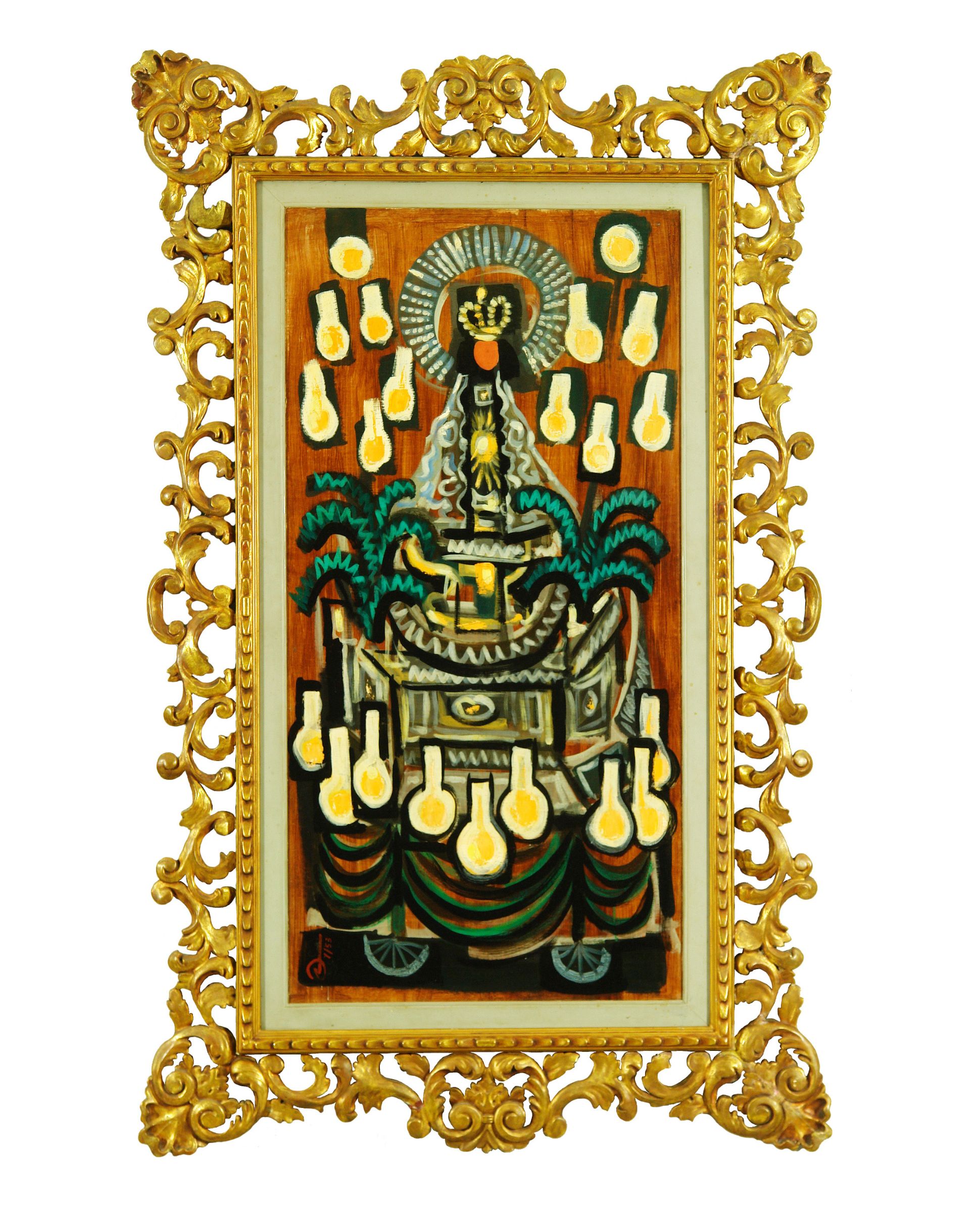
Fernando Zobel, Carroza, 1853, Polymer on wood, 119 x 59.5 cm. Gift of the Artist. Image courtesy of Ateneo Art Gallery.