

In Search of Mababangong Bangungot in Kidlat Tahimik's 'INDIO-GENIUS'

For all the years we've known Kidlat Tahimik—man with the cool moniker, carrying a rattan vintage film camera, rocking a bahag, and sporting flowy gray hair—he’s undoubtedly the quintessential proponent of the Filipino identity. His name crackles around the flame of Filipino imagination, much to the admiration of the communities he's ideologically fostered.
He's become an omnipotent presence of sorts in cultural spheres. We hear about him constantly. Some artist tells us about his installations. A cinephile type won't shut up about Turumba. There was a class with a viewing requirement. He speaks at graduations. A friend spots him at a random art show in Benguet.
Icons, after all, each have their look. Each, however, can better be characterized by what lies beneath the surface. It is their ideas that define their work. In Tahimik's case, his was shaped by the experiences that had economist Eric Oteyza de Guia (his Christian name before he was christened by the Cordilleras) reincarnated as silent lightning, father of Philippine independent cinema.
A young Kidlat Tahimik in the 1977 Berlin Film Festival darling Mababangong Bangungot.

I remember my introduction to the guy. It was this surrealist dreamscape of a restaurant in Baguio he opened a while back. Oh My Gulay, in many ways, was the artist's imagined world taking on this cosmic physical form. Giant bululs and reclaimed wood installations (a lot of it) and Indigenous landscapes and unevenly beautiful bridges and paintings from Benguet artists define the ambiance of the joint. All of it is rooted in a colorful understanding of the dread of neo-colonial burdens. Our Filipino-hood is defined by these, whether we are conscious of these dichotomies or not. But these are only the tip of the iceberg, so to speak. Tahimik has been critiquing it for close to five decades now.
Those concepts, I would soon find out, are best illustrated in my personal favorite film of his, Mababangong Bangungot (Perfumed Nightmare). In 1977, Tahimik wrote, directed, and starred in it, becoming one of the great pieces of Filipino post-colonial cinema (even Francis Ford Coppola and Werner Herzog loved it). I remember its surrealist depiction of third-world realities and the woes that come with them. It had elements of a dream and a documentary. That was a mockumentary, too, if we think about it. Meta stuff.
Here's the synopsis: a young jeepney driver longs to leave his village for Europe, thinking of the promise of Paris. There, he comes to find out of inhumane modernity. He thinks to himself, "how different is this from home?"
Disillusionment, bewilderment, and the duality among first- and third-worlder identities are showcased (from the faithful bridge and jeepney in the Laguna village to the gumball machines and skyscrapers in Europe) here. The film touches on the gray areas of fantasy, bordering on migrants' delusion. It zones in and out of the fragile systems of Western dogma and indoctrination. We are asked to reckon with the allowable truths of the brown man in the West.
Kidlat Tahimik taking guests through the exhibit.

Different art form, the same motifs can be found in INDIO-GENIUS: 500 Taon ng Labanang Kultural (well, in all of Kidlat Tahimik's work, really). Both are haunting. Each asks questions like what is progress? Where do our forgotten memories go? Who gets to decide who we are as a people? How do we reclaim the Filipino? What even is he? Both hope to provoke a cultural awakening.
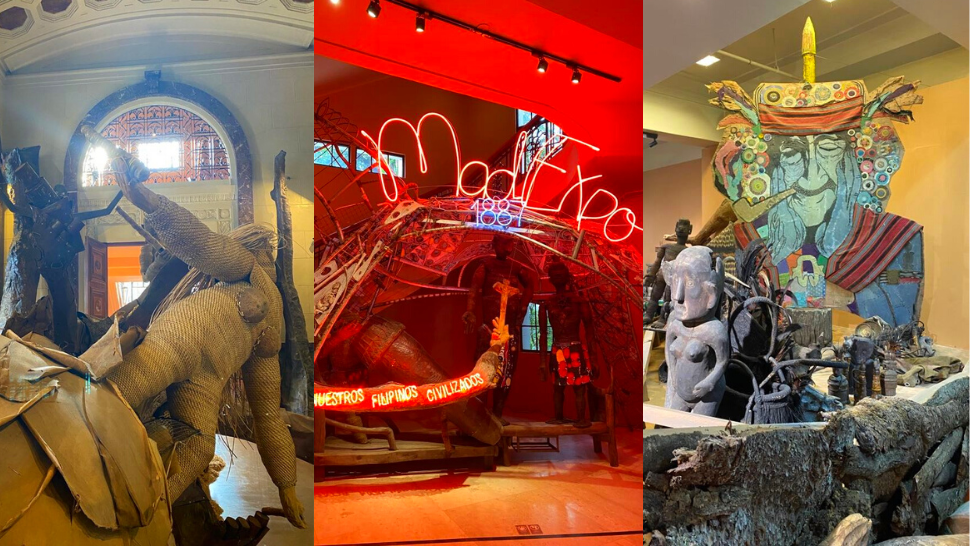
In this exhibit, which came out of Cordillera, making its way through the Museo De Sofia in Madrid, Spain, then to Manila last week at the National Museum of Anthropology, we see a depiction of the great culture wars of our torn people. We get to see monstrously beautiful installations, pieces of which were collected throughout the artist's life. It talks of cultural encounters and neo-colonial absurdity.
Tahimik weaves all that with various parts, both tangible and intangible, within the show. These are 500 years' worth of internal socio-cultural conflict, using indigenous knowledge systems and practices as the primary instrument for its retelling, which, in hindsight, is a good word for it, actually.
ALSO READ:
A 48-Hour Detour Around the Vignettes and Duwendes of Baguio City
This Indigenous Tribe in Mindanao Could Teach Us All a Lesson About Living With-Not Against-Nature
Spideys versus Anitos. Who really won?

By this, I don't just mean the history of politics. It's more about the politics in our history. I see these installations, dangling and on the ground, encompassing the destruction and disenfranchisement of our communities and the unfathomable spectacle of Western homogenization.
I want to get into the architecture of it all first. We can see wood from typhoon-stricken trees, balete, dried palm, rattan, and more. All of which flow and burst in epic proportions. Shells, stone, coconut husk, and local textiles like T'Nalak adorn some of the pieces, as well. Bululs, of course, are scattered all around the premises. They function as protectors and storytellers.
An installation that stands out to me is the humongous Trojan Horse on the second-story nook. If we look closely, we can see Spidermen around it. This, we may argue, is some reference to Western intrusion. In front of the wooden statue is a batalion of bululs wrapped around a wooden pillar, standing maybe 12- or 15-feet tall. Some of the bululs are sitting. Some are dancing. Some are standing. Each resists intervention. It's placed at the balete entrance marker of the exhibit and it is fitting.
"Memories of Forgetting Memory," one of the collections says.

"Postcards From a No-Read-No-Write Globe-Trotter," on the other hand, archives our pre-colonial existence. Its funny introduction reads as follows:
"The Self is today's instant archiving... so easy for encoding and storage. Our latest pa-cute pose, our victories or defeats—instantly liked across the globe."
This portion of the exhibit is a "kaleidoscope of memories." Each assemblage juxtaposes modern frills and indigenous milestones. Here, Kidlat Tahimik relies on local carvers to illustrate the voyage that created our patrimony and various points in the development of the "civilized" Philippines. Tahimik puts together textiles as dream weaving; bones as society's structural integrity; and fire debris as ancestral imagery. Some talk of the "alphabetization" of our languages and others of the whitewashing of our historical memory
Exhibit 4. Just mind-bending.

Exhibit 5. Just marvelous.

In "Harmony With Nature Amigos" inside the halls of the museum, for instance, we can see a quirky commentary on Magellan and Enrique. This part of the showcase challenges European accounts and historical distortion by way of nature and land and sea creatures.
The "Indio"-worldview of the land that we inhabit and the animals we walk with are much friendlier than that of old imperialistic Western perspectives. Our European counterparts looked at these things as something to tame or something to conquer. Colonized peoples look to nature and its various cogs as natural guides or allies, if you will, in the natural system. The Spanish also had naval technology while "Indios" had stars and the current for directions. These amigos teach us the collectivist notions of kapwa and kapwa-bisig. Look at these gigantic structures and we will experience awe. Look above them and we will see alternative fantasies.

Dialogues with history are happening all around. Two pieces that especially come to mind here are Tahimik's "Spirit of Rizal Freed at Last" and Kawayan de Guia's "Homage to Juan Luna's Spoliarium."
In the former, the exhibit notes how Rizal's so-called subversive ideas ignited revolutionary fervor. Here we have an alternative vision of our national hero's death with his "spiritual bahag" (he died in a Charlie Chaplin raincoat, after all). This visual metaphor is an attempt at reframing it as a "moment of liberation."
Meanwhile, De Guia, Tahimik's son, seeks to reframe a "Filipino-fied" version of the fabled "Spoliarium" in the latter. The mixed media artist carves out indigenous elements and historical narratives. Here, we get references to the battle of Mactan, the 1884 Exposición Nacional de Bellas Artes, and indigenous iconography (like textiles, rattan, and tools), among other things we may observe.
Odes to coinciding Filipino belief systems persist throughout the work (Christianity versus Spirituality, local versus Western accounts, idolatry versus community, color versus rust). This piece shows us the non-linearity, richness, and depth of Filipino culture. It is with this kind of lovely chaos we can understand how complex our (many) identities are. Hence, the portraits of Filipinos as bystanders, warriors, and captives. We get a sense of humorous undertones throughout the installation, too.
We are reminded that we're not those "Indios" anymore. The term itself, after all, has long been appropriated by the Filipino people, as noted by historian Xiao Chua. That word is no longer a slur. We must derive a sense of pride from it as its meaning blossoms, without negating its roots.
Even Dr. Jose Rizal, Chua explains, had written a book called Indios Bravos.

See, the clenches of neo-colonialism seem inescapable. Most of the time, they are. Our people continue to reckon with it to this day. We likely always will. What we can do, however, is not to flee. We must address this head-on, no matter how uncomfortable these circumstances may be. It is only then that genuine reclamation can happen—only then can we make a worthwhile attempt to truly be free of our colonial past.
It can be the stuff of nightmares, for sure. Yet, if there's anything we've learned from Kidlat Tahimik and his work, it's that this endeavor can be the stuff of dreams, too.
INDIO-GENIUS: 500 Taon ng Labanang Kultural will be on display at the National Museum of Anthropology in Ermita, Manila until December 30, 2022.
