
Walang Masulingan Is a Search for Refuge in Spaces for Grief

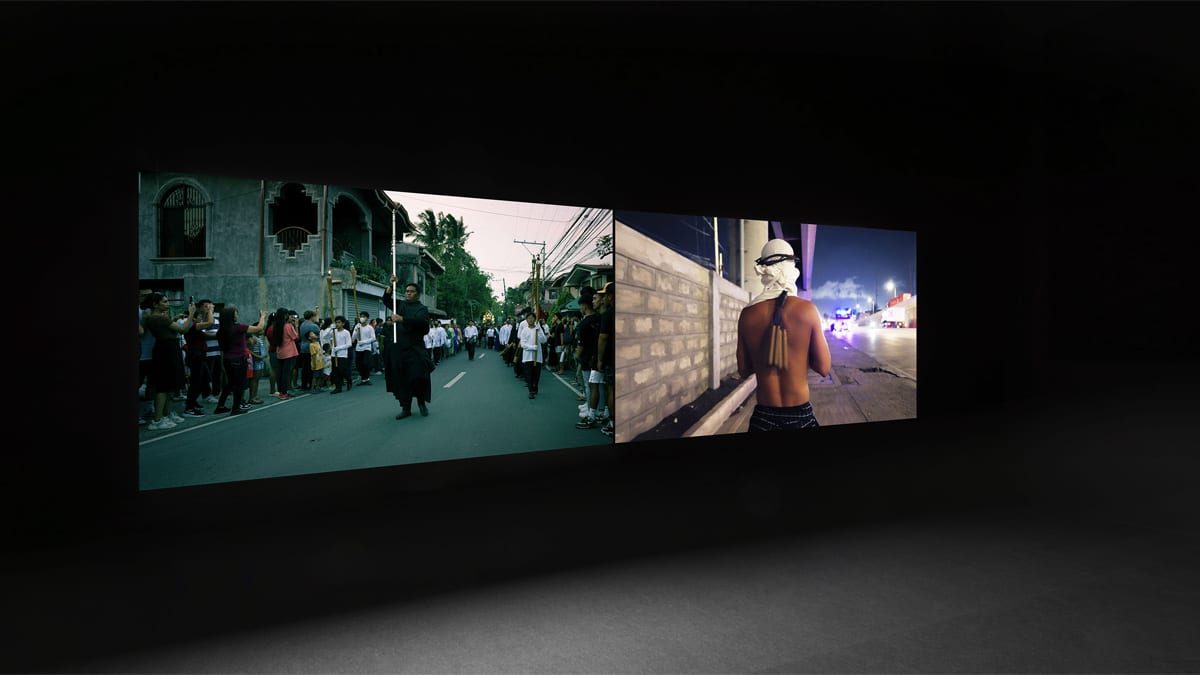
Walang Masulingan, a 37-minute, two-channel video installation by artist-activist Kiri Dalena and Berlin-based cinematographer Ben Brix, immerses viewers in the nooks and crannies of Metro Manila, portraying the everyday struggles and resilience of its people, who are constantly searching for refuge amid the precarity of life.
It was mounted from April 4 to 6 at the culture hub-slash-reading room-slash-exhibition space WHYNoT, Karrivin Studios, in Makati. Entrance on the first day was free, but the next two required a fee of P300. For the duration of the screening, the venue—which also doubles as a coffee shop—hosted a takeover by Silingan Coffee, a cafe run by relatives of extrajudicial killing victims, with all profits from sales going to the staff. At the core of the film, after all, is the Duterte administration's so-called "war on drugs."
Two Channels, Two Cities
Filmed between April 2023 and February 2024 in Manila and Davao—two cities at the forefront of the drug war—the two-channel format allows the film to present multiple perspectives simultaneously. Tight shots create a sense of intimacy with the subjects, while wide and aerial shots frame their movements within urban spaces. The splitting and mirroring of images serve as a way to juxtapose and establish parallels between the social conditions of different protagonists, which makes the film more compelling to view the screens as smaller frames of a single whole. This visual technique is integral to the film's structure, and as an installation of moving images, it shows how, in the absence of traditional narrative storytelling, the images themselves assert their presence and power to represent aspects of reality and human experience.
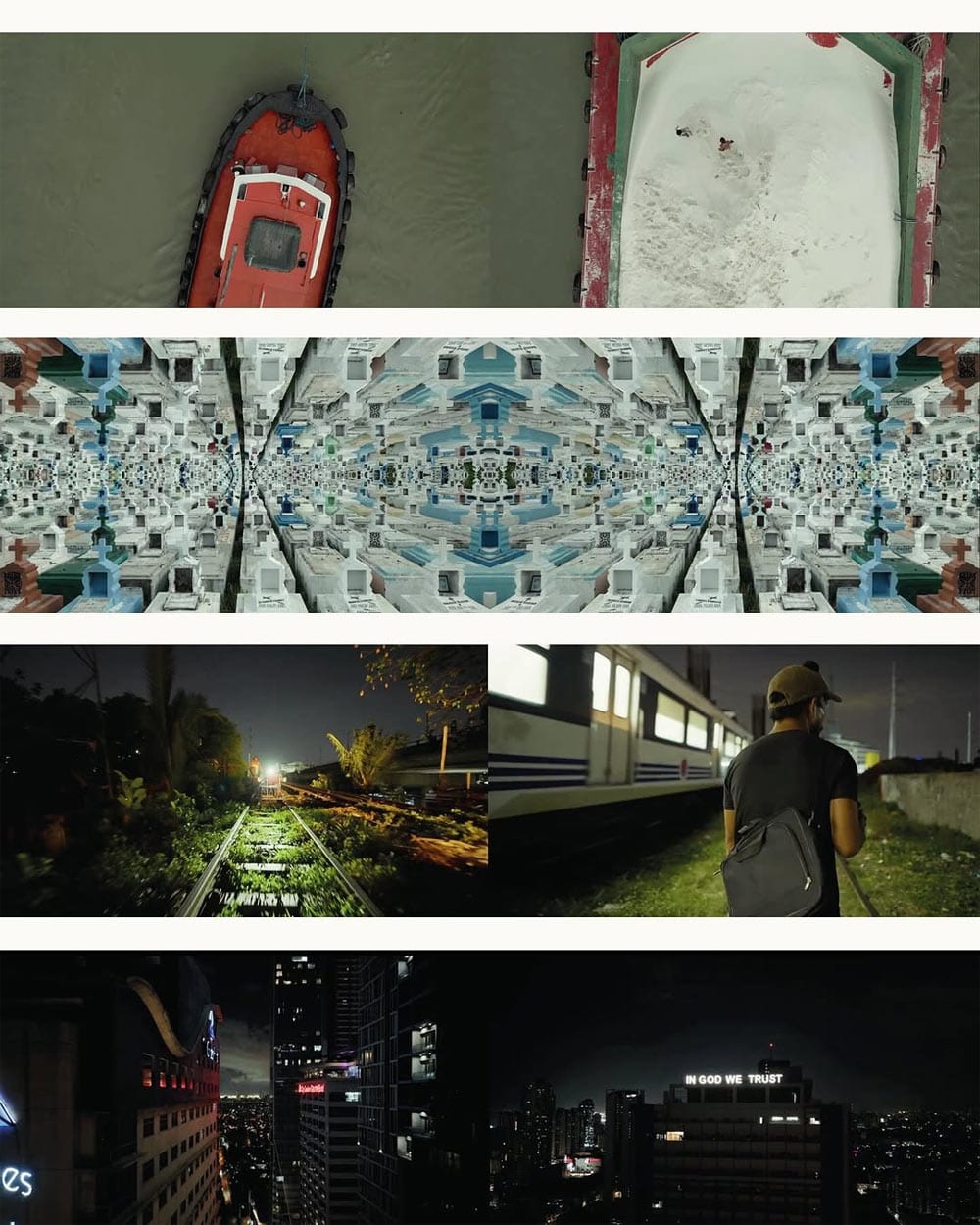
The film blends documentary and fiction. The camera, a tool for documentation, becomes an active spectator, following the protagonists as they navigate the city. The use of fiction—by restaging events and alluding to Philippine myths—subverts the violence typically associated with the camera as a tool. According to art critic Susan Sontag, the language of the camera shares striking parallels with hunting terminology: capture, shoot, subject, aim. In contrast, the slow-paced use of a drone camera hovering over the city and its people creates a dazzling, almost hypnotic effect, with skyscrapers mirroring one another across both screens. This approach hints at the filmmakers' attempt to convey care—being looked after—rather than being surveilled.
'Walang Masulingan' (2024) by Kiri Dalena and Ben Brix, two-channel video installation, color, sound, 37 min (video still)
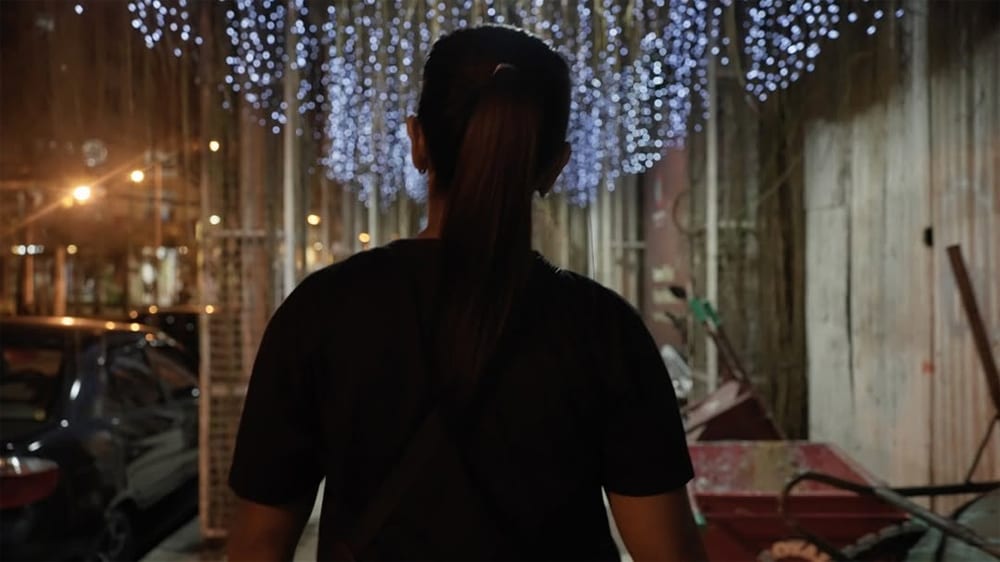
The actors in the film, in contrast to what was pointed out during the talkback by another artist in the audience, revealed their faces. They are fully aware, even in their seemingly unguarded moments. One scene follows journalist, poet, and impresario Pablo Tariman alongside his grandson Emmanuel Acosta, son of the slain rebel poets Kerima Tariman and Ericson Acosta. Projected side by side on dual screens, they represent two different generations who have experienced extreme state violence—encompassing a wide range of injustices, from Martial Law to the so-called war on drugs, from Marcos to Duterte. They are seen attending a recital, playing in a band, and protesting on the streets—both sharing a love for music. Songs, chants, scoring, and ambient sound become central in evoking the city’s innate rhythm, as well as the dynamism and grit found in urban spaces.
In a symbolic (and poetic) depiction of the precarity of life, the filmmakers take us through the lived experiences on tracks along the then-open railway extension of the Philippine National Railways (PNR) that traverses from Pandacan to Sta. Mesa. With high-rise condominiums in the backdrop, it shows a trolley pusher accelerating her speed as she approaches the part of the railway above the river, where there are no barriers and landings. The train approaches her from the other side of the track, from the other side of the screen. This temporary closure of the PNR makes way for another billion-worth road development project.
Spaces and Access
WHYNoT operates on a membership-access basis, and the free entrance on the first screening day seems to be an attempt to open up its space to a broader public and make it more accessible. However, the bigger question remains: what kind of public? Perhaps the moderation of the talkback discussion after the inaugural screening holds part of the answer. There was a sincere effort from the WHYNoT hosts to make everyone comfortable, including the protagonists of the film who were present during the talkback, by asking questions in Filipino. However, their efforts did not resonate as well as they hoped. The first question came from a prepared script, and it seemed disconnected from any genuine curiosity about the film that had just been screened. It was Dalena who, from time to time, steered the conversation back on track, speaking and code-switching eloquently. A more effective moderator could have spared the artist from having to translate every so often and could have encouraged Brix and the rest of the cast to engage more actively in the discussion. Dalena encouraged viewers to invite more members of the audience in the coming days, citing the space's foot traffic, which averages 15 people daily.
Through the lenses of Dalena and Brix, the viewers are reminded how urban spaces serve as the arteries that pulsate life to the city and its people. However, it is perhaps through the perspective of Grace, a team lead barista in Silingan Coffee and one of the protagonists who lost her father and brother to the drug war, that the full impact of the film can be understood. In the film, the protagonists continue with their daily activities—preparing for school and work, performing religious rites, participating in protests— emerging from the streets, braving the ungodly hours of the night, at the most precarious times, when the city becomes a silent witness to countless acts of bloodshed.
In the final scene of the film, Mebuyan, the Bagobo’s mythic goddess of the underworld, is depicted holding a torch and strolling across tombs in a cemetery. She approaches a figure of the Pietà—a sculpture of the Virgin Mary cradling the wounded body of Jesus after the crucifixion. She inspects it, her gaze intent as if searching for something.
Walang Masulingan premiered at the contemporary art space Neuer Berliner Kunstverein (n.b.k) in December 2024 in Berlin.
