
From The Art of War to Sining ng Pakikidigma: The Making of the First Known Tagalog Translation of Sun Tzu's Classic

Call this book a labor of love—a long labor of love that was several decades in the making.
The journey in writing this first Chinese-English-Filipino trilingual translation of The Art of War by Sun Tzu started in 1958. Then 14-year-old Fernando Ang chanced upon copies of Life magazines at home that contained stories of the Korean War depicting setbacks suffered by American troops against the Chinese Communist army. The Chinese forces under Mao Zedong were applying the various military principles and strategies espoused by the ancient philosopher-warrior.
Years later, with his interest in military warfare unabated, Ang discovered that his cousin Chua Bun Pin shared a similar passion. Together they wrote an English translation that was serialized in the Manila-based Chinese newspaper United Daily News in 1982.
A book proposal ensued but, unfortunately, the first draft “disappeared” when it was borrowed by a family friend and taken to Germany, never to be seen again.
Almost four decades after, Ang, now retired, decided to rewrite the book from memory by hand. Upon the suggestion of nephew Wesley Chua, he refashioned Sun Tzu’s book into a trilingual version of Chinese-English-Filipino to be able to reach a wider audience.
The inclusion of Filipino is what makes this trilingual translation unique as it is the first known Filipino version of the Art of War. As the principles taught by Sun Tzu are timeless and can be applied in various fields of endeavors beyond warfare, it becomes even more imperative that it be disseminated to as big a group as possible.

While the Chinese translation is from the original classical version, months of deliberations took place to reconcile the different interpretations and nuances to produce the best English and Filipino translations. It mattered not whether it was a word, a phrase, a sentence, as the same painstaking effort was employed. Where there was uncertainty, language mavens were consulted and many reference books, like the different Chinese versions in the vernacular baihuawen (???) were pored over.
For instance, the choice was made to use the word “governance” over “politics” (the latter preferred by many English versions) to reflect the administration of a state’s affairs. Or choosing the Filipino words “kubli” and “tago” instead of “sikreto” to mean hidden or concealed over the preferred word “secret,” which was used by many English versions to translate the original Chinese text. A distinction was drawn that being hidden is not synonymous with keeping it a secret.
The Filipino title alone took days of back and forth until it was finally decided to use Sining instead of Arte, taking the English title rather than the literal Chinese translation as the point of reference.
Each chapter title in the book (and there are 13 in total like Sun Tzu’s original monograph) contains a caption that succinctly captures the essence of that particular section.
It took the collaborative efforts of almost a dozen people from different time zones and intergenerationally (an age range that spans from 24-76) to produce the book. Multiple rounds of editing occurred with some side debates taking place into the wee hours of the night.
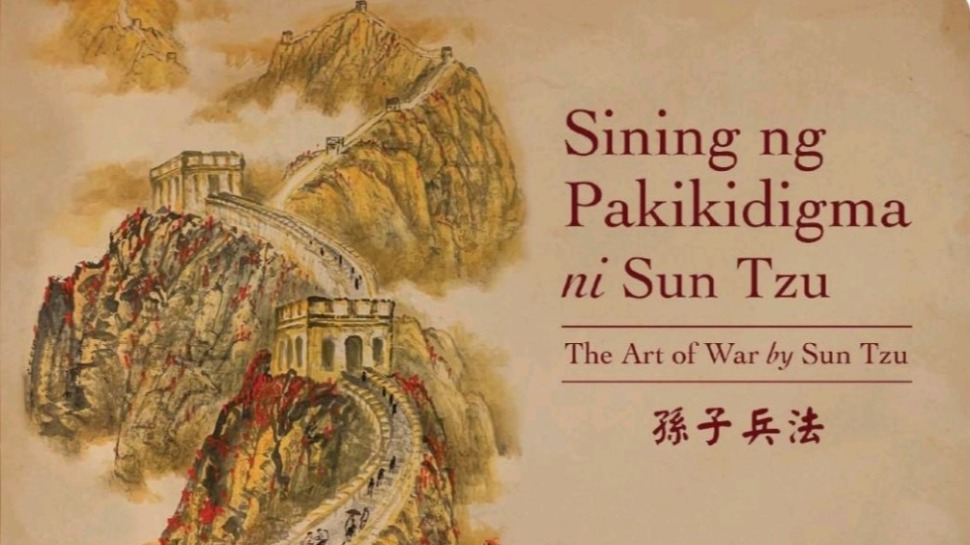
The cover for the book depicting the Great Wall of China was adapted from an original scroll done by renowned Tsinoy artist Hau Chiok. The Great Wall was originally built for defense. The painting was chosen to reflect the emphasis that war should not be an option. Diplomacy should be pursued above all.
The appendix of the book contains local and international events in the military realm that Ang used to illustrate the application of Sun Tzu’s tenets and strategies. That the author is steeped in military warfare lore is undoubtedly obvious.
Readers can find the nuggets of wisdom applicable to a myriad of situations in life. Admonitions like “choose your battles,” “prepare well,” “know your environment and your enemy,” “leave an exit for your enemy,” can be adopted to help manage crises beyond the military sphere. This was what made the Art of War one of the most popular and enduring classical pieces of literature of our time.
When the book was finished, everyone involved heaved a sigh of relief and was overcome with joy. What started as a seed of an idea has finally borne fruit, notwithstanding a gestation period of more than six decades. The birth is now complete.
Note: For those interested, the book will be launched in June. For pre-launch orders at promotional price, click this link or email KAISA at [email protected]

