
Letter from Frankfurt

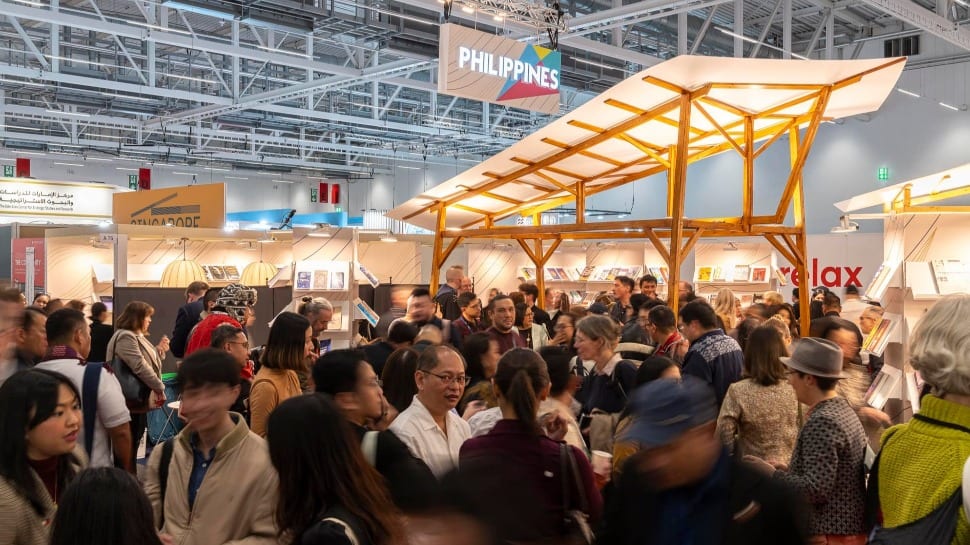
Call me naive, but, really, one of the best things that happened at the recent Frankfurt Buchmesse was that weird sense of fellowship that just seemed to happen, even among writers who had never really spoken to each other (by chance or choice)—and/or, strangely, hardly ever saw each other, either, even while we were there in Frankfurt or any of its associate cities during that humongous, at times humorous or hideous, juggernaut of a precursor visit.
It was weirdly comforting for me to be seeing fellow Filipinos I knew in the crowd more often than ever, or just knowing they were around somewhere, considering I always seek being alone in crowds and that is one big reason why I like traveling, despite all the absurd expenses.
For a while we were all the same strangers in a strange land, and even if some of our relationships had been tenuous, or a few times removed, or something on the cooler side of acquaintanceship, or even something this shy of a bar fight, things were, for two weeks, you know, “all OK.”
Apart from the veterans, we were all outsiders for once, each with a bone, or a stone, or in Butch Dalisay’s case, a screw in a shoe. But as people who chose to go there, as writers, as producers and publishers, as promoters and impresarios, we all knew what was what and which part went where.
Call me naive again but at some brief moment we were proud of the same things again: proud of Rizal, for example; and proud of each other’s achievements. And I mean achievements in the most expansive way: not just someone getting a translation deal, or someone’s chosen genre getting hot at the market—I mean, oh man it made us proud to see our work and the work of others up there on the shelves, or being pitched, or being purchased. It made us proud to find someone suddenly interested in stories in Hiligaynon or set in Marawi.
What was also interesting was how, for the mainstream trade market, there was no need for a divining sense of history or inclusivity when it came to what we had on offer. Neither was there much of a sense of Imperial Manila—everyone was welcome to a place on the shelf. It also turned out that writing in English was not really an advantage—and that’s for another panel discussion. In fact, it was our books in Filipino that made a number of key inroads at the market. For a flicker of a moment, I felt sad that I wrote in English; and for next flicker, challenged, because I have no choice but to consider English my Filipino language and there’s a lot of work to be done and a lot more to prove you’re authentic when you’re a Filipino writer writing in English.
Since Frankfurt is the OG publishing market capital of the world, the translation of our writing into German has become sort of the fine print-slash-watermark that is part of our facing in our nation-as-brand next year. Translator, novelist, and scholar Annette Hug, who translates directly from Filipino to German, has been instrumental in highlighting the many significant advances our writing in Filipino has made—and will continue to make in this much more level playing field. With the recent leaps we have made in translating our own languages to each other, there is enough time to make the field even more level as the promised and proven post-Guest-of-Honor year surge happens; the deep bench of our literature in other languages can take advantage of the long tail that will follow 2025.
Level on every level, I should say. Instead of what the cynical, sad sack writer in me had half come to expect, there arrived a lightness of being, down to its novelistic, Kunderaic—and kinda geographically close—definition. Like we were a traveling circus (or a singing tram, to be more precise) that was just like our writing scene back home, only more feathery-edged, and the edges flowing and fleeting. But we had a kind of meta motive direction. Maybe we were all on an ocular visit for a prospective revolution, just on all our many different terms. I was cool with that.
It helped, of course, that we had a very manageable and what I felt was a very well-planned schedule to follow. That needed an admirable level of perspective and understanding of all the various issues surrounding the materialities of our literature. Plus a more than skin-deep knowledge of the networks of personalities and ideologies that lie underneath.
This year, the emergence of independent publishing came just in Filipino time to put more cooperatively- or independently-published IP on the Philippine stand’s shelves than anybody could have predicted. Small presses bringing small—by fact or by shameful underestimation—voices are going to make for a good big inclusive footprint in 2025. A year before our industry is guest of honor at the world’s largest market of printed ideas, our creators are part of the industry, and our industry is part of our community. Ronald Verzo’s and Bebang Siy’s Balangay Books, Ina Stuart Santiago’s Everythjng’s Fine, and Jane Arguelles’s Grana Books became among the many key conversation pieces because of their culturally and socially committed editorial policies.
It helps that I’m an optimist and moderate in my approach, sometimes to my embarrassment. I’m also impulsive about my feelings toward things, like really enjoying full conversations with Jade Mark Capiñanes while ADHDingly attuned to a panel at the Asia Stage in progress, or like getting starstruck finding out Nida Ramirez was that comics visionary I had always wanted to know more about.
But much of my optimism also lies in how much the publishing industry has done in such short a time to map out our printed—and even our painfully unprinted and underrepresented—past and present. If we were going to hash something out for the future, and if it was going to be led by these guys we were with, the patrons and the veterans and the real hearts who were also real advance thinkers (and by advance I mean by at least a decade), I was cool with that, too.
It may have helped that for the unfunded pocket of our visit, Mookie and I went to Berlin, great and heavy with its remaining walls and bulky veils of history, past and very recent. It was our first visit and we took in the Brandenburg gate and the Memorial to the Murdered Jews of Europe after the daylight hours. It was solemn and it was quieter than Frankfurt and there was no business to be done. At Berlin, we finally gave in to Chinese food, the refuge of the Filipino European traveler, because maybe Berlin was where we felt lonesome the most.
After Berlin, there was Heidelberg, the name itself a beautiful European postcard, the picture you always saw in your head when you wrote about imagined European towns. This was for the more diplomatic and symbolic (and no less important) part of the trip where we would put a little ribbon on it—and stick a nice solid flagpole right after.
Heidelberg was a smaller town than Frankfurt, but the more I talked about it and heard about it, the more it grew in my imagination. When we arrived, the circle of Filipinos grew, and the center of that circle was Rizal. I don’t think anyone can plan that scale of coincidence—you want to be guest of honor at Frankfurt and your big connect to Frankfurt is that your National Hero lived a 52-minute train ride away. That’s something. What a pitch that must have made, brilliant by concept and by coincidence.
So there was a lot of Rizal in Heidelberg, and there were suddenly all these Filipinos from all over, who had been living in Germany or even all the way over in Switzerland or Austria for years or decades, happily coming to see us, or more correctly, our historians, and our writers, but also as historians. Ambeth Ocampo showed us where Rizal began his life in Heidelberg, as a student, and then he took us all over from there. Eh di ba nga, they all said we all proceed from Rizal.
Basically, we did what Rizal did, too, and in our own big little way, as writers and poets, as students on allowance and always unused to the cold. It was recalled to us how he went over to Berlin and wrote the very last word of his book there and he published it, as the most lone wolf indie Indio bravo publisher that ever was out there, and changed the world. The world as we Filipino writers know it and see it, for better or for a little bit worse. Eh di siyempre feel mo yun, kahit papaano.
We felt it even if a fleet of us inexplicably found ourselves gathering at the same Irish (why??) pub every night for one drink or three. We hardly asked why, and we just welcomed the company. An Irish pub in a German town is the best place to do it because, you know. I don’t know, Rizal might have done it. He must have identified more with Ireland in the 1890s.
At Heidelberg we felt the ache for home sharpen when we heard of Kristian Cordero’s Savage Mind destroyed by flood, and for much needed donations this piece is also a call for. We had all known each other before and we knew each other a little bit more know, and that should absolutely count for something.
By that time, were at the Völkerkundemuseum in Heidelberg, at a particularly warm and well thought out reception held by the NCCA, the Philippine Embassy in Germany, and the Consulate in Frankfurt. They played that cool video again that had premiered at the opening press con, where the 2025 project’s name (“The Imagination Peoples the Air”) and visuals were launched. I thought it put together a really well-balanced and sophisticated vibe by delivering, through a tight lattice of text and imagery, a sharply literary and critical entry point toward the actual product we’re going to be selling and the actual amount of Eurodollar business we need to make.
It is a rights market, after all, but more to the point, a market of markets, but it is also our ability to market ourselves that we are marketing. I was proud to see the Filipino imagination present itself in Luna Sicat’s reading of her poems, published in parallel text in a book in a brilliant red cover and such a sonically beautiful German title—Offenes Meer; in Egay Samar’s very articulately situated excerpt that covered so much literary and cultural ground in seven minutes; and in the readings of our German counterparts.
As our small crowd became looser, it took the admins on the Viber groups to point us here and there, as they had been for months, with Sha Capuchino and Mhy San Miguel herding us this way and that, with a quiet handover to Loen Vitto and Mikka Cabangon for the Heidelberg leg.
By this time, Butch, Ambeth, and I had found ourselves in a lot of groufies and three-shots, ever since at the Frankfurt panel where I moderated their insights on Rizal and our literary history. I suddenly realized that we were the happy front acts, and much of the whole thing, especially for the writing and publishing industry that lay at the center of the entire plot, was led by all of these amazing women—Karina Bolasco, Neni Sta. Romana-Cruz, Charisse Aquino-Tugade, Ani Almario, Andrea Pasion-Flores, and of course Senator Loren Legarda, to name a few out of so many.
Kinda like the Bene Gesserit of publishing, if you will. Because I’m thinking this while enjoying my 4th screening of Dune: Part 2—I’ve made sure to do one viewing per connecting Etihad flight.
I’ll be happy to be home not thinking and talking about books and translation while drinking four-euro coffee, not including non-reimbursable tips. On that note, I shiver at the thought of liquidating my expenses, but the thought of all of us going home dreading the same thing makes it all comforting, too.
Would Rizal liquidate ahead of time or right at the deadline? Would Nolledo? Would Allan Derain? Would he even liquidate?? After all, what he was to Frankfurt, and to Heidelberg, and to Wilhelmsfeld, where he worked and lived and wrote letters to home, was nothing like what he was, and always is, to every unjust and corrupt power, to every colonial force, to colonialism and postcolonialism, to public image and to realpolitik, and now, here at the Buchmesse, to a world of globalism and continuing injustice. What would he do?
The fundsourcing page for the rehabilitation of Savage Mind bookstore is here.
