

Silk, Silver, Spices, Slaves: Lio Mangubat Brings Philippine History to Life

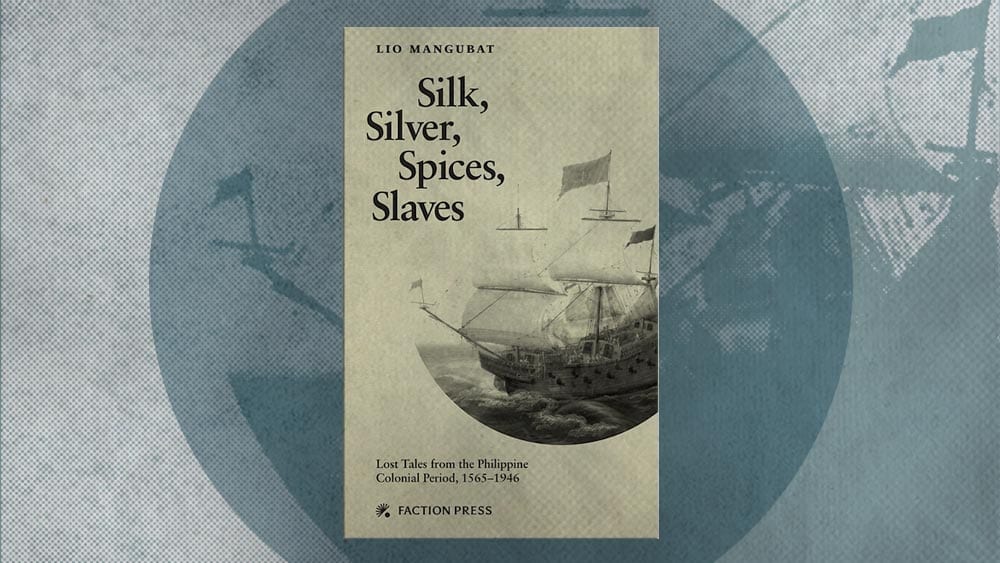
ILLUSTRATION: Igi Talao
Unless you really loved history as a child, the subject is just something you have to sludge through to make it through primary school. But it's different when you read up on it in adulthood when the fragmented stories we know turn out to be interwoven—as they should be, and things just make a lot of sense. For author Lio Mangubat, writing about Philippine history in his non-fiction collection Silk, Silver, Spices, Slaves: Lost Tales from the Philippine Colonial Period, 1565-1946, is exactly that: "collisions and frictions" of events that have created a domino effect on our lives today.
ALSO READ
This Underrated Podcast Reveals Unsung Tales from Philippine History
Everyone Should Learn History. But How Should It Be Told?
Silk, Silver, Spices, Slaves author Lio Mangubat has worked as an editor in various print and digital publications in the Philippines. In 2021, he founded the independent podcast The Colonial Dept.

Silk, Silver, Spices, Slaves: Philippine History in Bite-sized Stories
Silk, Silver, Spices, Slaves was published in Singapore by Faction Press, an independent publishing house dedicated to Southeast Asian non-fiction. The book officially launched in the Philippines last August 31. It features 13 essays that take readers to lesser-known narratives of Philippine colonial history. Every essay is made up of vignettes, where one bite-sized trivia leads to another through a related word, personality, event, or place. The end of every essay circles back to where it started as if tying a loose knot.
Chapter One, "Auroran Gods," sets the tone of Mangubat's collection. It started with a story most of us are familiar with: how Baler, Aurora was used as the filming location of the 1979 war movie Apocalypse Now, directed by Francis Ford Coppola. As if letting readers ride on barreling waves that Baler has become known for, the chapter eventually brings us to the year 1609, when Franciscan missionaries started preaching to the Aeta tribes and lowland migrants in Casiguran; then to 1747, when one Father Bernardo de Santa Rosa violently dealt with Indigenous practices only to come face to face with what we know as "sumpong."
Mangubat then brings it back to how Apocalypse Now's cast and crew may have faced their own experience of this Tagalog word that's buried deep in the Filipino psyche. The author also sprinkles references all throughout the essay, including Resil Mojares' House of Memory, a quote from psychologist Rita Mataragnon, and a journal article by Mark Dizon. For all intents and purposes, every chapter of Silk, Silver, Spices, Slaves is a masterclass in RRL-writing (Review of Related Literature), with Mangubat normalizing the practice for an enriched hold of history.
While we see the same technique in the succeeding chapters, every page always surprises us as the author turns something we already know into its head and digs deep into the recesses of the past. But more than that, there's always an attempt—not a heavy-handed one—to remind readers of the realities of colonization hidden under the guises of sports (as in the history of Philippine basketball in Chapter Two), slavery at the time of European empires (as in Chapter Four and the story of trading otter furs), and the Filipinos’ complicated relationship with precolonial practices and the colonizers’ influence. Chapter Ten, in addition, makes a case about the highly contested seas surrounding the Philippines by surveying various maps of the country throughout history.
Other chapters explore stories that trace the Philippines' role in various moments in world history. Chapter Three, "That Sweet Gangland Music," in particular, revealed the exciting heist-like story of Jack Riley (a.k.a. John Becker), the slot machine king of Shanghai. As a side note, the chapter also looked into how Filipino musicians treaded the waters to make it big in Shanghai.
From The Colonial Dept. Podcast to Print
Mangubat, in a press statement, hopes that the “different essays in the book would help us understand their decisions and the historical events that ensued, all in an entertaining way.” And that it did.
It probably helped that the narratives were initially released as podcast episodes for Mangubat’s The Colonial Dept. What’s more entertaining, after all, than a conversational treatment of history rather than a very textbook take on it?
The Colonial Dept., “was a passion project that also felt like an interesting creative challenge,” Mangubat said. “I’d always considered myself as a writer, but how could I tell these stories as audio experiences? I set a goal of writing, narrating, engineering, and publishing a main episode every two weeks, and see how far I could take the project. And now, here we are, three years later, with more than a hundred episodes in the bag.”
It was in 2023 when Faction Press got in touch with the author, who was asked to release the podcast scripts as a book. “Faction Press is dedicated to publishing unique voices from across Southeast Asia, and I am immensely proud and honored to be the first Filipino in their roster of authors,” he said.
Less than a year later, Silk, Silver, Spices, Slaves was published and debuted at number two in The Straits Times’ non-fiction bestseller list.
"Afterword: The Professor and the Book" from Silk, Silver, Spices, Slaves
Mangubat punctuated his collection with an afterword dedicated to his uncle, Benjamin Mangubat. "My uncle and I share the same birthday, and perhaps a few of the same oddities," he wrote.
As it turns out the author's penchant for history comes from his Tito Ben, a history professor at the University of the Philippines - Manila whose teaching style "didn't value tests, or papers, or reports." He's the same professor who introduced the "bangkarwayan" to the world, a mashup of the Filipino words for boat ("bangka"), bamboo ("kawayan"), and car ("sasakyan"). And the odd contraption is actually that: a makeshift amphibious vehicle made from bamboo slats that runs on wind and solar power.
More than a heightened interest in storytelling and history that came from his uncle, it is perhaps this mashup of words and materials that inspired Mangubat’s Silk, Silver, Spices, Slaves—a mashup of stories, a blend of trivia and lore, and his very own way of telling our country’s history.
Silk, Silver, Spices, Slaves: Lost Tales from the Philippine Colonial Period, 1565-1946 (Faction Press, 2024) by Lio Mangubat is available at Everything's Fine, Prince Tower, 14 Tordesillas Street, Salcedo Village, Makati.
