

Filipino Gallery Silverlens in New York: 'Nobody Here Is Doing What We're Doing'

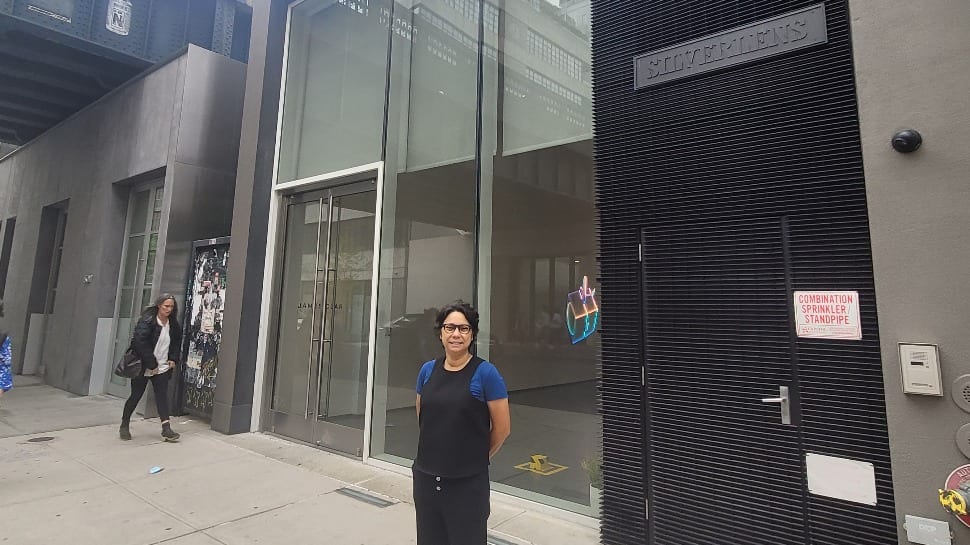
NEW YORK: Much has been said about Silverlens Gallery since it opened its second location in the Chelsea District of New York City last September. The first Filipino-owned art gallery in the city considered the very center of the art world was quite the news story, and founders and co-directors Isa Lorenzo and Rachel Rillo found themselves talking about their latest baby to numerous publications and news platforms.
And so I was more than a little intimidated when I dropped by the gallery one Friday afternoon and asked for a meeting with Lorenzo. What else could we possibly talk about that hasn’t already been discussed?
Rachel Rillo and Isa Lorenzo of Silverlens
 (1).jpg)
“You must have a million people walk in here asking to hear the gallery’s story,” I open.
“Yes, but the thing is, it's a great story,” she says as she settles in her chair in her office at the second floor. “So, I feel like I'm not tired of repeating it yet.”
ALSO READ
Silverlens Gallery Is Opening a New Space in New York
Silverlens Challenges Conventions in Two Thought-Provoking Exhibits
To recap this remarkable story, Lorenzo first opened Silverlens in her own apartment as a gallery devoted to photography in 2004. After partnering with Rillo to co-manage the space, it evolved and expanded to eventually become a leading promoter of multi-media art in Manila—from paintings and sculptures to more experimental works crafted by up-and-coming artists.
Silverlens eventually made its way to Singapore in 2012, where a unit opened to cater to a wider market across the region. But the outpost permanently closed in 2016.
Isa Lorenzo stands outside the Silverlens Gallery in New York
.jpg)
Opening in New York was ambitious but relatively frictionless, Lorenzo says. The idea started solidifying in November 2021 and they locked in on the space—the ground floor of 505 West 24th Street, just a few short blocks from the Whitney Museum—between January and April 2022. By September, Silverlens New York was open.
“It was easy, which is unheard of,” she says. “And even until now, how things are unrolling and unfolding. Of course, there's a lot of growing pains.
“And I'm tired,” she grins. “I mean, it's a lot of work, right?”
Lorenzo shares learnings from the Singapore experience that proved helpful when they once again tried their hand at an overseas expansion.
“First is you need to include and engage with artists in the place where you settle,” she says. “Because in Singapore we really didn't take on any local artists. We just did our program and we kept trying to introduce Filipino art into Singapore. We realized later on that people, audiences, need to see themselves in the work. And how do you do that? By getting artists from that place.
“So that's part of what we're doing here in New York.”
An exhibit by Filipino-American artist James Clar at Silverlens Gallery in New York
.jpg)
The idea now is mixing up the gallery’s program by including artists who are from the United States—either they're Filipino-American, or they have some sort of kind of connection to a mixed-race background or a diasporic situation. They don’t necessarily have to be Filipino or even from Southeast Asia.
“So, like last January, our show included, among other artists, a Moroccan-American, and then we had two Filipino-Americans, and then one German-Filipino,” Lorenzo says. “The point is not so much that you have all of these kinds of people, but that there is diversity, and it transcends place. It's not about how people look or the geography they come from, but it's about the art that they make.”
New York was a logical goal for Silverlens. Lorenzo herself lived here from 2000 to 2004 when she studied at Parsons School of Design. And if you’re going to make it anywhere in the art world, New York, specifically the Chelsea neighborhood, is the place to do it.
Artwork by James Clar
.jpg)
“In terms of a brick-and-mortar space right in the middle of Chelsea, this (Silverlens) is a very big deal,” Lorenzo says. “This is blue chip. All the galleries that are here are…well, they're the top galleries in the world. So it's really, it's really super exciting because nobody here in New York is doing what we're doing.
“It's also a big responsibility, because we need to sort of establish what ‘contemporary’ looks like from our part of the world.”
But how exactly does one earn their stripes in the high-stakes, cutthroat world of contemporary art?
For Lorenzo, it’s all about longevity, and the caliber of the artists they exhibit.
“Here, their markers for success are, first, if you're still open after a year or two or three, because it's expensive to run a business here. Then, also, if your artists enter into museum collections and private collections, and that their work is included into the conversation or in shows. That's really the measure."
She couldn’t help but compare the situation in Manila, where a big measure of success is whether the artwork sells or not.
Rillo and Lorenzo are working nonstop on the two outposts of Silverlens in New York and Manila
 (1).jpeg)
Sales is, undeniably, one measure, but for Lorenzo, it’s all about what happens after: how do you get more people to see the work even after it's bought? What is the ripple effect?
“It doesn't stop,” she says. “We're swimming in this. We're just moving forward. There are many things that are happening. And sometimes something happens, sometimes things don't happen.”
During the time of my visit, works by Filipino-American artist James Clar fill the gallery. Born in Wisconsin but now based in Manila, Clar uses light and technology to explore themes of perception and identity. Installations that may seem simple and straightforward with a cursory glance reveal layers of complexity upon closer inspection. He even collaborated on a couple of pieces with Olympic gold medalist Hidilyn Diaz.
“I think that’s very special,” Lorenzo says.
It’ll be a busy couple of months for the Silverlens team in New York. Lorenzo rattles off several upcoming activities, including the closing of the Clar exhibit, a special drum performance, and the first solo show of artist Maria Taniguchi in the U.S. The week of May 17, there’s an art fair called Frieze New York where the gallery is presenting works by Filipino-American artist Carlos Villa from San Francisco, who passed away recently.
The Silverlens outpost in Manila isn’t idle, either. Showing now is an exhibition curated by Patrick Flores by artist Santiago Bose, who died in 2002. There’s also a project in Davao City called Lubi, which is in collaboration with a local artists’ group, as well as the planned relaunch of their art house in Malate called Calle Wright, which is going to be “a slow art lab for mid-career artists.” Calle Wright is opening this month with Gary Ross Pastrana, an artist who will also be the curator-in-residence.
“It's in an old house in Malate, so it's got a lot of character,” Lorenzo says. “It's gonna do a lot of more less commercial stuff.”
Silverlens is the first, and so far only, Filipino-owned gallery in the Chelsea neighborhood of New York
.jpg)
It’s enough to overwhelm anyone, but Lorenzo and her team are leaning into the hustle.
“We’re busy yes, but ang sarap because, the audience, they get it,” she says. “You don't need to explain so much to them. They appreciate what you're doing and there's an understanding. They come in with a wealth of information that they already have so when they see the work or when they talk to you about it, there's already a baseline understanding of what's going on.
And despite her earlier claims of exhaustion, Lorenzo's bright, alert eyes and easy smile belie her true feelings about her work.
“Hindi sya nakakapagod.”
