
EdJop: The Voice That Challenged a Dictatorship

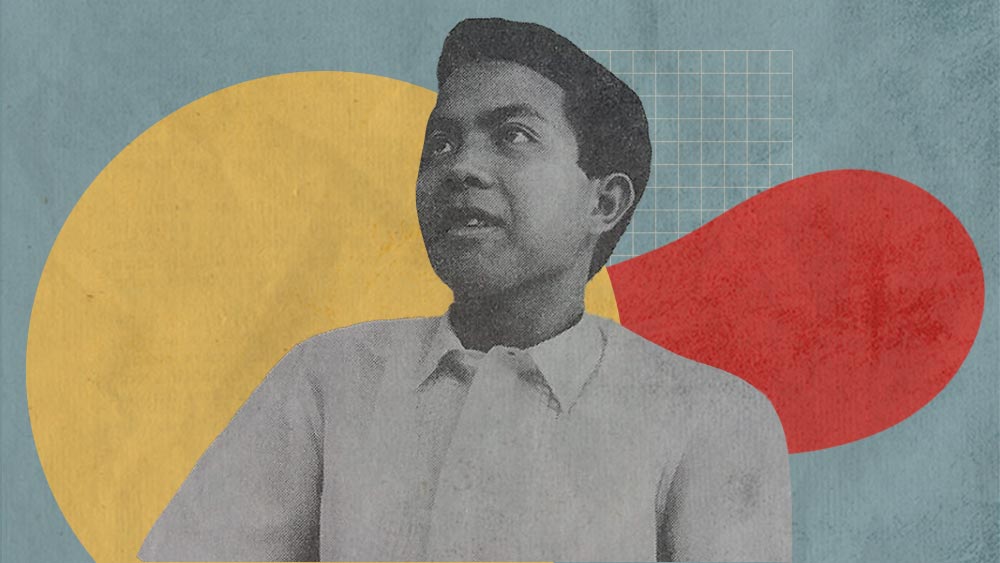
ILLUSTRATION: Igi Talao
On Sept. 20, 1982, a young student leader was killed during a military raid in Davao City. His name was Edgardo Gil Mirasol Jopson, or in short, Edgar Jopson. He is often remembered during Martial Law commemorations as one of the opposition’s most notable martyrs and a symbol against oppression. But it would help to know how exactly he became such.
Jopson was born on Sept. 1, 1948. His parents ran the Jopson Supermarket which was popular in the Sampaloc, Manila area in the 1950s. Originally studying in Malate, Manila, Jopson was then invited by a Jesuit priest to the Ateneo de Manila University. There he spent his grade school and high school years till he graduated as valedictorian in 1966.
ALSO READ:
General Ver's Daughter Reckons with Her Father and the Legacy of Martial Law
Listen to These Podcasts to #NeverForget About Martial Law
The time following his enrollment in college was marked by growing student protests calling for reform in the government of Ferdinand Marcos. Some groups, connected to the Communist Party of the Philippines (CPP), supported the radical path of armed struggle and overthrowing the government. Jopson was part of the moderate side at this time, calling for political reforms as the president of the National Union of Students of the Philippines (NUSP). In January 1970, the NUSP held a protest against the then-ongoing Constitutional Convention in Manila, starting what is known in history as the First Quarter Storm.
Though Jopson was a fervent critic of the Marcos regime, Marcos apparently noticed his influence and invited him for a dialogue. He called for Marcos to step down and not run for president a third time (this was during Marcos’ second presidential term), but Marcos refused. After that, Jopson with lawyer Charito Planas created the Citizens National Electoral Assembly (CNEA) which designated student council leaders as poll watchers over the Constitutional Convention delegate elections.
Nevertheless, 1970 still had its high points for Jopson as he was named one of the Ten Outstanding Young Men of the Philippines (TOYM). The following year, he graduated with a degree in Management Engineering from the Ateneo. However, instead of looking for a high-paying job, he opted to help labor groups such as the Philippine Association of Federated Labor Unions, apparently having a soft spot for workers and the poor. He helped people from two barrios, Ora East and Ora West in Ilocos Sur, which were reportedly attacked and burned down by the henchmen of a local political clan. He also raised funds to help reforest parts of the Sierra Madre mountain range damaged by major floods in 1972.
Following the Martial Law declaration, Jopson decided to switch from the moderate route to the armed struggle, working with the CPP and National Democratic Front of the Philippines (NDFP). He still participated in labor-related initiatives, such as helping organize the 1975 La Tondeña workers’ strike.
In 1979, he was arrested and tortured at Camp Crame. He later escaped and went to Mindanao, while a P180,000 bounty was placed on his head. He hid there until his death during the 1982 raid.
The upcoming movie “EdJop” stars Elijah Canlas as Jopson with Jodi Sta. Maria as his co-star.
