
Is Balut the 'Worst' Egg Dish on the Planet? Foreigners Just Don't Get It

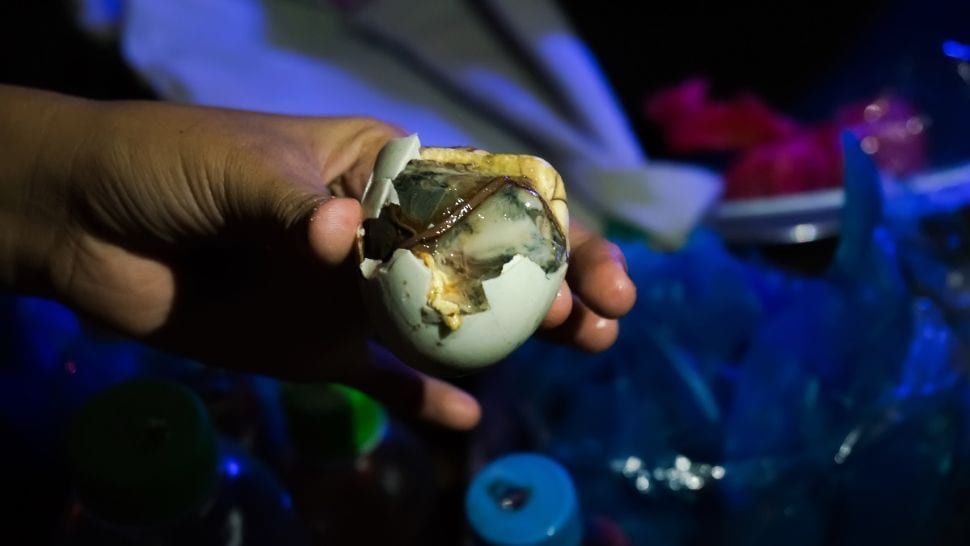
Balut (fertilized duck egg) was recently named the worst egg dish by traditional food guide Taste Atlas, again inciting protests among lovers of the delicacy that has come to represent the ugly deliciousness of Filipino food.
Located at the bottom of rung of the list that was led by Tortang Talong (Filipino eggplant omelette) as the best egg dish on the planet, balut got a 2.7 rating from TasteAtlas audiences across the world.
Balut is often considered the national street food of the Philippines and is said to be as popular as hotdogs are in the United States. Why the complicated legacy?
More: Tortang Talong Makes Case as Supreme Egg Dish, What Makes It So Good?
Understanding balut
Balut is sold cheap (usually priced at P15 to P20) at nightimein the streets of the Philippines and is popular among the middle class and the low income.
Balut is best eaten 17 days old (called "balut sa puti"), when the duck egg' embryo is still small, without feathers or beak, and wrapped in a white membrane. To properly eat it, one has to crack one end of the shell, drop a pinch of salt and a dash of vinegar, and then sip the broth. The act of adding salt and vinegar is repeated depending on one's liking, in order to really savor the taste of its parts.
Based on The Food Composition Table for Use in East Asia, balut is regarded a "superfood" that contains 188 calories, including 14 grams each of protein and fat, 2 milligrams of iron and 116 milligrams of calcium, earning itself a reputation as a "poor man's meal" due to its potential as a nutritional substitute. Since it's ready-to-eat, it is also easy to take from places to places, making it an ideal snack for those on-the-go.
Pregnant women and sick people are often urged to it. Some regard it as a good hangover cure and that it can supposedly strengthen the knees and joints. It is also believed to be an aphrodisiac, which has made it popular among male Filipinos.
Though largely associated with the Philippines, balut is said to have been an influence of Chinese traders, who settled in the country in the 16th century. The practice of eating fertilized duck egg is also present in other Asian countries like Vietnam, where it's called hot vit lon, as well as Thailand, Laos, and Malaysia.
Just like adobo, balut has embedded itself in the culture of the Filipino diaspora, as many immigrants consider it a comfort food, a reminder of home, from whichever part of the world they decided to relocate.
In countries like the U.S., home to some 4.2 million Filipinos, as of 2019, balut is sold widely by Filipino-owned businesses.
Due to its popularity among Asian immigrants, foreigners have taken notice of the delicacy, with a reputation too often negatively described as “exotic” and "disgusting" and based on the belief that it's only eaten during extreme food challenges and as a way of proving one's masculinity, said a 2019 article in the Journal of Ethnic Foods.
In television shows like "Fear Factor" and "Survivor," balut is usually featured in daring challenges, wherein contestants have had to eat balut under time constraints and without proper guidance on how it is eaten the Filipino way.
"The usual pained expression on their faces depicts a negative portrayal of balut on national television," the article said, noting how this "presents an exaggerated one-dimensional representation of this delicacy."
"Television viewers will immediately assume that such delicacy tastes bad or is unpleasant by purely basing on how the television show presented its physical appearance," it added.
Balut has also been a subject of ethical controversies, particularly, whether or not it is okay to eat an unborn animal.
Balut is part of Filipino culture
Eating balut is ultimately a matter of preference. The verdict on whether or not it is delicious or disgusting is for one to decide in the end. Even Filipinos are free to not like it.
But what cannot be argued perhaps is how balut—its preparation, presentation, and consumption—is a vessel of culture. The late writer Doreen Gamboa Fernandez, named by the New York Times as "Filipino Food’s Greatest Champion," wrote about this in 1996.
Fernandez wrote about the intricate ways in which the duck eggs are prepared, and how when they fail to become balut as we know it, vendors would still have a use for it anyway.
The unfertilized would be turned into a salted eggs, coated with a mixture of equal parts mud and salt and stored for 18 days, while eggs that do not develop are made into penoy, which has four kinds, namely sariwang penoy (fresh hard-boiled egg), higop (penoy with broth to sip), penoy tuyo (lik a hard-boiled egg, but has the yolk and the white parts mixed within), and penoy sa balut (which has a small sisiw).
"Obviously this is a whole culture, a highly articulated world built around the fact that the duck egg has changing excellences and tastes, and need never be wasted," she said, also noting balut vendors also have individual techniques that give their product a special taste that endear patrons or their suki.
"To the foreigner, it is another bit of exotica, product of uninhibited Asian imagination, which knows few food taboos," Fernandez said, noting how for her, balut was "another of our definitions of perfection."
From: Reportr World
