

What's Up With People Wearing Tiny Rubber Ducks On Their Heads?

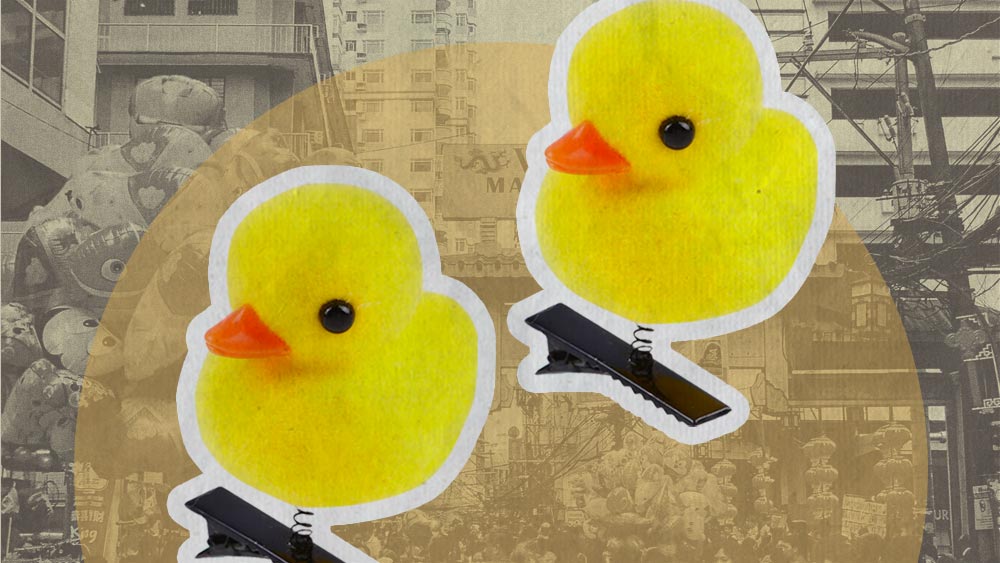
I first noticed my college-age nephew wearing them as he left for school one morning last week: two yellow rubber ducks attached with springs on a hairclip. As a geriatric millennial (or a baby Gen X-er), I remember thinking how strange young people are today.
Two days later I saw the rubber duckies again, this time all over my social media feed. Apparently, it’s been a thing now for at least a couple of months. People have been wearing them in big cities all over the country, most notably in Baguio City, where the trend reportedly started, and during the Chinese New Year celebrations in Binondo.
A nationwide epidemic of people just casually wearing rubber duckies on their heads as they go about their day. What’s up with that? We had to investigate.
But first, a bit of history about the rubber duckie.
ALSO READ
A Filipino Discovered a Portrait That Looks Just Like Her at the National Museum
How Islander Became a Part of Many Filipinos' Journey
History of the rubber duckie
Believe it or not, these toys go as far back as the 1800s, according to internet resources. After vulcanized rubber was invented, it didn’t take long for people to find uses for them. Of course, in some cases, people just wanted to create something aesthetically pleasing without a real practical purpose.
The first rubber ducks were supposedly created as chew toys—for babies as well as pet dogs. Later in the 1930s, two separate developers proposed designs that were the precursors of the modern-day bathtime companion. One of them was a collaboration between the Walt Disney company and a latex manufacturer for a bath floater toy that the company named after the two most popular ducks in their IP: Donald and his partner who was then-named Donna. (She wouldn’t be renamed Daisy until 1940).
But the first iteration of the rubber duck people know and love today is often attributed to an artist named Peter Ganine, who filed a patent for a duck-shaped toy made out of vinyl and painted bright yellow in 1947. It was a big seller and was exported around the world.
Rubber duckies really hit the mainstream though when Ernie from the children’s TV show Sesame Street sang the eponymous song and it became a massive hit. From there, a yellow rubber duckie has become ubiquitous in bathrooms all over the world.
Rubber duckie hairclips
Now, unlike the history of the rubber duckie itself, the phenomenon of people in the Philippines wearing tiny rubber duckie hairpins is a bit harder to, well, pin down. Most online resources point to Baguio City as ground zero for these artsy accessories, specifically an anime cosplay convention that happened there in either August or October 2023. Attendees were spotted wearing clips in their hair with either a duck or a sprout design. It must’ve caught on because, by December last year, it was a common sight among people of all ages and walks of life in the city up north.
By February, the phenomenon had spread outside Baguio City, with sightings in Laguna, La Union, Pampanga, and Ilocos Norte. The Chinese New Year celebrations over the weekend in Binondo surfaced hordes of tourists and daytrippers all proudly wearing the yellow duck hairpiece.
The general consensus, as with most things of this nature, is that the sight of tiny rubber duckies bouncing around people’s heads is just “cute.” Harmless, immensely cheap, and relatively easy to get, the rubber duckies-as-hair-accessory trend soon spread among impressionable youth and anybody just looking to jazz up their OOTD.
But is there a deeper reason people are all of a sudden sprouting yellow ducks on top of their heads?
The China connection
Reddit user Pinoybrad offers a theory: that the yellow rubber duckie trend started as a way for Chinese Filipinos (or Chinoys) to “give a finger” to China. You see, back in 2013, the rubber duckie became an unexpected symbol of resistance against the Chinese government when activists started photoshopping a well-known gigantic rubber duck art piece by Dutch artist Florentijn Hofman into the iconic photos of the Tiananmen Square protests in 1989. Because of this, results for searches for “big yellow duck” were blocked in China.
It probably wasn’t a coincidence that, in the same year, one of Hofman’s giant rubber duck inflatables made its way to Victoria Harbor in Hong Kong. But the duck deflated, some say prematurely, although organizers explained that they had always planned to deflate the art installation.
In June last year, however, Hofman’s giant rubber duck inflatable made a return to Hong Kong. This time, there were two of them, although one deflated, again under mysterious circumstances. There were speculations it could have been the intense summer heat the city was experiencing at the time, but there were more than a few conspiracy theorists that proffered more sinister motives behind the deflation.
Pinoybrad seems to think that the wave of rubber duckie hairclips in the country today is directly related to the rubber-duckie-as-a-symbol-of-defiance-against-China. It’s important to note, however, that the Reddit user doesn’t exactly offer any solid evidence to back up this claim, but it’s as good a guess as any to explain the trend.
In any case, after posting about the trend in Reddit, users started chiming in about sightings of the rubber duckie hairclips from different corners around the world, proving that it’s not just happening here in the Philippines. So far, there have been sightings in countries like Australia, Mexico (also during Chinese New Year celebrations), Indonesia, Colombia, Peru, and Chile.
Back home in the Philippines, we reckon we’ll see more of these things pop up all over until it reaches a saturation point and people get sick of it before moving on to the next trend.
As for my nephew, when I asked him about it, he just gave me a shrug and said, “I just like ducks.”
