
A Filipino Discovered a Portrait That Looks Just Like Her at the National Museum

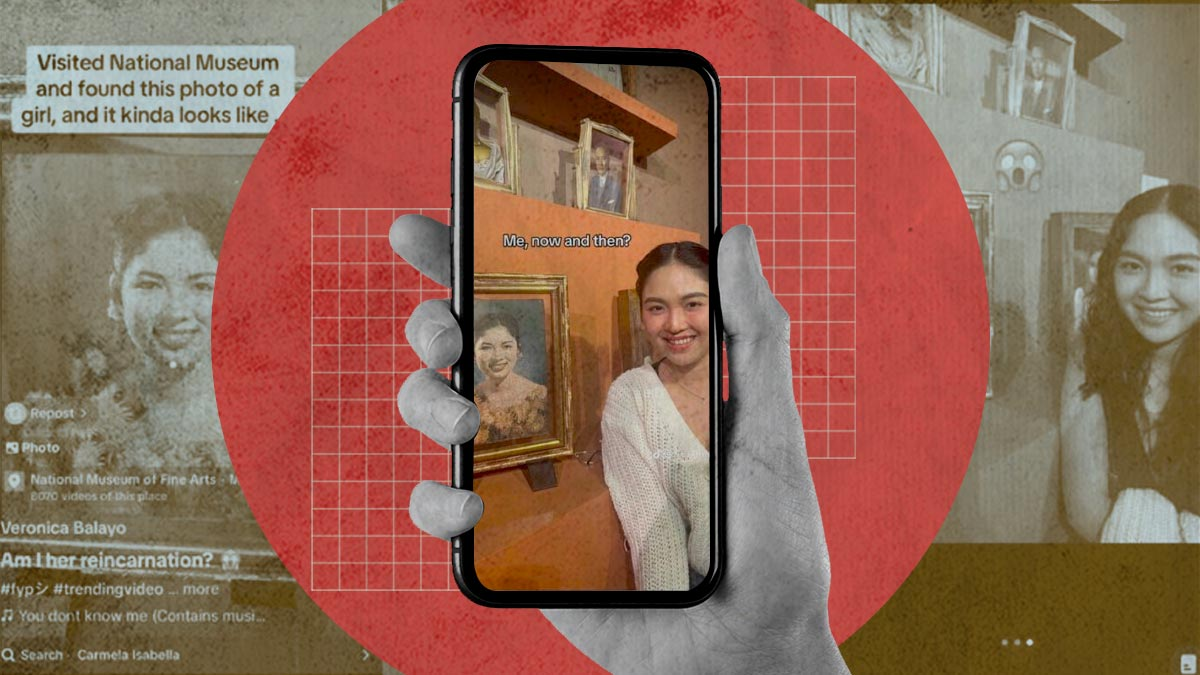
The TikTok post of Veronica Balayo showing herself next to the vintage portrait of a woman who bears a striking resemblance to her is going viral on social media. The snap was taken at the National Museum of the Philippines (NMP) during Balayo's recent visit, and the woman in the foto-óleo turns out to be the mother of historian Ambeth Ocampo, Belen Ocampo.
The portrait of Mrs. Ocampo was included in an exhibit titled "Larawan at Litrato: Foto-óleo and Picture Portraits in the Philippines (1891-1953)," showcasing 43 other foto-óleos, a unique art style prevalent from the mid-19th century to the mid-20th century.
As of this writing, Balayo's TikTok video captioned "Am I her reincarnation?" has amassed a whopping 7.5 million views on the platform. Similarly, Ocampo's Facebook post has racked up 15,000 shares and counting, as Ocampo's followers started posting their own photos next to their doppelgangers, turning the comment section into a fascinating gallery of past-meets-present encounters.
Balayo, hailing from Davao, was in Manila on a work trip with colleagues. With time to spare before their return flight, they visited NMP and checked out the exhibit. "The similarity was unmistakable," Balayo recounted her surprise to Esquire Philippines. After confirming the resemblance with her colleagues, she seized the opportunity to take a photograph alongside the portrait, only later discovering the subject is the mother of a Filipino historian and was a model for the Philippine Travel Bureau (now Department of Tourism).
ALSO READ:
Here's How Much It Costs to Book Your Wedding at the National Museum
There Are Over 1,000 New Reasons to Visit the National Museum of the Philippines
While we don't know for sure if Mrs. Ocampo shares any blood relation with Balayo, the probability of someone finding their doppelganger, whether alive or deceased, is an intriguing mystery. In fact, there have been studies that explored the likelihood of a person having lookalikes or doppelgangers.
According to a BBC Future article titled "You are surprisingly likely to have a living doppelganger," research conducted by Teghan Lucas from the University of Adelaide analyzed facial features of nearly 4,000 individuals to calculate the probability of two people having matching faces. The study suggests that finding an exact doppelganger is incredibly rare—only one in 135.
However, if we consider lookalikes in a broader sense—those who appear very similar to us but not identical—the chances of finding a lookalike increase. Factors such as hair color, hairstyle, facial structure, and other characteristics can contribute to someone looking similar to another person without being an exact match.
The study also indicates that for someone with an 'average' face, it's easier to find good matches due to the limited number of genes that specify face shape.
According to a CNN article, researchers in Spain also conducted a study, recruiting 32 people who looked alike as part of a photo project. Their DNA as well as their facial features were analyzed with recognition software.
The study found that doppelgangers with the most resemblance shared more genetic variants related to facial structures. These genetic similarities could influence not only physical appearance but also certain habits and behaviors, such as weight, smoking, and education levels.
Epigenetics, which is "the study of how behaviors and environment can cause changes that affect gene function," and microbiomes, which refer to "communities of microorganisms that exist in a particular environment," have both been subjects of research. These studies have revealed variations even among individuals who appear similar, suggesting that environmental factors and behaviors may influence our appearance and possibly our personality traits.
What about the possibility of a reincarnation happening between two lookalikes?
Studies on reincarnation often delve into past-life memories. The most prominent work in this field was conducted by Dr. Ian Stevenson from the University of Virginia's Division of Perceptual Studies. Stevenson's research compiled over 2,500 cases over several decades, with some of the cases offering intriguing details that were seemingly corroborated by independent sources. Some found his work convincing, but others criticized it because it was based on personal stories.
Child psychiatrist Dr. Jim Tucker now continues this work, trying to find scientific proof of life after death. Still, many scientists are skeptical about reincarnation because there's no known way for memories to pass from one life to another, and it's hard to prove these memories are real. Studies in places like India look at how belief in reincarnation affects people and their cultures. Despite interesting reports, reincarnation is generally seen as a belief, not a proven fact.
