
Cinemalaya 2025, Part 2: History, Home, and the Hydra's Hold


ILLUSTRATION: Igi Talao
The 21st edition of the Cinemalaya Philippine Independent Film Festival concluded last Sunday, October 12, with the awarding of Noni Abao's documentary Bloom Where You Are Planted as Best Film, a first for the festival that has previously recognized solely fictional forms for the title. Recognizing a narrative that sheds light on the plight of land rights activists who are often red-tagged, arrested, or, worst—abducted and tortured by the state—makes for a bold statement. Not to mention that most of the films in this year's Cinemalaya insist on remembering, especially in a time of disinformation and taking advantage of the Filipinos' affinity toward forgetting (e.g., forgetting trauma as in Raging, forgetting the massacres during the war as in Cinemartyrs, and forgetting about our collective consciousness as in Republika ng Pipolipinas).
ALSO READ:
Cinemalaya 2025, Part 1: Martyrs, Mythologies, and the Making of a Nation
Still within the themes of forgetting and remembering, below are quick reviews of the other Cinemalaya 2025 films that I was able to catch on the last weekend of the festival:
Bloom Where You Are Planted (directed by Noni Abao)
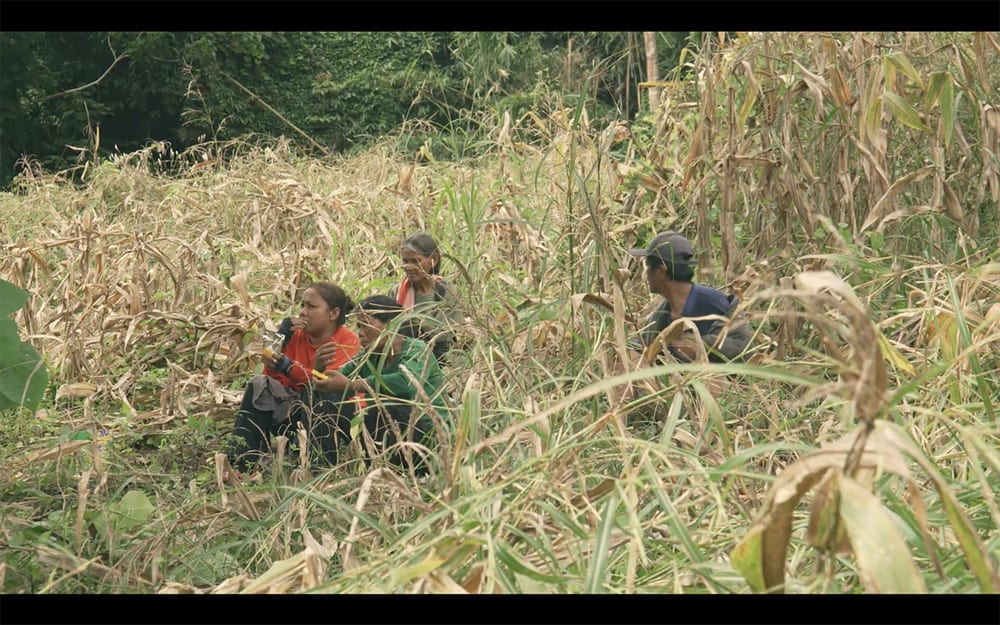
Noni Abao's Bloom Where You Are Planted is a must-see documentary that boldly reclaims the narratives of political activists, individuals whom the government relentlessly vilifies as terrorists. The film details the motivations of these figures: Agnes Mesina, who found her life's calling in Cagayan Valley fighting alongside farmers; Amanda Echanis, whose initial research focused on genetically modified yellow corn and its role in debt and land destruction; and Randy Malayao, who served as a peace consultant in the 2016 negotiations between the National Democratic Front of the Philippines (NDFP) and the Philippine government, as recounted by Raymund Villanueva. Ultimately, the documentary narrates the reality of how these activists, simply dedicated to helping fellow Filipinos, are red-tagged by the Philippine state. Malayao was gunned down by an unidentified man in 2019 while on board a bus in northern Philippines.
Abao brilliantly bookends the film with a montage of protests, transitioning from early marches at the start of the documentary to the most recent movements. What is perhaps most notable about the structure is that this triptych is purposefully introduced with a five-minute clip of Cagayan Valley's bountiful fields. A voice-over speaks of the region’s fertile land—a reminder that the Philippines could be rich, if not for the powerful few who push people into poverty.
The narrative then shifts into a talking-heads format, significantly enriched by the cinematographers’ (Mike Olea and Steven Evangelio) keen eye for detail. We are given intimate close-up shots of small building blocks, the toy of choice of Amanda's son; of the hands of the subjects, evoking a sense of empathy among the activists and their families; and of meandering conversations between the activists and the communities they serve.
The segment focused on Amanda is arguably the most moving and is craftily placed in the middle of the triptych for impact. A powerful sequence uses animation as the creative writing student reads (via voice-over) a poem. The verses, inspired by his family's chosen life of serving the people, function as a powerful reminder that activism is an act of profound defiance and sacrifice committed for the sake of the future.
Paglilitis (directed by Cheska Marfori, written by Raymund Barcelon)
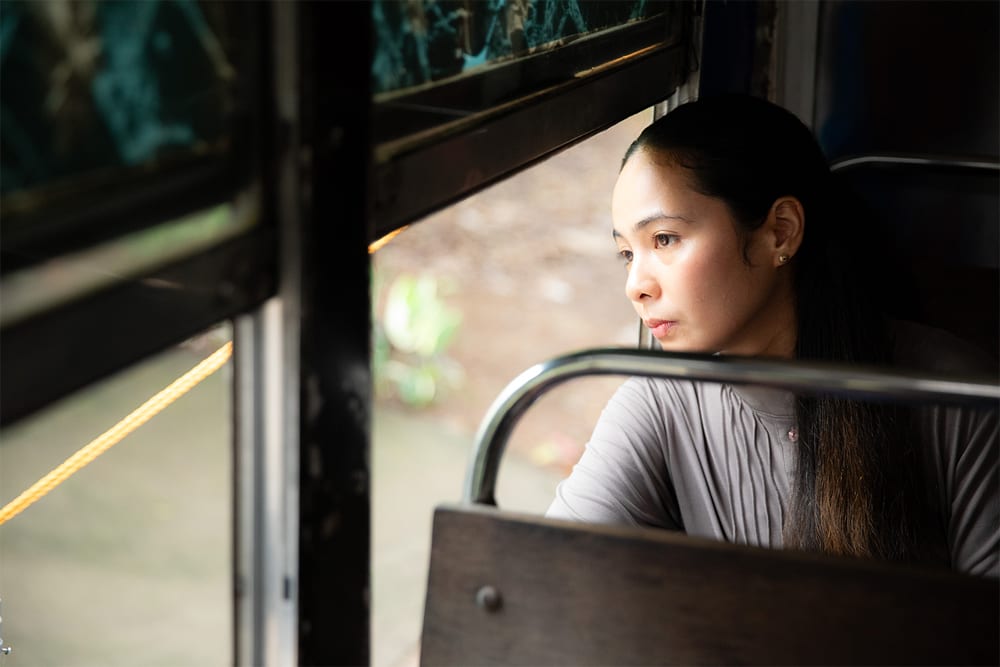
Cheska Marfori's Paglilitis presents a straightforward narrative centered on Jonalyn Samuel (Rissey Reyes-Robinson). After years of experiencing sexual harassment at her workplace and being wrongfully terminated, she is persuaded by Atty. Sylvia Ardenia (Eula Valdez) to file a case against her former employer, Eduardo Guzman (Leo Martinez), CEO of Mother's Pride, the makers of infant milk formula. Yet, the case never reaches a trial—an irony emphasized by the title. Instead, Samuel finds herself subjected to the court of public opinion.
Paglilitis may be too "on the nose," especially in its direct appeal to standing up for oneself. But perhaps that is precisely what we need, especially since it's "2025 na" (as Inka Magnaye, playing herself, says in a reel within the film). While the movie may lack complexity in its plot, it compensates with the discourse it generates on how it tackles women characters—or, at least, tries to. The film pits women against each other in an attempt to discuss how male characters still dominate and manipulate the women's respective stories. For instance, Atty. Ardenia is revealed to be advocating for Jonalyn's case solely to make a name for herself in the male-dominated field of law. Mildred Guzman (Jackie Lou Blanco), the wife of the accused, is riddled with guilt as she enabled her predator husband and continues to lie to protect her son. Myrna (Cherry Malvar) prods her daughter Jonalyn to work hard for their family, especially since the padre de pamilya is not capable of doing so—even if that means pushing her daughter to stay in an unsafe work environment.
This scrutiny of women tearing down other women highlights the desperate conditions that force them into these roles of ambition, complicity, and pressure. Visually, these women characters are almost always presented within frames or boxes, conveying images of being boxed in or trapped. An example is when Mildred looks in the mirror of three frames and/or is positioned in between the poles of the bed frame—both scenes showing how she is trapped in her role as a wife and mother. And it all boils down to the film's final argument of resistance, though almost a Hallmark moment, through Jonalyn's younger sister, Jasmine (Barbara Miguel). She represents much-needed hope, possibly a new generation that can truly own their narrative. But as Jonalyn's case ends without resolution, one is left to wonder: is this conclusion—a promise of hope rather than justice—enough for the movie to stand, or does the film itself, like the trial, end without a true resolution?
Warla (directed by Kevin Alambra, written by Arah Jell Badayos)
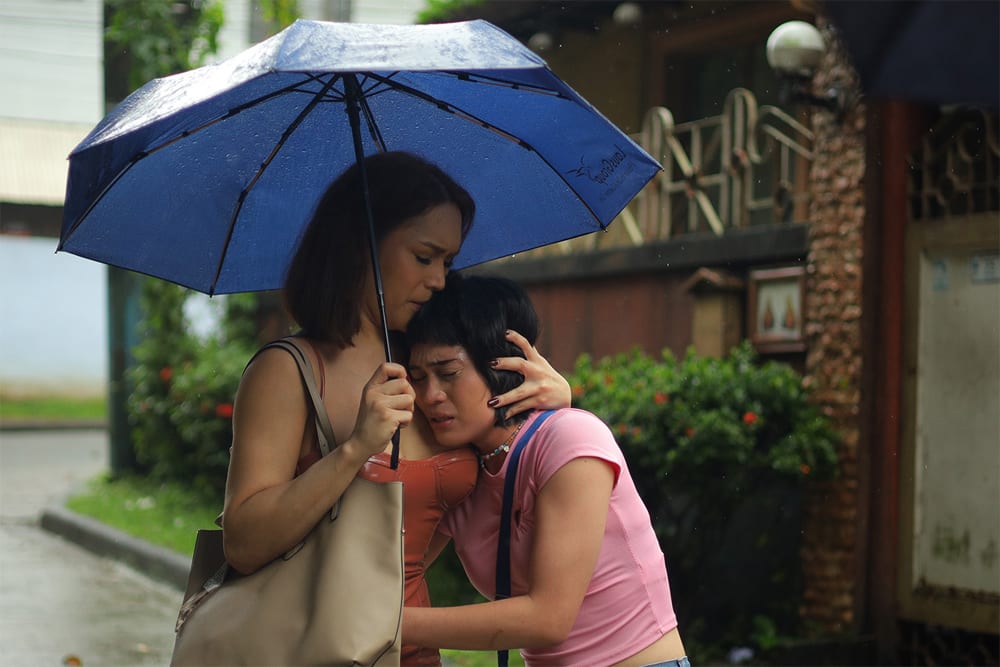
The jump from one scene to the next in Kevin Alambra's Warla means the viewer never knows what to expect—unless they know it's based on the real-life October 2022 case where eight transgender women were arrested for kidnapping foreign nationals for ransom to fund their sex reassignment surgery. I only learned about the Warla Criminal Group after watching the film, so going in blind, I immediately raised a critical question: Why did this narrative choose to villainize a group already facing severe discrimination in our society? Behind the film's chaotic, neon-lit style is the answer: the reality of systemic oppression and the high cost of gender-affirming care that pushed the characters to raw, impulsive desperation.
This underlying rage is seeded immediately in the opening, when the tortured body of a transwoman named Lalie (Matmat Centino) is found in the river. Her violent death leaves Kitkat (Lance Reblando) without a mother figure, a loss compounded when Kitkat is thrown out of her home by her father, effectively losing her biological mother (Dimples Romana) in the process. Kitkat finds a new family in Joice (KaladKaren), who introduces her to the group's operation. One by one, we find out what pushed the all-trans cast to these desperate measures: one believes surgery is necessary for acceptance by her lover, while another hopes to live fully as a mother to her son. Each member carries deeply personal truths, and Warla sheds light on these struggles through its ensemble storyline.
Still, the film does not justify the crime, but rather exposes the conditions that necessitate it. In the end, it isn't greed, but empathy—for themselves and for one another—that dictates their desperate actions. While the pacing is messy and the script could use some tightening, Warla makes a critical, necessary statement about the daily struggles of transwomen: even something as seemingly simple as having the basic right to use the women's comfort room.
Habang Nilalamon ng Hydra ang Kasaysayan (written and directed by Dustin Celestino)
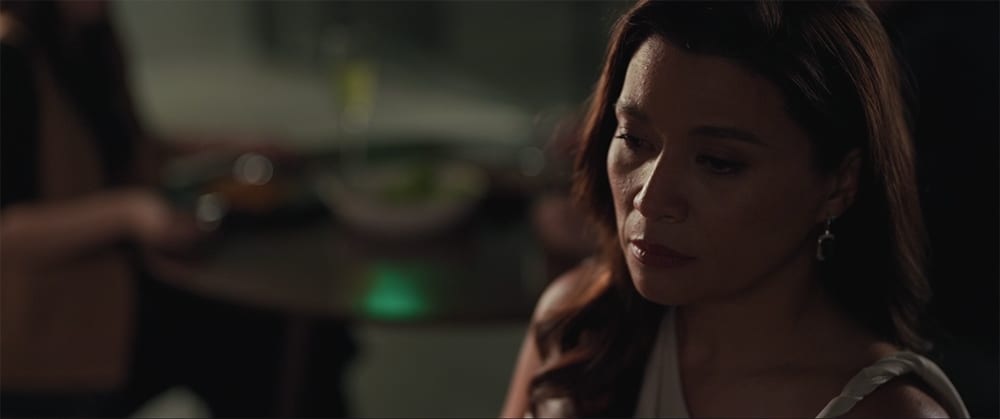
Dustin Celestino's Habang Nilalamon ng Hydra ang Kasaysayan was my bet for Best Screenplay, a prize ultimately bagged by Tim Rone Villanueva and Herlyn Alegre for Child No. 82. To be fair, one of the two competing films I didn't catch. Still, Hydra's script is masterfully tight that every sequence, every line of dialogue, and every beat feels essential. This skill in craft is especially reflected in the punch lines, teeming with dark humor, that are often hard to pull off. Mylene Dizon, who plays Mela, just shines in those moments of sharp, cynical wit—well deserving of the Best Actress title.
The film uses plenty of allusions to Greek mythology to present philosophical questions and what-ifs: What if you fall in love with someone who doesn't share your political ideologies? What if you come face-to-face with your father's and the nation's executioner during Martial Law? What if you bump into the politician you hate most? What if one of the most evil people forgets everything because of dementia? And isn't writing really that? A continuous questioning of what-ifs.
The film questions the nature of good and evil, presenting these philosophical debates in titled chapters, echoing the structure of a novel. This is fitting, as the narrative centers on David (Zanjoe Marudo), a disillusioned speechwriter who writes a novel about the hydra that's eating its way through the world using its multiple, lying heads. Habang Nilalamon ng Hydra ang Kasaysayan is literally about how lies and disinformation are erasing our history. We already know this. We're fed up with it. We're losing hope, especially after losing one election after another. What can we do? Celestino reminds us that the answer isn't a single political figure, a single election, or a single protest—but instead, the kind of hope that comes from within, and the sacrifice we choose to make.
Cinemalaya 2025 ran from October 3 to 12 at Red Carpet Cinemas, Shangri-La Plaza, Mandaluyong. Satellite venues included Gateway Mall and Ayala Malls (Manila Bay, Circuit Makati, Market! Market!, and U.P. Town Center). Follow Cinemalaya on social media for future screenings.
