
Review: The Most Wicked Part of Wicked Is Its Relevance


The Wizard of Oz isn’t actually a wizard. He’s a humbug of a man who crash-landed in Oz from Omaha, Nebraska, on a hot air balloon waylaid by a hurricane. A circus magician by trade, Oscar Zoroaster Phadrig Isaac Norman Henkle Emmannuel Ambroise Diggs wrote the initials of his first two names on the side of his balloon to promote his act and, through fate or happenstance, landed in magical Oz thereafter ascending to the highest position in the land. Basically, a con man who became the leader of a nation. Even in 1900, when L. Frank Baum wrote The Wonderful Wizard of Oz; this seemed to be a recurring theme.
ALSO READ:
Theater Etiquette 101: Dos and Dont's When Watching a Live Show
New Musical Featuring Songs by Rico Blanco Is Coming Out in 2025
Gregory Maguire wrote Wicked: The Life and Times of the Wicked Witch of the West in 1995, a dark revisionist prequel of sorts to Baum’s novels that explores the nature of evil and how ascribing villainy to individuals might turn out to be self-fulfilling prophecies. Like saying immigrants, for example, are criminals or that they’re eating the dogs and eating the cats. It’s the first bullet point in the fascist’s playbook, fomenting fear by giving the people something to fear. A relatively easy feat when pointing at someone who looks different, maybe darker-skinned or even, I dunno, green. The Wizard, basically, is a charlatan, much like every other real-world despot, who maintains power through lies or giant mechanical heads, pyrotechnics, and propaganda.
When composer Stephen Schwartz adapted Maguire’s novel to the stage, he did away with much of its darkness while keeping true to the core of its political and social commentary. In Schwartz’s Wicked, the Wicked Witch of the West and Glinda the Good are college roomies and bitter rivals turned BFFs, while the wizard is, well, the same weak man he is in Baum’s and Maguire’s novels. What Schwartz gets right in his version is embracing Elphaba (Maguire’s clever homage to Baum using his initials, LFB) as a misunderstood, ostracized, and demonized heroine in the wizard’s political theater without the baggage of infidelity, bastard children, and religious atonement. By shifting the focus to Galinda Upland and Elphaba Thropp’s friendship, Schwartz masks Wicked’s inherently political and arguably incendiary nature in song and dance with Mean Girls energy.
This might be the most wonderful thing about Wicked, the movie adaptation of the musical adaptation of the fan fiction novel adapted from the classic children’s novel. It’s unadulterated fun. It takes everything great about the stage production and magnifies it to cinematic proportions. It loses none of the musical’s magic and indeed adds to it. For all intents and purposes, the movie is Wicked, not merely an adaptation of the stage production but arguably what Schwartz had envisioned it to be all along.
The enduring resonance of Wicked, the fourth-longest-running Broadway show of all time, can be attributed in part to its memorable and catchy tunes. Still, perhaps there’s something more, a deeper relatability that goes beyond the urge to sing along to "Popular" or "Defying Gravity." We have all, at one point, been Glinda or Elphaba to varying degrees, two characters who are far more nuanced and complex than their simplistic titles suggest. The Good Witch Formerly Known as Galinda, or Glinda for short, starts off as your average Regina George and her coterie, making life hell for the visually unsettling and all-too-easy to socially shun Elphaba. But she genuinely changes over the course of the story, developing a deep and lasting friendship with her rival that starts from one of the most powerful and moving scenes in the film. Yet despite this, Glinda remains ambitious, shallow, and not altogether very bright.
Elphaba, on the other hand, grows to understand and embrace power in the face of oppression and ostracism. Refusing to play into the hands of those who would use her for political gain, she is made into the enemy, the Wicked Witch of the West, and she makes little effort to sway the public’s perception. Wickedness is thrust upon her, but we, the audience, know that it isn’t true. Maguire attempted to explore but not answer the question of what makes people evil, but Schwartz empathically frames Elphaba as good. She commits herself to the cause of Oz’s sentient animals, who were once viewed as citizens of equal standing but are now rounded up and put in cages. Surely, nobody thinks sentient talking animals should be locked away in cages? Right? The fact that there’s a pause to this answer is the only gap needed to explain evil, which is, at its core, a lack of empathy.
Graham Greene wrote that "hate is a lack of imagination," the inability to put ourselves in others’ shoes, the failure to imagine ourselves as talking animals or having green skin. The way some people find it unimaginable to kiss another person of the same sex or gender, or how it’s unimaginable that some people worship another god (or don’t worship one at all). Othering is easy when people lack imagination. That’s how we end up with great and terrible wizards.
Ariana Grande as Glinda and Cynthia Erivo as Elphaba in 'Wicked' (2024, dir. Jon Chu)
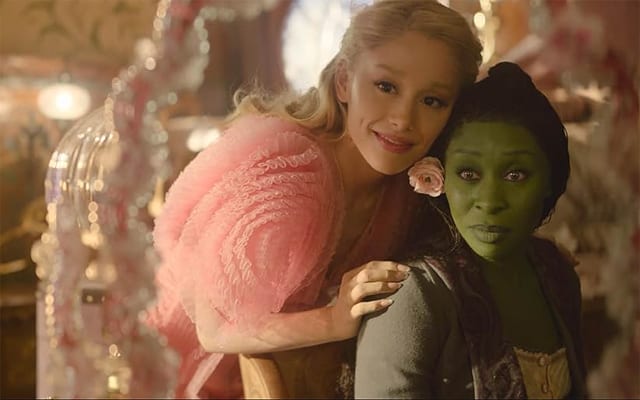
But what we need are more Elphabas and Glindas. Wicked is an unintentionally heavy-handed allegory that explores the friendship between a (green-)colored woman and a white woman who, if they worked in tandem, would have been unlimited. Could there be any more perfect casting than Cynthia Erivo, a queer, black woman, as Elphaba and the home-wrecking but otherwise everyone’s sweetheart Ariana Grande-Butera as Glinda? Both women were born to play those parts and Wicked is a perfect film because of it. As iconic as Idina Menzel and Kristin Chenoweth were as the original besties, this and future generations will forever know Elphaba as Erivo and Grande-Butera as Glinda. Wicked isn't just how musicals should be adapted into film, Wicked is how musicals should be.
It’s bittersweet that Wicked is more relevant than it needs to be because we live in a world where we’re all (well, most of us are) just munchkins easily wowed by fancy machinations and that Glinda wasn’t wrong in saying that it’s all about being popular. "Celebrated heads of state or great communicators," Glinda sings, "Did they have brains or knowledge? Don’t make me laugh! They were popular!" That an uppity social climber can speak the truth in a world bedazzled by a man who hides behind a literal tough facade is too on point. Too many leaders lack brains, knowledge, or, more tragically, the best interests of their people at heart. But they’re popular, and now we’re here.
It took a lot of gumption for Universal Pictures to split Wicked into two films, taking the stage production’s first act and stretching it out to 160 minutes, which is about as long as the entire Broadway show, including intermission. But the film doesn’t feel long at all, which is a masterstroke for director Jon Chu, who brings Oz to life in the most spectacular way. The Land of Oz has been interpreted in film countless times, most recently with Sam Raimi’s The Great and Powerful Oz in 2013, but there’s never been anything like this. Wicked draws you in so completely that by the time Elphaba flies at the end of the film, it feels like a shared triumph.
Splitting the story into two films is arguably the best and only way to give "Defying Gravity" the gravitas it deserves. For this reason alone, Wicked Part 1 should be justified. Having that number be in the middle of the film would’ve robbed it of its power, and Wicked is all about reclaiming power. Instead, we all walk out of the theater on a high and hope for an equally perfect Part II in what is a year-long intermission. It’s a long wait, but thankfully, we can keep watching Wicked over and over until it’s out.
Wicked was released in Philippine cinemas on November 20, 2024.
