
The Politics of Superman: Goodness and Heroism Are Choices We Need to Make


Stop me if you’ve heard this one before. Alien baby crash-lands on Earth and gets adopted by a childless couple in Kansas. The parents raise the boy, teaching him their values and showing him love. The boy learns of his alien heritage and a message from his home planet: “take the world.” The boy then uses his newfound alien abilities to murder his parents and flies off to subjugate humanity. Oops. Wrong James Gunn movie.
In 2019, Gunn wrote and produced Brightburn, a horror movie retelling of the Superman story where Brandon Breyer, the movie’s version of Clark Kent, embraces his malevolent alien nature and calling to lord over humanity. The year before, Gunn had been approached by the then-heads of Warner Bros with an offer to direct a Superman movie, but the Guardians of the Galaxy director declined, saying that he was ‘daunted’ and didn’t know how to approach the iconic character. Fast forward to 2025, and Gunn appears to have cracked the code, almost certainly with the help of his experience making Brightburn.
ALSO READ:
Does James Gunn’s Superman Live Up to the Hype?
All The Superman Movies Ranked From Worst to Best
What if, instead of being sent to Earth to save humanity, Superman was instead meant to rule over it? Kryptonians are, after all, by every metric, a superior race. A master race, if you will. Kal-El is the physical embodiment of Nietzsche’s Übermensch, which literally translates to Superman. If there were any sort of actual racial hierarchy, the last son of Krypton would be at the very top. What if Superman’s Kryptonian mandate was to rule instead of serve? Gunn shakes up Superman’s core by asking this very question, a particularly relevant one at a time when resurgent white supremacy and Nazism don’t even bother to disguise themselves. If there’s anyone at all who can quantitatively claim to be superior, surely it’s Superman, right?
Here’s the kicker, though: Superman is an immigrant. More accurately, he’s an illegal alien immigrant refugee. Superman is exactly what Nazis hate and what the current government of the United States is devoting so much of its energy into persecuting. There’s a strange dichotomy in being the kind of person eugenicists and bigots aspire to be while also being the kind of person they want to exclude, which brings us to Superman’s archnemesis, Lex Luthor, played in brilliant, sinister glory by Nicholas Hoult. Luthor’s hatred towards Superman is driven by his unfathomable envy towards a man (or, as Lex puts it, an ‘it’) who is superior to all of humanity simply by the accident of birth —ironically, the sort of unearned superiority that white supremacists feel they have.
Lex Luthor (Nicholas Hoult)
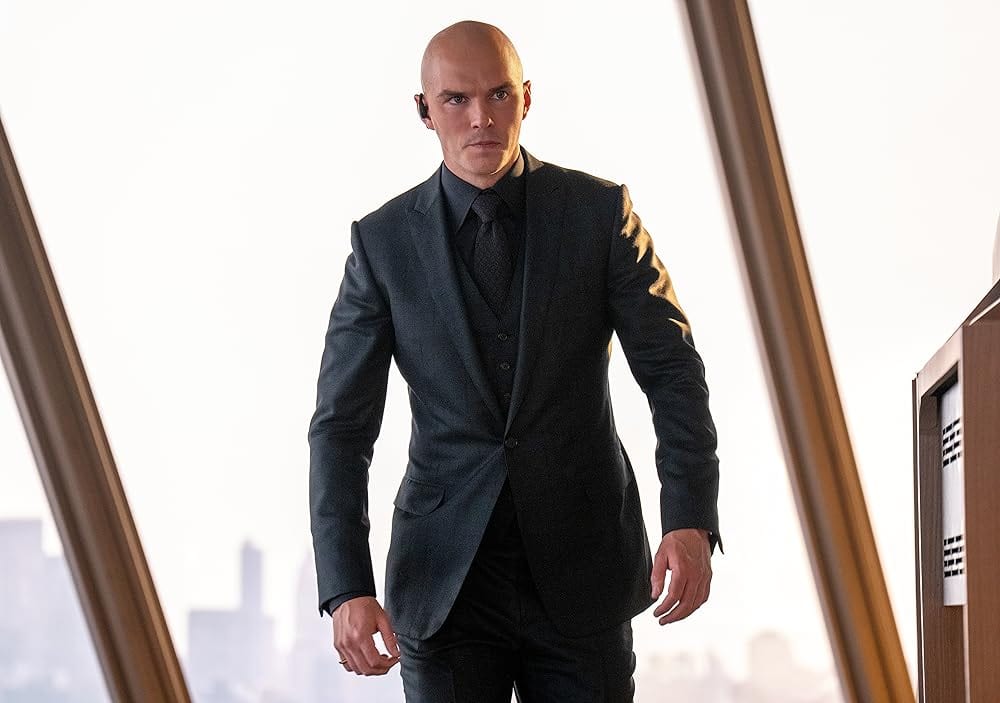
Gunn’s Lex Luthor is exponentially smarter and more dangerous than any we’ve ever had on the big screen. He’s arguably the world’s smartest human, a multibillionaire industrialist arms dealer with significant government contracts and considerable political influence who has invented all manner of things from pocket universes to nanotech blood to a complex set of video game-like combat moves to counter his greatest enemy. Without Superman in the picture, Lex Luthor could very possibly be the most important human being on the planet, loved and adored by all. At least, Luthor thinks so.
So when Luthor’s genius and achievements are ignored because the world would rather fawn over someone who can fly, this makes him very, very, very mad. Like other narcissistic billionaires, Luthor can’t stand it when the news cycle isn’t about him. And just like other narcissistic billionaires, Luthor is simply obsessed with the person who beat him and has devoted all his energy and resources to their destruction. That’s where James Gunn drops audiences at the beginning of Superman. There’s no origin story, no long set-up, just some lyrical introduction text that leads up straight to the action, where Lex’s plan to destroy Superman is already in motion.
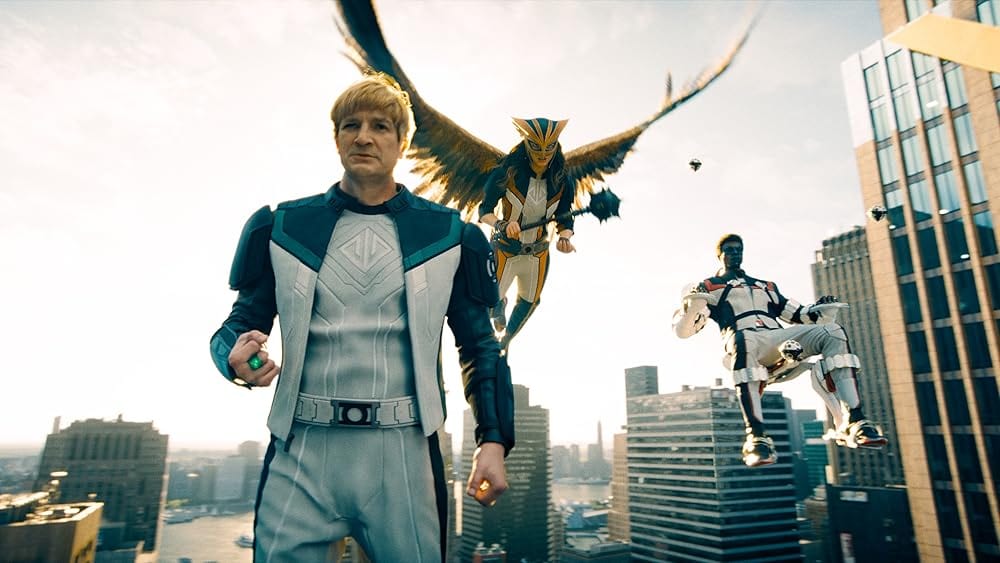
It takes exceptional confidence for a storyteller to start in the middle. It takes even more courage to trust audiences to catch up and understand what’s happening in the story, especially one with as many moving parts as Superman. But Gunn’s gamble pays off because Superman’s story is extremely easy to understand, even if it involves a country called Jahranpur, which is totally not Palestine, being invaded by a country called Boravia, which is totally not Russia or Israel. It’s easy to identify and follow the different bad guys, from Luthor to the Engineer (María Gabriela de Faría) to Ultraman to Eve Teschmacher (Sara Sampaio); and the good guys like Guy Gardner (Nathan Fillion), Hawkgirl (Isabela Merced), Mister Terrific (Edi Gathegi) and all of Clark’s friends over at the Daily Planet. Superman is a fully realized world, brimming with life, with fanciful superheroes, fire-breathing kaiju, and neon-colored dimensional imps. Gunn’s reboot of the DCU hits the ground running and never lets up on the gas.
Guy Gardner (Nathan Fillion), Hawkgirl (Isabela Merced), and Mister Terrific (Edi Gathegi)
Superman is necessarily political, whether by accident or design, because the hero is an illegal immigrant whose archenemy is a ruthless billionaire who, at some point in the comics, actually gets elected President of the United States. Back in 2001, the idea of one of DC’s greatest villains becoming President was the height of comic book fiction. In 2025, the Land of the Free is the land where citizens get rounded up and sent to outsourced Terrorism Confinement Centers without receiving due process. In Superman, Superman turns himself in voluntarily and is roughed up by the government-contracted Ultraman, who smashes his face into the ground. “Was that really necessary?” Superman asks, a pointed reference to police brutality and ICE’s inhumane treatment of the migrants they round up. He adds, “You didn’t read me my rights,” which the Secretary of Defense, Rick Flag, Sr. (Frank Grillo), responds to by pointing out that Superman is an alien, and as such doesn’t have any rights. Flag, Sr. seems to have misunderstood the Pledge of Allegiance, which ends with, “liberty and justice for all.” The ‘all’ is inclusive and really should apply to the adopted son of Kansan farmers, an American citizen, the way it should apply to undocumented immigrants.
There’s no way Gunn could’ve known about El Salvador’s CECOT or Florida’s Alligator Alcatraz, but Superman, which finished filming at the end of July in 2024—more than three months before Trump won the Presidency—has an equally terrifying comic book version where Lex rounds up his enemies. If Superman feels political, it just might be because real-world supervillains exist, and that we’re living in some sort of dystopian reality. The sad part is that Superman is still very fictional, and as hard as we wish for it, there’s no one person who can stop wars by flying power-hungry despots into the desert and giving them a stern talking to.
Gunn’s unsubtle digs at Internet trolls, literally monkeys who foment hate online en masse; and the conservative manosphere, represented by the horrifying Kryptonian mandate to breed with as many Earth women as possible, would have been funnier if they were pure fiction. But men such as Elon Musk and Nick Cannon exist, and views of women purely as reproductive machines have been codified, as is the case with Georgia’s ethically questionable abortion law that resulted in the brain-dead Adriana Smith being kept alive for months purely to carry her unborn child to term. This is the very real, very dark world we live in today, with no Superman in sight to save the day.
What we do have, however, is our humanity. James Gunn understands that Superman, the Übermensch, the godlike being who can fly and shoot beams out of his eyes, is actually super not because of his powers or heritage but in spite of it. Gunn’s deliberate and Earth-shattering retcon of the Kryptonian mandate pits Superman’s godlike nature vs. his humble, down-to-earth nurture. “Parents aren’t for telling their children what to do,” Pa Kent (Pruitt Taylor Vince) tells his son, and reminds him that, “your choices, your actions—that’s what makes you who you are.”
Kal-El may very well have every reason and certainly the power to rule the world, but Clark Kent chooses not to. Luthor, just like many misguided fans of Zack Snyder’s Man of Steel, thinks that Superman’s strength is his bulletproof skin and being able to punch a hole through a mountain. But Superman tells Lex that his humanity is his greatest strength, that despite not knowing what to do and messing up all the time, he manages to put one foot ahead of the other and keep on persevering.
This is why James Gunn’s Superman works. David Corenswet’s Superman is human in a way that Cavill’s never was. If Snyder’s idea of humanity was fallibility, angst, and wavering faith in the goodness of man (one of Superman’s most memorable lines in BvS was, “no one stays good in this world”), Gunn presents us with the opposite: a smiling, kind beacon of hope who sees beauty in all those around him. Gunn’s Superman is always trying to find a better way, whether it’s how to safely transport a giant monster to an intergalactic zoo or painlessly euthanize it, to telling enemies, “it’s not too late for either of you!” even as they smash their fists into his face. Corenswet has a boyish affability and disarming smile; his Superman operates with a somewhat unthinking naïveté, punching first and asking questions later … which is why Lois Lane (Rachel Brosnahan) is his perfect match.
Lois Lane (Rachel Brosnahan) and Superman (David Corenswet)
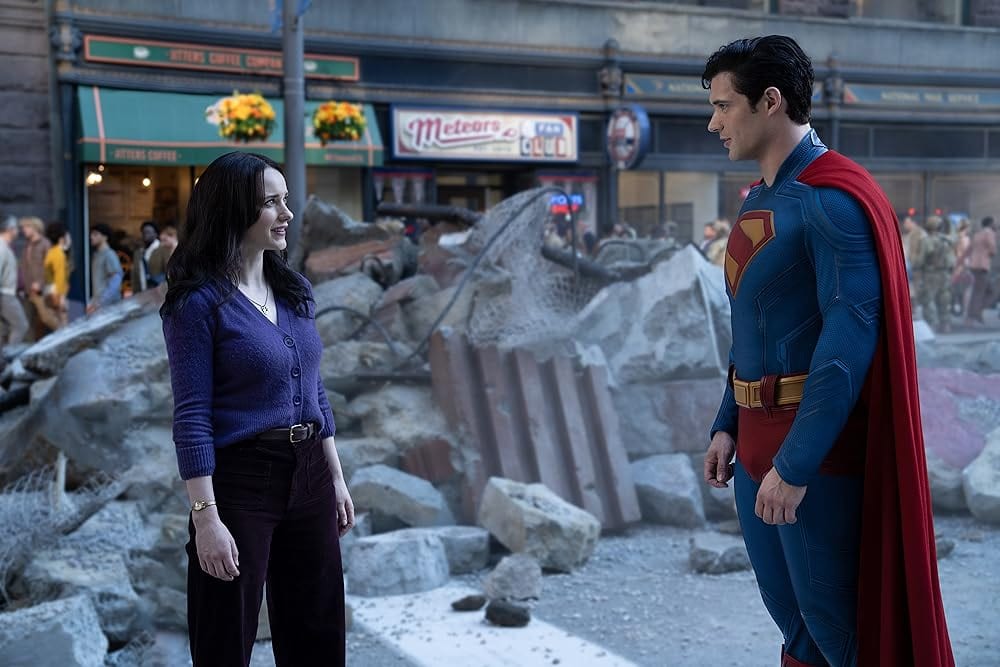
Brosnahan’s Lois is the most competent and consequential Lois Lane we’ve ever seen on the big screen, a hard-nosed reporter who asks all the important questions that even Superman himself is afraid to ask. In a world overtaken by social media and where print journalism is all but moribund, Gunn presents Lois Lane as the tireless seeker of truth, the necessary complement to Superman’s pursuit of justice. And while once Superman stood for ‘Truth, Justice, and the American Way,’ it appears that America has lost its way, and the whole world knows it. The American Way no longer seems to align with Superman’s values, and the comics changed his iconic motto into the future-proof ‘Truth, Justice, and a Better Tomorrow’.
If there’s anything we can take away from Gunn’s Superman, it’s that we are owed nothing by virtue of our heritage and that it is upon us to make the choices that make this world a better place. These days, kindness is in short supply, and showing empathy is a superpower of its own. In a tender exchange, Lois teases Superman about his musical choices, “You are not punk rock,” she tells him, pointing out that he has too much faith in humanity and sees the beauty in everyone. Superman thinks for a bit and responds, “Maybe that’s the real punk rock.”
He’s right, of course. In an age where world leaders think that cruelty and hate are virtues, Superman’s ethos of kindness and compassion is the anti-establishment change we need.
