

New Discoveries in Palawan Reveal Human Life 25,000 Years Ago

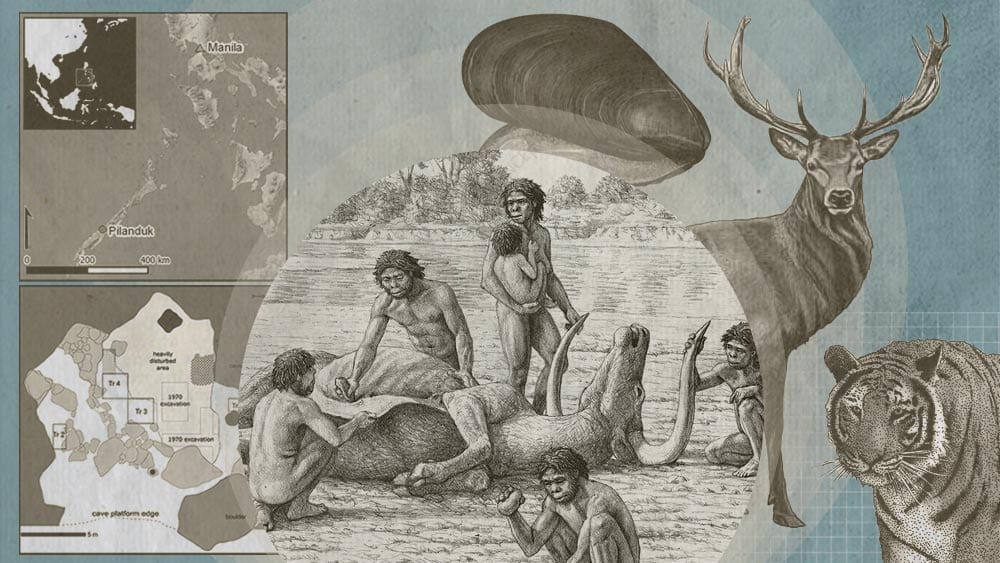
Recent research findings by archaeologists from the University of the Philippines Diliman, the National Museum, and members of the indigenous Pala'wan community at Pilanduk Cave in Palawan offer crucial insights into the life and survival strategies of early humans during the Last Glacial Maximum (LGM), or the peak of the last ice age, approximately 20,000 to 25,000 years ago.
New data from the re-excavation of Pilanduk Cave support past discoveries of people living in the cave during the Ice Age. The cave has signs of people hunting deer and eating freshwater mollusks during the coldest period of the Ice Age. The research also found signs that early humans changed their hunting and gathering habits to adapt to different tropical environments on Palawan Island over roughly 40,000 years.
ALSO READ:
This Ancient Dog Burial Site in Manila Proves Filipinos Loved Canines
Fossils of Ancient Marine Creatures Discovered in Masungi
"Based on these associated dates, we also present the oldest fossil remains representing the nine vertebrate species found in Pilanduk, which include the iconic tiger (Panthera tigris)," the researchers added.
The team embarked on a re-excavation of the site in October 2016 in collaboration with Ame Garong, PhD, from the National Museum.
According to UPD archaeologist Janine Ochoa, their team analyzed the archaeological materials that were excavated, which included vertebrate fossils, mollusc/shell remains, and lithics/stone tools. They undertook the re-excavation of the cave to further research done by Jonathan Kress and the National Museum from 1969 to 1970.
“There has been a need to verify the dates reported by Kress, due to the limited stratigraphic data available for Pilanduk, and the limitations of the radiocarbon dating method at the time of Kress’s excavation in the 1970s, particularly for dating mollusc remains,” explained Ochoa.
The research enriches the archaeological record of the Philippines, particularly for the LGM period. Pilanduk Cave is depicted as an essential archaeological site with the best-preserved LGM subsistence record in the Philippine archipelago, filling a significant gap in the regional prehistory.
By providing a clearer picture of how modern humans adapted to life during the Pleistocene in Southeast Asia, the study contributes to the broader understanding of human evolution, migration, and adaptation on a global scale.
