Love in the Time of Late-Stage Capitalism

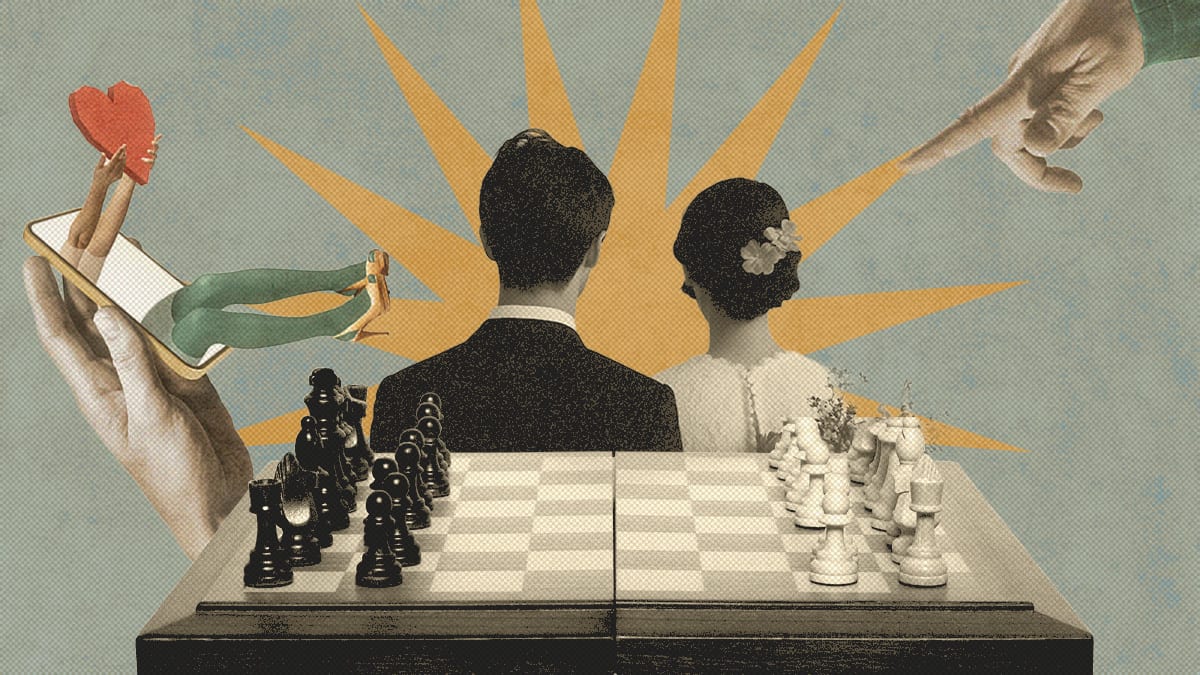
Love has long been subsumed by capitalism. From the age of dowries, to the age of blockbuster rom-coms, to the conflict-riddled diamond trade, and the multi-billion dollar wedding industry—the commodification of relationships, particularly marriage, is so prevalent that to opt out of the obscene consumerism that fuels it is perceived, especially in our culture, as being less-than.
But have you noticed that, more than ever, the language of commodification has begun to undergird the way we talk about romance? We talk about “investing” in relationships. We assess whether we’re getting a good return. We approach dates the way we optimize business meetings: stacked, scheduled, and efficient. And increasingly, people are burning out from it all.
ALSO READ:
Is Digital Life Rewiring the Way Men Love?
Dating During a Transport Crisis: 'Is It Shallow to Only Want to Date Someone With a Car?'
The Divine Comedy of Dating in Middle Age
Modern dating app users experience emotional fatigue and decision paralysis from too many options, too many swipes, and not enough connection. It’s no surprise, then, that an entire swathe of the single population is pulling back from the swipe economy if not swearing off dating altogether.
It’s not necessarily that people want to be alone. More likely, they just want to break free of the loneliness of digital-age dating. One way to do that is to recognize and name the ways our idea of love is warped by late-stage capitalism’s commodification of every morsel of existence.
Here are some common patterns of transactionality you may be consciously or unconsciously subscribing to, how they may affect relationships, and what might be at risk if they’re not disrupted.
1| The Marketplace Mindset
In the meat market of yesteryear, we’d strike up a conversation one at a time. Now, we chat with multiple matches at once, consuming people like fast fashion: swiping, trying on, discarding, repeating.
Despite the convenience, digital-era dating overwhelms us. Journalist John Tierney’s “decision fatigue” explains how too many choices lead to anxiety and poor decisions. And it’s just as detrimental to the swiped as it is to the swiper. MIT’s Sherry Turkle says dating apps recast people as products, and experiences as transactions.
When we treat people like commodities, we flatten their fullness—and miss the chance to genuinely get to know someone, learn something new, or see the world from a different perspective.
2| Stack Dating and the Productivity Trap
Gen Z has popularized stack dating—fitting in dates alongside errands or between appointments to keep things “organic.” On the surface, it’s about authenticity. And while that is valid and valuable, it overemphasizes productivity and efficiency as a key performance indicator of a relationship.
The risk is that it overshadows the messiness of humanity. Real human relationships are sometimes inconvenient. They require us to give care even when we’re not feeling patient. To be kind when we’re feeling annoyed. And to show up even when it doesn’t fit into our calendar.
This is true not just for romantic relationships, but also for being in a community at large. If we bypass the inefficiency of human connection, we bypass connection.
3| Return on Investment (ROI)
Once we’ve gotten past meeting people and have decided to settle down, we speak of relationships as a source of return on investment, asking if we're getting enough "value" out of something in comparison to what we put in.
While it's certainly important to address and express our needs and the rest of our internal life within a healthy relationship, all relationships—even the ones with few problems—have seasons. Sometimes we lean more on our partner. Other times, they lean more on us.
Keeping a strict accounting of who's getting what and who owes what debt to whom is a reliable way to lose the whole point. Relationships are not startups. They’re not supposed to yield consistent quarterly gains—although gains do exist. Human relationships have losses, too. And a good one will have the grace and make the space to get through.
4| Situationships: That Space Between Friendship and Committed Relationship
For those who don’t want the long-term investment of a relationship, there’s the situationship—a low-commitment setup offering just enough intimacy without the weight of accountability.
For some, the flexibility is freeing. But for many, it’s an emotionally disorienting echo of our subscription-based lives. In this model of consuming love, we keep the connection only for as long as it serves us. Then we cancel when it no longer does. No questions asked.
It’s dating without depth, and intimacy without vulnerability. Like most things built for convenience instead of substance, it often leaves us feeling emptier than before.
5| Market Logic Breakups
Even the way we talk about exes reeks of market logic. “He downgraded.” “She upgraded.” As if people are cars or iPhones, quantifying relational worth on metrics like mileage, looks, or social capital.
We reduce the arc of intimacy to a consumer decision. We analyze, compare, and critique relationships like it’s a purchase. And when we buy into this way of thinking, we approach human interactions as customers: entitled, critical, or perhaps even pleased—as long as we keep receiving what we ordered.
What We Lose When Love Becomes Transactional
The commodification of relationships signals a deeper disconnection from love itself—one of the things that makes us human. The result of all this transactionality is detachment, not just from each other, but from our own humanity. And the subsequent dehumanization that happens is not limited to dating.
We can blame the screens, the culture, the pace. But we also have to take individual responsibility for the erosion of our own compassion. Do we look at our screens—see a genocide unfolding, children starving, floods swallowing cities—and, set on self-optimization and the pressure to extract net value from every moment, turn instead towards what “serves” us? That is: turn away.
What if the emotional cost of vulnerability yields the greatest returns? What if the inefficiency of compassion produces a world worth living in? Love and capital haven’t always been inextricably linked. What if we lost the chains?