
Why Carlos Yulo Does Little Penguin Hops During the Floor Exercise
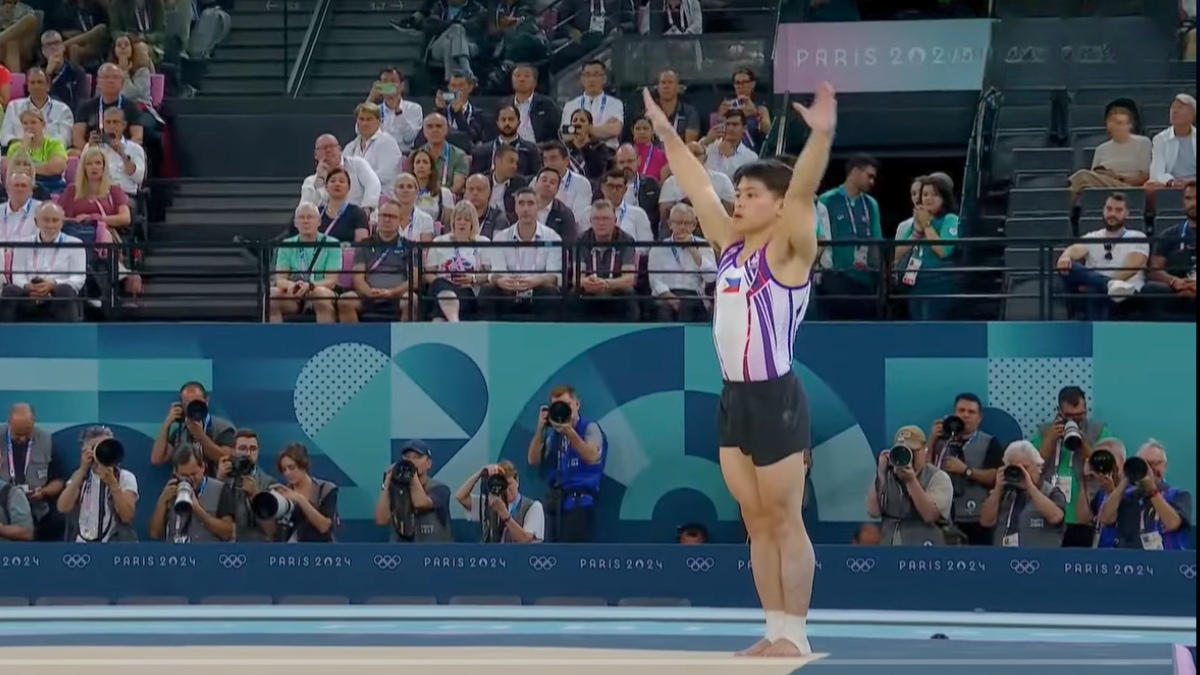
Unless you took up gymnastics as an extracurricular or have a very niche interest in watching the sport, most of us don't know anything about it. It’s likely we just got drawn into it, especially when Filipino gymnast Carlos Yulo earned himself a slot at the finals of the Paris Olympics 2024 and eventually bagged two gold medals during the Floor and Vault exercises in Men's Athletics Gymnastics.
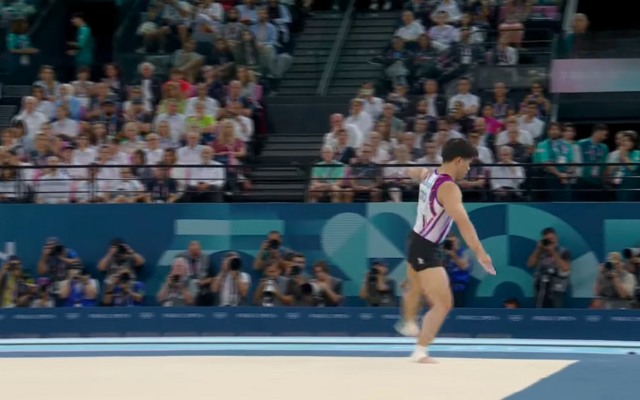
We think about its unwritten hacks (e.g., using honey and a container of chalk for extra grip) and interesting moves that we find quirky but actually have a written rule. One of which is: Why is Yulo, after landing on his two feet, hopping on one foot and turning on the corner with arms outstretched—like a penguin or a toddler imitating an airplane?
ALSO READ
Paris Olympics 2024 Is a Clarion Call for Gender Equality
Paris Olympics 2024's Most Hilarious Memes and Tweets
Basic Rules of Men's Artistic Gymnastics
The Olympics uses the official rule book, or Code of Points, issued separately for Men's Artistic Gymnastics and Women's Artistic Gymnastics by the International Gymnastics Federation (FIG). These rules and regulations are updated every quarter, culminating in the Summer Olympics.
On its basic rules, the mat used for Men's Artistic Gymnastics - Floor measures 40 feet on each side. The objective is for athletes to use the entirety of the floor area as they showcase acrobatic and other gymnastic elements (strength, balance, flexibility, handstands, and choreography), with a maximum duration of 75 seconds. There is no minimum time.
Gymnasts must go to and or from each corner of the floor. They can do their flips, back flips, tumbles, leaps, and hops from one corner to another diagonally. This path is about 56 feet, which is just enough distance to do and maximize as many executions as possible. There is no limit to the total number of times a diagonal may be used, but they can't use the same diagonal path more than three times in a row.
Deductions are incurred if the athletes don't land in the general area of the opposite side of the diagonal during the passes. Each acrobatic element or series must end in a visibly controlled landing and pause before continuing to a non-acrobatic element. An exercise must always end with an acrobatic element that lands with both feet together.
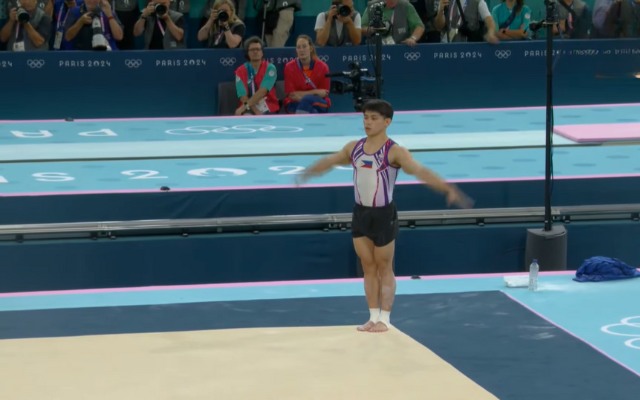
Passes and skills are scored based on their difficulty. Athletes also get deductions for errors, like landing with feet apart, going out of boundary lines or color separation on the mat, and so on.
So why is Carlos Yulo hopping towards the corner after he lands?
Another stipulation in FIG's Code of Points is that "a gymnast must not use simple steps to arrive in the corner." Section 10: Floor Exercise, under Part III: Apparatus, further explains: "Simple steps occur when a gymnast repositions himself on the floor area without any choreography," where choreography is defined as "turning greater than or equal to 180 degrees, jumping, lifting leg above horizontal during step, etc." "Simple steps" are basically walking; so, for us mortals, this just means that no walking is allowed when a gymnast repositions himself on the floor area.
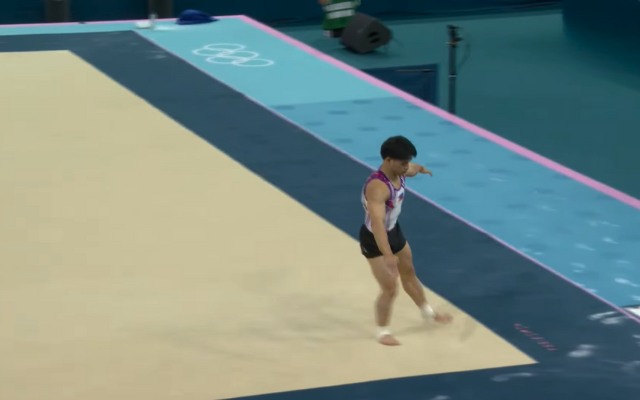
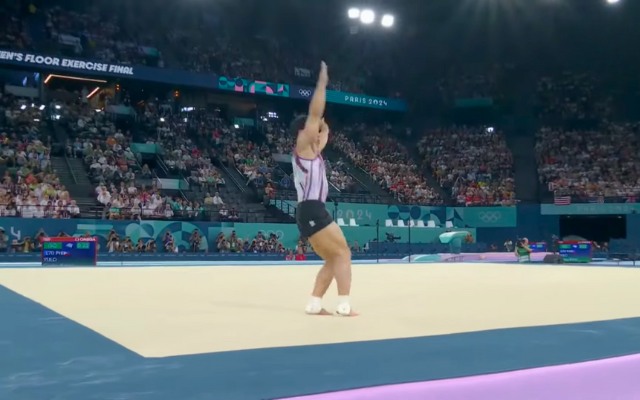
After every exercise that Yulo executes from one corner to another, he lands on his two feet. He then springs one foot towards the line or the corner, turns with his other foot, and starts again with feet together.
Carlos Yulo's Gold Medal-Winning Final Scores
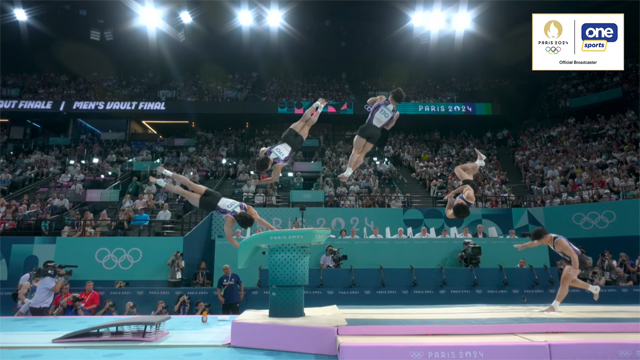
For the Floor finals, Yulo scored 15.000, with a difficulty of 6.600 and execution of 8.400, with the three-and-a-half twist dismount as his final move. For the Vault finals, he got an average of 15.116 after a score of 15.433 on the first vault and 14.800 on the second vault. His first vault featured a piked Dragulescu.
Israel's Artem Dolgopyat got silver, and Jake Jarman of Great Britain got bronze for the Floor; while Artur Davtyan from Armenia came in second, and Great Britain's Harry Hepworthy came in third for Vault.
