
How EJ Obiena Fought Against the Odds to Compete in Paris

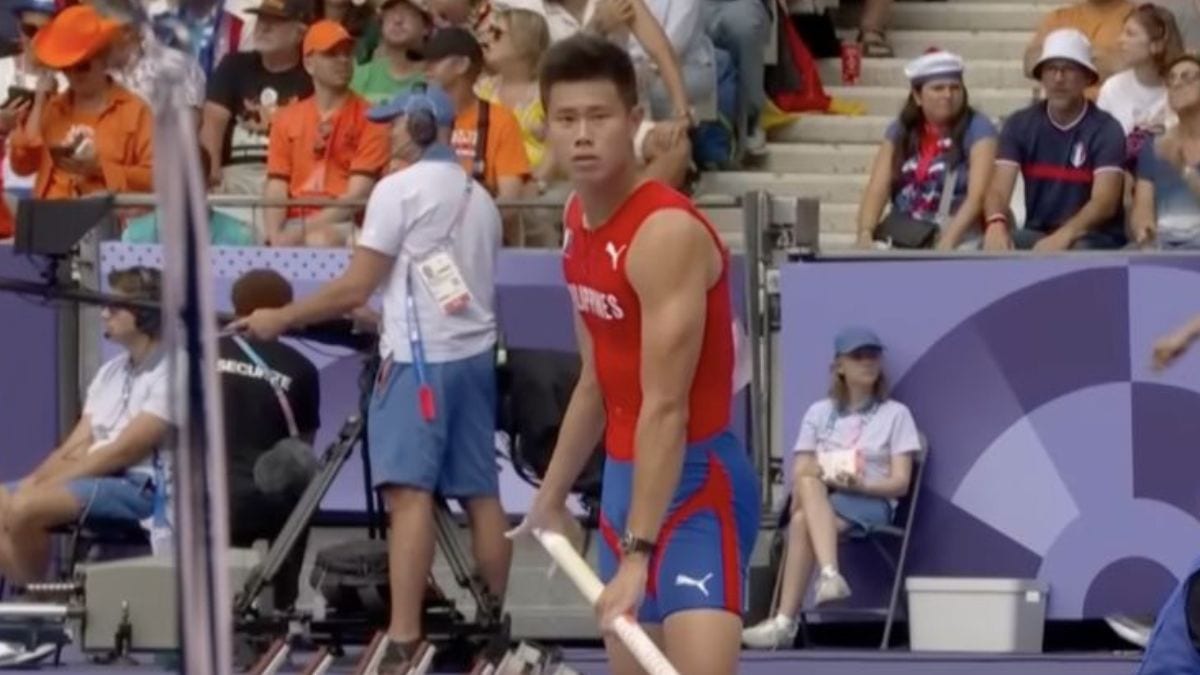
Six days before the opening of the Paris 2024 Olympics, EJ Obiena, the Philippines' pole vault superstar, opened up about the "bumpy road" he had journeyed in the months leading up to the world's biggest sporting event.
On his social media accounts, he shared that he had been battling various physical problems since April but assured his followers that he could still "perform at the highest level" in Paris.
Despite finishing fourth at the recent Olympics—a commendable achievement—the World No. 2 felt a sense of loss and regret over his performance.
"Fourth place is painful to say the least; and in sports with three podium places, perhaps 4th is the harshest place to be. I am heartbroken that a single failure cost me and cost a nation I so deeply love—the podium," he wrote. "I apologize for this outcome; such is life as the world of competitive sports can be exhilarating at times, and painful at others. I have experienced both and unfortunately today I am on the other side of it!"
ALSO READ
Filipino Pole Vaulter EJ Obiena Finishes Fourth at Paris Olympics 2024
Health hurdles
A day after the finals, Obiena, together with his mentor, manager, and good friend Jim Lafferty, faced the Philippine press in a Zoom conference to detail what Obiena had gone through over the past couple of years.
Lafferty started by explaining that Obiena's July 20 post was intentionally vague because revealing too much about his physical condition could give his competition an advantage. "This is not something you want to disclose. You can either withdraw, which EJ was never going to do, or you can basically stay vague. But to tell everything would be foolish because it plays into the hands of the competition. All of these pole vaulters are friends. They all know each other, but when they get into the arena, they're all lions and they're all fighting," he said.
Obiena explained that he's been suffering from a lumbar facet joint problem. "It's that small joint at the back between the L4 and L5 regions. However, it's not just one facet joint but multiple ones. These facet joints have sensory nerves that can get triggered and irritated, causing spasms, inflammation, restrictive movements, and other issues," he said.
When the pole vaulter started to experience the health issue two years ago, he underwent a denervation procedure. "This basically deadens the nerve that is causing all the issues, and it allows him to compete and go on without any risk to his long-term health," explained Dafferty.
The procedure was done in 2022. Unfortunately, the nerve grew back, and by 2024 Obiena started to feel the symptoms again. So the entire season has been marked by inconsistencies, with him needing to take days off and medications. There were good days and bad days, he recalled. On bad days, even jogging felt difficult, and definitely was vaulting.
Road to the Olympics
"Twelve days before the Olympic Games, it got so bad that EJ was unable to vault and couldn't even run with the pole," said Lafferty. "So, we searched for a doctor—basically a neurosurgeon in France—who could help. The only thing we could do was either pull out [of the competition] or have an injection of a cortisone derivative to reduce inflammation and deaden a bit the pain so he could go into competition, and that's far from perfect."
Nobody in France would take this case because the procedure required an operating room, a fluoroscope to guide the needle, an MRI, and an anesthesiologist to administer anesthesia. "It's not a simple procedure. It's done in a very delicate area where they can't hit the nerve and they have to put it in the right position," says Lafferty, who has a degree in psychology and physiology.
To address the Obiena's condition, the athlete flew to Italy ten days before the Olympic Games. "Over a 24-hour period, he left the training camp in Normandy, flew to Rome, met with the doctors, and had the procedure done. Then we flew him back to France. He needed a 48-hour recovery period from the shot, and only after that did he start to gradually work his way back."
Obiena believes his condition did not hinder his performance on the day of the Paris Olympics. But it did affect his preparation and consistency leading up to the event. It also impacted his overall program going into Paris. His goal was not just to jump 5.90 meters. He aimed to jump six meters, progressing from his performance at the Tokyo Olympics. He knew that a six-meter jump would set him apart from many others. Going into the season, he wanted to be consistent in reaching that mark. "But things happened," he told the press sadly.
In Lafferty's point of view, Obiena ended up achieving fourth place was "beyond amazing. He only had one workout session with the pole before the Olympic Games, and yet, during the Olympics and especially in the final, he cleared 5.95 meters on all his attempts...I can't even state how proud I am of this guy, and proud to know him, proud to work with him, proud to be a part of his team. The toughness and the unwillingness to make excuses, I think everybody should be so proud of him." Lafferty has been Obiena's coach and mentor since 2015.
Health comes first
Asked about his plans, Obiena said they are still figuring out their next move. His immediate priority is to focus on getting healthy and making decisions that will benefit his long-term health.
"There's no reason to be on pain meds and try to compete. Let's try to fix the problem. Let's see if the doctor thinks we should finish the season. That's what we're going to do. We're not going to take any risks with my health and long-term health plans. We'll definitely take it from there," said Obiena.
The Filipino pole vaulter aims to maintain his World No. 2 ranking until the end of the year, provided his health permits. "That's something I still want to do. I think it is doable. Definitely tough," he says. "The points that I missed in the Olympics is not going to be that big, I would say. It's not going to be small, but the difference from silver to fourth place was five centimeters. I think that's around 25 points, something like that. I need to find 25 points somewhere along the season."
Deciding to vie for the Los Angeles 2028 Olympics, said Obiena, is also something he's still thinking about. "I'm taking it one day at a time, seeing what exactly fuels my fire. I can't give you a definite answer because I don't want to lie. I don't want to say, 'Oh yeah, we're gunning right away for this and that,' if I don't truly feel that way or if I don't fully comprehend the sacrifices I need to make. I don't want to be in L.A. just for the sake of being there. If I'm going to do that, I'm going to go all out and I'm going to win the thing. If I were to commit to that, I need to be able to look my parents in the eye and tell them I probably won't see them again for at least the next four years, maybe just a month each year at best.
"It's not an easy decision to make. I think I need time to process it and, hopefully, be able to fully commit with all my gut and all my being. I'm going to be there and represent the Filipinos to the best of my ability. If not, then not at all," he said.
