
DOT Finally Responds to PH Landing in HelloSafe's Least Safe Countries in the World List

The Department of Tourism issued a statement on June 19 following HelloSafe's supposed ranking of the Philippines as the least safe country in the world based on the platform's travel safety index.
"The publication by HelloSafe of a FALSE ranking that labeled the Philippines as the 'least safe country' for travelers has caused serious and lasting harm. Though the listing has since been altered to remove the Philippines’ false designation and replace it with another country, the correction is not complete, and damage to the country’s reputation and to the lives of our people has already been done. This cannot go unanswered," started Secretary Christina Garcia Frasco in the statement.
ALSO READ: Turns Out, the Philippines Isn't on HelloSafe's Least Safe Countries List
HelloSafe's List of Safest and Least Safe Countries to Travel to
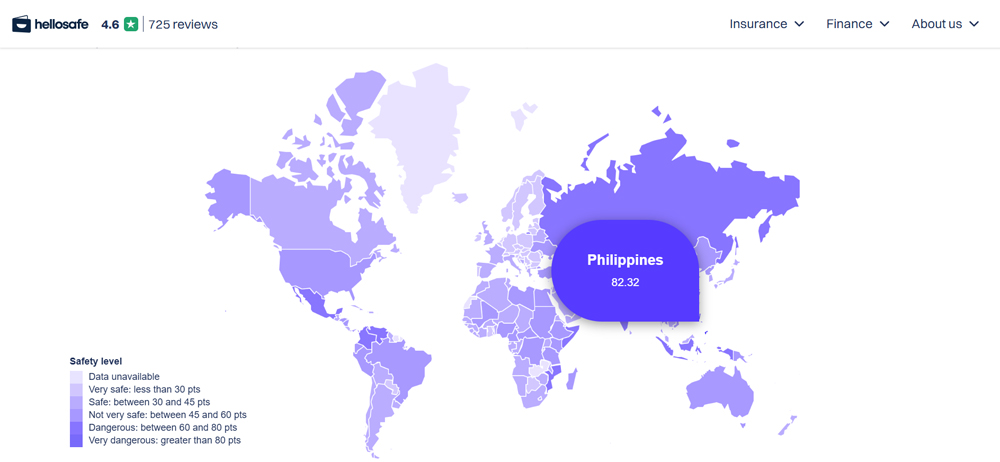
It was in early June that HelloSafe came out with its "Map of the Safest Countries to Travel to in 2025." The said map indicated a safety index of 82.32 (out of 100) for the Philippines. In the (dot)ca domain of HelloSafe, the Philippines (82.32), Colombia (79.21), and Mexico (78.42) were described to be the "Least Safe Countries in the World in 2024."
Just this week, the same article on HelloSafe's (dot)com domain included "Sudan, South Sudan, and Afghanistan Emerge as the 3 Least Safe Countries in the World in 2025." The safety indices are the same: 82.32, 79.21, and 78.42.
Likewise, as of writing, the interactive map on both the (dot)com and (dot)ca domains still reflects the Philippines' travel safety index of 82.32, where the larger the number, the less safe the country is.
Screenshot of "[HelloSafe Safety Index] The Map of the Safest Countries to Travel to in 2025," as of June 19
HelloSafe is a comparison platform specializing in financial products (insurance, loans, investments) in over 10 countries worldwide. Its annual HelloSafe Safety Index is calculated based on a set of 35 criteria divided into: occurrence of natural disasters, violence in society, involvement in internal and external armed conflict, healthcare infrastructure, and militarization.
The platform claimed that its data is drawm official reference sources, including UN agencies, the World Bank, and international research organizations; with a disclaimer that: "this index is not intended to reflect the tourist attractiveness of a country, but rather a global index of security and safety based on the largest possible number of objective criteria."
Statement of the Department of Tourism About HelloSafe's List
The rest of Frasco's response continues:
"What was presented as an objective safety index was, in fact, built on questionable data, lacking in transparency, and entirely disconnected from realities on the ground. Moreover, a thorough examination of HelloSafe’s websites reveals a focus on driving travel insurance sales rather than ensuring accurate safety assessments, as it clearly lacked full methodology disclosure or identifiable data sources, reusing the identical score (82.32) for different countries in just 6 days. Safety indexes, when tied to sales and commercial interests, can unfairly distort national reputations, and warrants closer scrutiny about the fairness and accuracy of such rankings.
Most concerning, when the flaws became evident, the Philippines was simply removed from the index narrative—without clarification or accountability.
We fully recognize that the Philippines, like any country, has challenges. We do not deny that. The fact remains that extensive work is being done daily to address those challenges. Across our key and emerging destinations, safety is not taken for granted. It is upheld by trained police personnel, supported by strong partnerships with law enforcement agencies and local governments, and reinforced by the commitment of our tourism workers.
The impact of this false narrative is not abstract. It disrupted bookings and businesses. It casts doubt on our destinations. Worse, it harmed the livelihoods of millions of Filipinos who depend on tourism, and entire communities whose economies rise and fall with the confidence of travelers.
We demand that HelloSafe correct all references to the erroneous data against the Philippines across its platforms and ensure the accuracy and consistency of its reporting tools, including interactive visual assets.
Further, we call on all media outlets that carried the incorrect data to carry out corrections and observe due diligence and integrity in publishing information that can directly influence travel behavior and public perception.
And to our fellow Filipinos—especially those who have worked so hard to build our tourism sector with skill and sacrifice—this is the moment to speak with one voice. Defending the truth of our country is not about denying its imperfections. It’s about refusing to let those imperfections be distorted or weaponized.
The Philippines is not defined by a flawed and false statistic. It is defined by our people—resilient, disciplined, and deeply proud of what we offer the world."
The Philippines Is a "Rising Muslim-Friendly Destination"
On June 17, DOT welcomed the Philippines' recognition by Mastercard and CrescentRating's 2025 report on the Global Muslim Travel Index (GMTI). The country climbed to eighth place from 12th place in 2024 in the list of 20 non-Organization of Islamic Cooperation destinations.
"This recognition for the Philippines by the Global Muslim Travel Index 2025 affirms our steady commitment to introduce the Philippines as a halal and Muslim-friendly destination, as well as transforming our leading and emerging tourist spots to become those that practice inclusivity and diversity regardless of race and faith. With a country such as the Philippines that is known for its warm hospitality, rich cultural heritage, and breathtaking natural attractions, introducing halal and Muslim-friendly tourism has been crucial in our work at the Department of Tourism,' Franco said.
"By prioritizing halal and Muslim-friendly tourism, we not only demonstrate our commitment to inclusivity and cultural sensitivity but also open up opportunities to attract more Muslim travelers from around the world, while expanding markets for our tourism stakeholders and creating more livelihood and employment for our fellow Filipinos," she added.
The Philippines' GMTI score is 53, which is up by six points from 2024.
This improvement is an effect of how the tourism office has expanded its halal and Muslim-friendly tourism portfolio by introducing halal-certified dining options, recognizing Muslim-friendly establishments, and hosting awareness orientations.
